Access/VSA Playwright Discovery Program
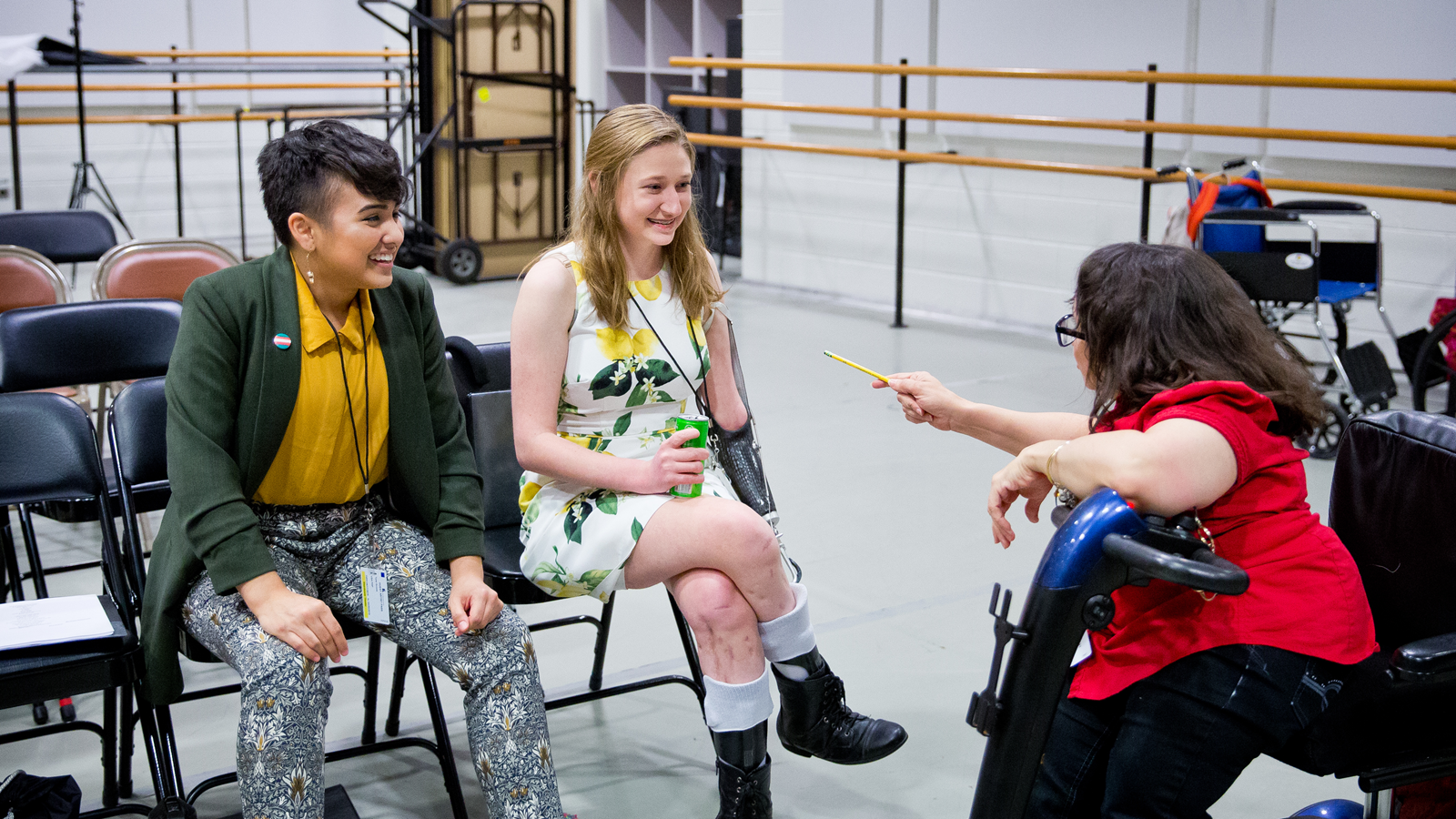
High school students with disabilities are invited to explore the art of writing for performance by developing a 10-minute script through the Access/VSA Playwright Discovery Program.
A Jean Kennedy Smith Arts and Disability Program
About the Program
This program "truly changed my life and [gave] me a renewed confidence in who I am as a disabled artist."—2024 Participant
Each year outstanding disabled writers from around the world are selected to participate in the Access/VSA Playwright Discovery Program. In addition to receiving financial stipends, these talented young writers enrolled in secondary school (generally, ages 14-19) participate in a script development program and explore the theater industry through exclusive workshops.
The program focuses on developing works in the 10-minute script format. Multiple winners will be selected by a panel of theater industry professionals.
The program includes:
- Virtual and in-person script development sessions
- One-on-one sessions with a professional dramaturg
- A trip to the Kennedy Center in Washington, D.C. for a session with professional actors and theatrical designers that mimics a first day of rehearsal
- Workshops covering key business-related topics
- Networking opportunities
Carousel Controls
Application Information
Applications for the 2026 program are due Wednesday, January 7, 2026.
What is a Ten-Minute Script?
A Ten-Minute Script is a fully developed piece. It is not a scene, skit, or sketch. Structurally, it should have a beginning, middle, and end, just as any good one-act or full-length play. Reaching beyond the surface, the text should be enriched with subtext. Since there is only ten minutes to bring the story full circle, a dramatic conflict should be posed as quickly as possible. The resolution of that conflict is what plays out across the remaining pages. The true success of a Ten-Minute Script is reliant on the writer's ability to bring an audience through the same cathartic/entertaining experience that a good one-act or full-length piece accomplishes.
Ten-Minute Scripts are typically eight to ten pages when written in standard 12 pt. font. Read your play aloud and time it.
For additional student-friendly guidance on developing a piece in this format:
Frequently Asked Questions
Q: I’m not sure my script is a “play”—do you accept other formats?
A: Absolutely. The program activities are intended to work with material that is in development for performance. This could include scripts or screenplays for traditional theater, film, podcast, or television scripts as well as long-form spoken word poetry, scripts that emphasize the use of multimedia, puppetry, or audience participation. All entries must not exceed 10-minutes when read aloud and must be in English or ASL.
Q: I am interested in writing scripts for TV and film. Can I submit a screenplay instead of a stage play?
A: Yes. We accept entries written for performance, including screenplays, plays, and musical theater as long as they are in English or ASL and adhere to the ten-minute format.
Q: What qualifies as a disability?
A: Eligible young writers may have visible, physical, and/or sensory conditions, as well as less visible conditions like anxiety, ADHD, chronic illness/pain, PTSD, dyslexia, neurodivergence, and more. Review definitions of disability associated with the Americans with Disabilities Amendments Act.
Q: I wrote a play for a class at school. Can I enter it into the competition?
A: Yes. Please make sure that all application guidelines are met.
Q: When do the 2026 activities take place?
A: Virtual activities will occur March 28, April 25, May 30, and June 27. Activities at the Kennedy Center in Washington, D.C. will occur July 12-16, 2026.
Q: I don't live in the United States, can I still apply?
A: Yes! We welcome international applications. International applicants must be enrolled in high school/secondary school (generally, ages 14-19), have a disability, and submit all materials in English or ASL.
Q: Will my script be performed at the Kennedy Center?
A: As a writing development program, we place the emphasis on the creative development process. We host closed reading and feedback sessions as part of this process. While a public performance is not part of the process, we work to model a “first day of rehearsal” feel with the D.C. portion of the program. Writers will be paired with a professional dramaturg and each script will receive select design treatment presentations (lighting, costume, sound, set, etc.).
Q: I need more information. Who do I contact?
A: Watch our Application 101 Webinar for more answers to frequently asked questions and tips on how to put together a successful application. For more information or to request application materials in an alternative format, we can be reached at 202-416-8898 (voice) or via e-mail at [email protected].
Funder Credit
For U.S. participants, the content of this program was developed under grant H421F240164 from the U.S. Department of Education (Department). The Department does not mandate or prescribe practices, models, or other activities described or discussed in this program. The content of this program may contain examples of, adaptations of, and links to resources created and maintained by another public or private organization. The Department does not control or guarantee the accuracy, relevance, timeliness, or completeness of this outside information. The content of this program does not necessarily represent the policy of the Department. This program is not intended to represent the views or policy of or be an endorsement of any views expressed or materials provided by any Federal agency. (EDGAR 75.620)

The Vice President of Education is generously endowed by the A. James & Alice B. Clark Foundation.
Generous support for educational programs at the Kennedy Center is provided by the U.S. Department of Education.
Gifts and grants to educational programs at the Kennedy Center are provided by The Paul M. Angell Family Foundation; Bank of America; Capital One; The Morris and Gwendolyn Cafritz Foundation; Carnegie Corporation of New York; The Ednah Root Foundation; Genesis Inspiration Foundation; Harman Family Foundation; William R. Kenan, Jr. Charitable Trust; the Kimsey Endowment; The Kiplinger Foundation; Laird Norton Family Foundation; Lois and Richard England Family Foundation; Dr. Gary Mather and Ms. Christina Co Mather; The Markow Totevy Foundation; Dr. Gerald and Paula McNichols Foundation; The Morningstar Foundation; Myra and Leura Younker Endowment Fund; The Irene Pollin Audience Development and Community Engagement Initiatives;
Prince Charitable Trusts; Dr. Deborah Rose and Dr. Jan A. J. Stolwijk; Rosemary Kennedy Education Fund; The Embassy of the United Arab Emirates; The Victory Foundation; The Volgenau Foundation; Jackie Washington; GRoW @ Annenberg and Gregory Annenberg Weingarten and Family; and generous contributors to the Abe Fortas Memorial Fund and by a major gift to the fund from the late Carolyn E. Agger, widow of Abe Fortas. Additional support is provided by the National Committee for the Performing Arts..
The content of these programs may have been developed under a grant from the U.S. Department of Education but does not necessarily represent the policy of the U.S. Department of Education. You should not assume endorsement by the federal government.