A Space Senses Journey
with teaching artist Psacoya Guinn

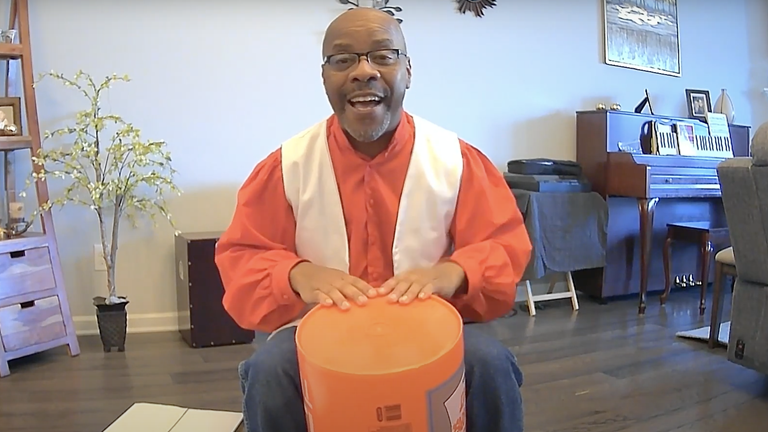
Teaching artist Psacoya Guinn demonstrates how to use the five senses to go on an imaginary journey through outer space, while introducing fun facts about our solar system.

Recommended for Grades K-12

In this resource you will:

  • Learn facts about the planets, stars, and moons in our solar system
  • Use the five senses to go on an imaginary journey through outer space 
  • Use your imagination and creativity to think about what it might be like in outer space 

Explore our other video-based activities!
Getting Started

Vocabulary You Will Learn:

  • None in this video

Materials You Will Need:

  • An object that can be used to create a soundscape

Watch the Video

A Space Senses Journey with Psacoya Guinn

A Space Senses Journey with Psacoya Guinn

Try It Yourself

How to Go on an Imaginary Journey Through Space

  1. To start off, we’re going to take a big jump and pretend that we’re landing in outer space! Take a look around - what do you see in outer space? Do you see stars? 
  2. Next, pretend that you are reaching out to grab a star. How does it feel in your hands? Is it hard like a rock or soft like a feather? Can you give your star a name? Put your star in your pocket before continuing to explore outer space. 
  3. Now you’re floating through space, surrounded by space rocks! What do the space rocks smell like? What do they taste like? 
  4. Next, we’re going to look at the planet Saturn. To see a picture of it, scroll to around 4:00 in the video. What colors do you see on Saturn? Imagine that you’re visiting Saturn. It’s very, very cold on Saturn. What does your body look like when it’s cold? 
  1. Because it’s so cold on Saturn, it might be very windy. Can you use your voice to make the sound of the wind? What else might we hear on Saturn? Maybe an alien! 
  2. Now we’re going to use an object, or objects, found at home to create a soundscape of an alien. Use your objects to create a sound an alien might make. Can you make the sound of it walking? Flying? The sound of its voice? 
  3. Finally, it’s time to go back to Earth! Jump as high as you can and land back in your own home. 

Think About

In this video, Psacoya takes us on an imaginary journey through outer space, using our five senses to explore our surroundings. If you want to go even further, think about these questions: 

  • What other parts of outer space can you explore with your five senses? What about a different planet, like Jupiter? What about the sun? Or the surface of an asteroid?
  • Can you create a scene that could take place in outer space? Think about another character you could talk to in outer space, like an alien or another explorer. Or maybe a planet comes to life and talks to you! What might you say to each other? 
  • Can you create a costume that you might wear in outer space using clothes and other items from your home? What might you wear as a space explorer? 
  • What other other imaginary environments could you explore with your five senses? What about a desert? A rainforest? Under the sea? What about the setting from your favorite book or TV show?

Accessibility

Don't forget that you can turn on "Closed Captioning" to view the YouTube video with English captions.


More about the Teaching Artist

Psacoya Guinn is a New York City-based actor and educator. In her work as a teaching artist, she visits schools, homeless shelters, and non-profit educational theaters, serving a broad range of students. Her mission is to show that, no matter who you are, theatre can amplify your voice and your unique story. To learn more, visit her website: psacoya.com.


Video Activity Credits

Resource Production: Kennedy Center Education

Additional Content: Laurie Ascoli

Copy Editing: Sandra Frey; Alyssa Kariofyllis

Revisions: Alice Doré

  • Teaching Artist

    Psacoya Guinn

  • Curriculum & Media Development

    Kennedy Center Education

  • Content Editor

    Laurie Ascoli

  • Revised

    January 16, 2024

Related Resources

Media Art/Space

How do composers hear space? What does space sound like? Is there music in space? Narrated by Roger Launius of the Space History Division of the National Air and Space Museum, this series looks at the way music and outer space connect.

  • Music Art
  • Space

Media Reach For The Moon

Just like President Kennedy had a vision for America, composers have visions of how they want their music to sound. For some, their musical mission is to explore a galaxy of stars and planets, moon shots, space walks, and galactic battles!

  • Social Studies & Civics
  • Orchestral Music
  • Composers
  • Space

Lesson Planets in Balance

In this 6-8 lesson, students explore the solar system through experimentation of mobile design in the style of Alexander Calder. Using independent research about the planets, students will work in collaborative groups to create mobiles that compare the size of the Earth to other planets in the solar system.

  • Grades 6-8
  • Visual Arts
  • Science

Kennedy Center Education logo


Kennedy Center Education provides resources and experiences that inspire, excite, and empower students and young artists, plus the tools and connections to help educators incorporate the arts into classrooms and learning spaces of all types.

Connect with us!

spacer-24px.pngyoutube.png    facebook.png    twitter.png    instagram.png    email.png

Sign up to stay informed!

Generous support for educational programs at the Kennedy Center is provided by the U.S. Department of Education.

Gifts and grants to educational programs at the Kennedy Center are provided by The Paul M. Angell Family Foundation; Bank of America; Capital One; The Morris and Gwendolyn Cafritz Foundation; Carnegie Corporation of New York; The Ednah Root Foundation; Genesis Inspiration Foundation; Harman Family Foundation; William R. Kenan, Jr. Charitable Trust; the Kimsey Endowment; The Kiplinger Foundation; Laird Norton Family Foundation; Lois and Richard England Family Foundation; Dr. Gary Mather and Ms. Christina Co Mather; The Markow Totevy Foundation; Dr. Gerald and Paula McNichols Foundation; The Morningstar Foundation; Myra and Leura Younker Endowment Fund; The Irene Pollin Audience Development and Community Engagement Initiatives;

Prince Charitable Trusts; Dr. Deborah Rose and Dr. Jan A. J. Stolwijk; Rosemary Kennedy Education Fund; The Embassy of the United Arab Emirates; The Victory Foundation; The Volgenau Foundation; Jackie Washington; GRoW @ Annenberg and Gregory Annenberg Weingarten and Family; and generous contributors to the Abe Fortas Memorial Fund and by a major gift to the fund from the late Carolyn E. Agger, widow of Abe Fortas. Additional support is provided by the National Committee for the Performing Arts..

The content of these programs may have been developed under a grant from the U.S. Department of Education but does not necessarily represent the policy of the U.S. Department of Education. You should not assume endorsement by the federal government.