Art from the Unexpected
with teaching artist Stephanie Krause

Teaching artist Stephanie Krause demonstrates how to find shapes in everyday objects, and then how to draw on folded-up paper to create four different pictures in one.

Recommended for Grades 3-12

In this resource you will:

  • Look for organic shapes in everyday objects 
  • Use your imagination to draw a shape and then turn it into a creature, landscape, or other creative picture 
  • Learn to use folded paper to create four different pictures in one

Explore our other video-based activities!

Getting Started

Vocabulary You Will Learn:

  • Organic shapes—Shapes with flowy or irregular edges.

Materials You Will Need:

  • A piece of paper
  • A drawing utensil

Watch the Video

Try It Yourself

How to Use Organic Shapes to Create Many Pictures in One 

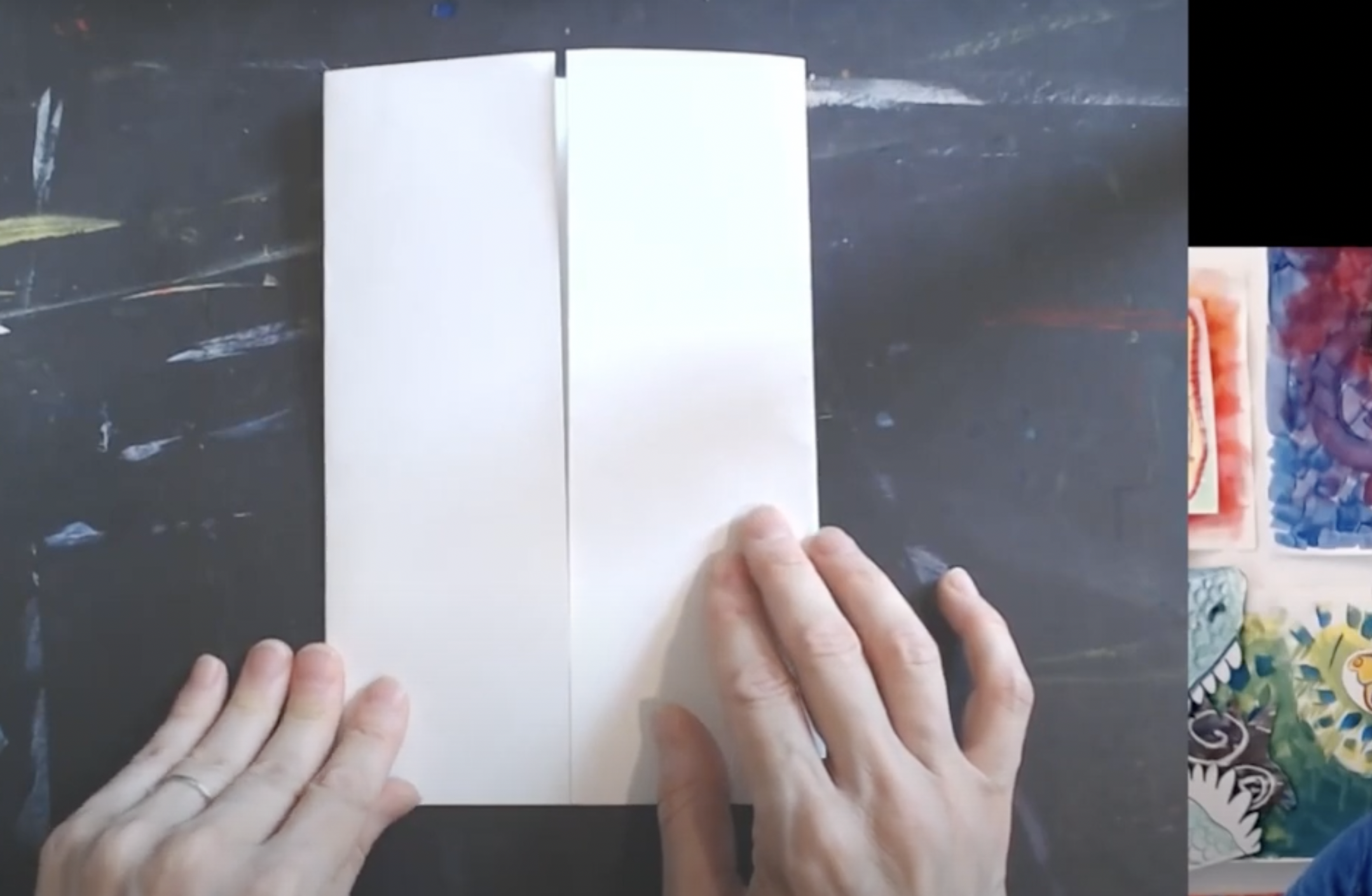
  1. First, lay your piece of paper in front of you horizontally, so the long edge is toward you. Fold the paper in half, bringing the left and right edges together; when you open the paper back up, the center crease should be perpendicular to the long edge. Next, you want to fold the left and right edges of the paper to meet at the center crease. Carefully fold the right side of the paper toward the middle, so the right edge lines up with the crease in the middle. Now, do the same with the left side. You should now have two flaps (let’s call them “doors”) which you can open  to reveal the paper underneath. 
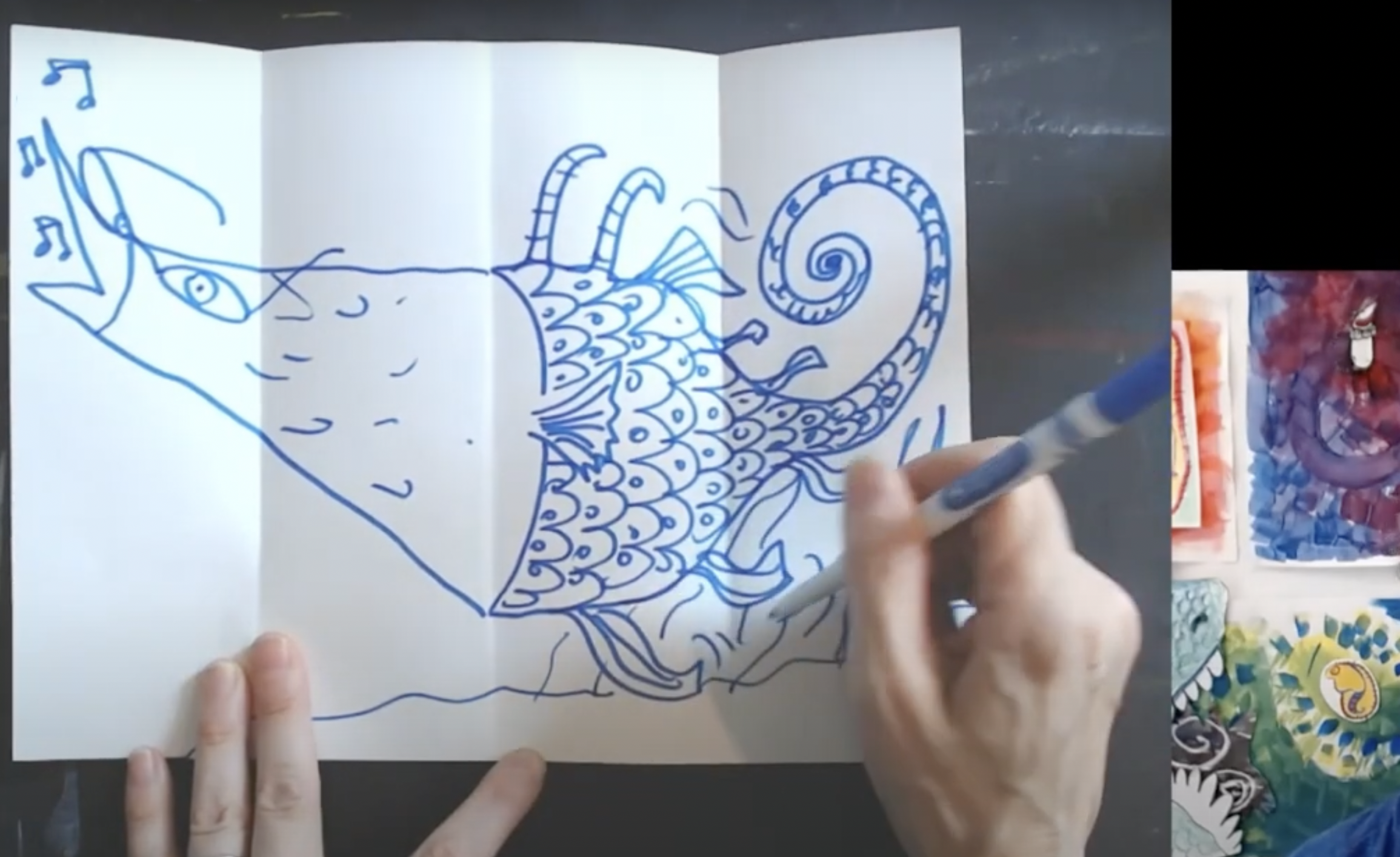
  2. Next, with the doors folded closed, draw a large, organic shape across their surface. Once you’ve created the shape, ask yourself what it looks like to you. Does it look like a creature? A landscape? A robot?
  3. Next, you’re going to add details to turn your shape into whatever you’ve decided it looks like. For example, if you think the shape looks like a creature, you can add eyes, scales, wings, toes, or fins.
  4. Now it’s time to open one of the doors on your paper, which will hide half of the drawing you’ve created. On the blank paper revealed underneath, you are going to draw something new to complete the half of the picture that remains. For example, if you made a creature, give it a new front or back half that is completely different from the one it had before!           
  1. Now, close the door that is open and open the door that was closed. Do the same thing you just did in step 4 with this newly revealed part of the paper: create a new half to go along with the part of the picture that’s on the closed door. 
  2. Finally, you’re going to open both doors, revealing the completed picture underneath, and see if you’d like to add any more details. If you drew a creature, you might want to draw a setting to show where the creature is, or add a few more features to the creature itself.

Think About

In this video, Stephanie teaches us how to use our imaginations to turn everyday shapes into other things, and then to use a drawing of an organic shape on folded paper to create four pictures in one. She also suggests other things we can do, like working with a friend to create the different parts of our picture. If you want to go even further, think about these questions: 

  • At the end of the video, Stephanie talks about how we can use our pictures to create a story. If you tried this, who would your characters be? Where would they live? How do they know each other? How would your other pictures from this activity play a part in the story?
  • Stephanie shows us, at the beginning of the video, how to look at everyday shapes and objects and imagine that they become other things. Could this inspire the first shape that you drew in that activity? Could you draw the shape of an everyday object, and then add details to turn it into something else?
  • If you start the activity over and draw the same shape on the front of your paper, what other possibilities can you dream up for what this shape could become? Can it become a different kind of creature? Or instead of a creature, can it become an object or something in nature?
  • If you add color or other textures (like pasting on glitter or other materials) to your initial pictures, does that change your ideas for what the pictures underneath could look like? Does it make the final picture underneath the doors more or less cohesive?

Accessibility

Don’t forget that you can turn on “Closed Captioning” to view the YouTube video with English captions.


More about the Teaching Artist

Stephanie Krause is a book artist based in Philadelphia, Pennsylvania, primarily working with elementary and middle school students. She believes we can all learn to see the world through “artist eyes” and find joy in the unexpected—like seeing animals in the clouds or dancing branches. Stephanie hopes to foster students’ spirit of exploration and creativity, and their ability to find art in the unexpected. To learn more about Stephanie, visit her website: https://www.bookteacher.com.
Video Activity Credits

Resource Production: Kennedy Center Education

Additional Content: Laurie Ascoli

Copy Editing: Sandra Frey; Alyssa Kariofyllis

Revisions: Alice Doré

  • Teaching Artist

    Stephanie Krause

  • Curriculum & Media Development

    Kennedy Center Education

  • Content Editor

    Laurie Ascoli

  • Revised

    November 19, 2024

Related Resources

Create Your Own Crown with Nicoletta Daríta de la Brown

Enter an artist studio space and witness the creative process. In this video, artist and performer Nicoletta de la Brown provides insight into her work where she creates headdresses that speak to her thoughts on identity and power. Watch as she breaks her process down into three steps: gathering, making, and activating.

  • Theater Art
  • Visual Arts
  • Sculpture & Ceramics

Lesson Visual Storytelling

In this K-2 lesson, students will examine how illustrations contribute to the telling of a story. Through picture books (without words), students will discuss and interpret details about the characters, setting, and plot. Students will create illustrations to accompany a text and then write text to accompany illustrations. 

  • Visual Arts
  • Literary Arts
  • English & Literature
  • Grades K-2

Kennedy Center Education logo


Kennedy Center Education provides resources and experiences that inspire, excite, and empower students and young artists, plus the tools and connections to help educators incorporate the arts into classrooms and learning spaces of all types.

Connect with us!

spacer-24px.pngyoutube.png    facebook.png    twitter.png    instagram.png    email.png

Sign up to stay informed!

Generous support for educational programs at the Kennedy Center is provided by the U.S. Department of Education.

Gifts and grants to educational programs at the Kennedy Center are provided by The Paul M. Angell Family Foundation; Bank of America; Capital One; The Morris and Gwendolyn Cafritz Foundation; Carnegie Corporation of New York; The Ednah Root Foundation; Genesis Inspiration Foundation; Harman Family Foundation; William R. Kenan, Jr. Charitable Trust; the Kimsey Endowment; The Kiplinger Foundation; Laird Norton Family Foundation; Lois and Richard England Family Foundation; Dr. Gary Mather and Ms. Christina Co Mather; The Markow Totevy Foundation; Dr. Gerald and Paula McNichols Foundation; The Morningstar Foundation; Myra and Leura Younker Endowment Fund; The Irene Pollin Audience Development and Community Engagement Initiatives;

Prince Charitable Trusts; Dr. Deborah Rose and Dr. Jan A. J. Stolwijk; Rosemary Kennedy Education Fund; The Embassy of the United Arab Emirates; The Victory Foundation; The Volgenau Foundation; Jackie Washington; GRoW @ Annenberg and Gregory Annenberg Weingarten and Family; and generous contributors to the Abe Fortas Memorial Fund and by a major gift to the fund from the late Carolyn E. Agger, widow of Abe Fortas. Additional support is provided by the National Committee for the Performing Arts..

The content of these programs may have been developed under a grant from the U.S. Department of Education but does not necessarily represent the policy of the U.S. Department of Education. You should not assume endorsement by the federal government.