Rock, Paper, Scissors, Anything!
with teaching artist Donna Washington

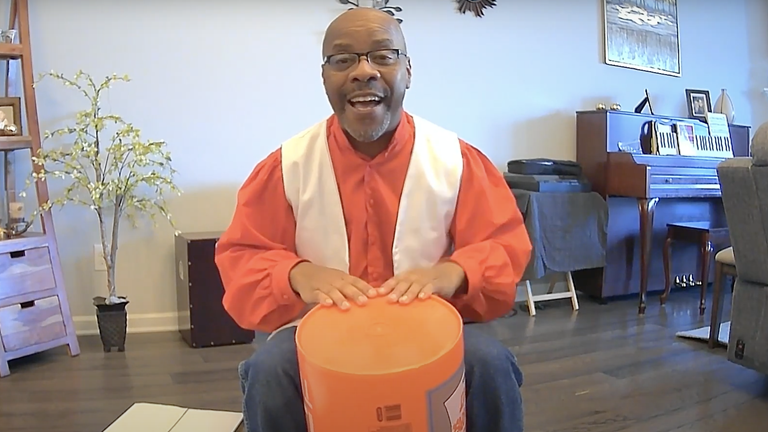
Teaching artist Donna Washington teaches students how to use creativity, pantomime, and improvisation to play a game that is a fun twist on Rock, Paper, Scissors!  

Recommended for Grades 3-12

In this resource you will:

  • Learn the rules of the improvisation game Rock, Paper, Scissors, Anything!
  • Improvise creative ideas using pantomime and vocal effects
  • Practice arguing your case in the game to explain why your idea should defeat your opponent’s

Explore our other video-based activities!

Getting Started

Vocabulary You Will Learn:

  • Improvisation - Thinking really fast to come up with ideas.

Materials You Will Need:

  • Just yourself and a friend to play with!

Watch the Video

Try It Yourself

How to Play Rock, Paper, Scissors, Anything!

  1. Stand face to face with your opponent. Make a fist with one hand and hit it into your opposite hand, the same way you would when starting a game of “Rock, Paper, Scissors.” As you do this, say, “Rock, paper, scissors, anything!” 
  2. On the word “anything,” use your body and your voice to become anything you want to! For example, you could clap your hands together in front of you while growling to become an alligator, or you could shake your body while making crunching noises to become an earthquake. Use your imagination and be creative! 
  3. Next, tell your opponent what you are and allow them to do the same.
  4. Now it’s time to advocate for yourself to win the game. Explain why you think the object that you created would defeat what your opponent created. Make sure that you are advocating for yourself, not arguing with your opponent. For example, if you created an earthquake and your opponent created an alligator, you could argue that the earthquake shook the alligator out of its swampy home. Or if you are a cactus and your opponent is a robot, you could argue that your needles could get into the robot’s gears and break it down.
  1. If you have a third person, they can be a judge and say who they think won. If you don’t, one of you will eventually need to concede to the other player, or you can agree that it’s a tie. 
  2. Some other rules: you cannot pick something that is immortal for your object, but you can pick imaginary creatures and prehistoric creatures. It also may be helpful to decide where your objects exist so that you’re on an even playing field. For example, are they on Earth? In outer space? In the ocean? Anywhere in the universe? You can make it as narrow or broad as you want! 

Think About

In this video, Donna Washington shows us how to use creativity, pantomime, and improvisation to play the game Rock, Paper, Scissors, Anything!, which is a fun twist on Rock, Paper, Scissors. If you want to go even further, think about these questions: 

  • What happens if you bring more people into the game? Try it with three or four people and see what happens when you imagine all of your creations together in the same environment! Who would win?
  • Do you find that the game is more fun if you choose a very specific setting where your objects exist or a very broad one? For example, is it more fun if you choose a specific setting like a grocery store or a broad one like planet Earth?
  • Do you find it challenging to come up with reasons why your creation would defeat your opponent’s? Does it get easier the more you play the game? How do your and your opponent work together to come to a conclusion on who should win? 
  • This is a game that uses improvisation, which means thinking really quickly to come up with an idea. What other parts of your life do you use improvisation in? Do you use it at school? At home? In other activities?
Accessibility

Don’t forget that you can turn on “Closed Captioning” to view the YouTube video with English captions.


More about the Teaching Artist

Donna Washington (she/her) is a professional storyteller from North Carolina and she’s held that job for 33 years—it's the only job she’s ever had in her adult life! Storytelling is the basis of language, music, and dance. It is how our brains make sense of the world. Donna has spent her life using storytelling to improve language and literacy acquisition. Learn more about her work at https://dlwstoryteller.com/.


Video Activity Credits

Resource Production: Kennedy Center Education

Additional Content: Laurie Ascoli

Copy Editing: Sandra Frey; Alyssa Kariofyllis

Revisions: Alice Doré

  • Teaching Artist

    Donna Washington

  • Curriculum & Media Development

    Kennedy Center Education

  • Content Editor

    Laurie Ascoli

  • Revised

    December 3, 2024

Related Resources

Media How to Rap

Teaching artist Harold “Fyütch” Simmons demonstrates how to create and perform an original, autobiographical rap using a simple template.

Media How to Perform Spoken Word

Teaching artist Deborah Magdalena demonstrates how to bring a poem to life through an expressive spoken word performance.

Media Names and Rhythms

Teaching artist Groovy Nate demonstrates how to create a rhythmic pattern using different names, and how to experiment with various vocal tones, pitches, and expressions to go with this rhythm.

Kennedy Center Education logo


Kennedy Center Education provides resources and experiences that inspire, excite, and empower students and young artists, plus the tools and connections to help educators incorporate the arts into classrooms and learning spaces of all types.

Connect with us!

spacer-24px.pngyoutube.png    facebook.png    twitter.png    instagram.png    email.png

Sign up to stay informed!

Generous support for educational programs at the Kennedy Center is provided by the U.S. Department of Education.

Gifts and grants to educational programs at the Kennedy Center are provided by The Paul M. Angell Family Foundation; Bank of America; Capital One; The Morris and Gwendolyn Cafritz Foundation; Carnegie Corporation of New York; The Ednah Root Foundation; Genesis Inspiration Foundation; Harman Family Foundation; William R. Kenan, Jr. Charitable Trust; the Kimsey Endowment; The Kiplinger Foundation; Laird Norton Family Foundation; Lois and Richard England Family Foundation; Dr. Gary Mather and Ms. Christina Co Mather; The Markow Totevy Foundation; Dr. Gerald and Paula McNichols Foundation; The Morningstar Foundation; Myra and Leura Younker Endowment Fund; The Irene Pollin Audience Development and Community Engagement Initiatives;

Prince Charitable Trusts; Dr. Deborah Rose and Dr. Jan A. J. Stolwijk; Rosemary Kennedy Education Fund; The Embassy of the United Arab Emirates; The Victory Foundation; The Volgenau Foundation; Jackie Washington; GRoW @ Annenberg and Gregory Annenberg Weingarten and Family; and generous contributors to the Abe Fortas Memorial Fund and by a major gift to the fund from the late Carolyn E. Agger, widow of Abe Fortas. Additional support is provided by the National Committee for the Performing Arts..

The content of these programs may have been developed under a grant from the U.S. Department of Education but does not necessarily represent the policy of the U.S. Department of Education. You should not assume endorsement by the federal government.