The Art of Clowning: Transforming Everyday Objects
with teaching artist Armando Batista

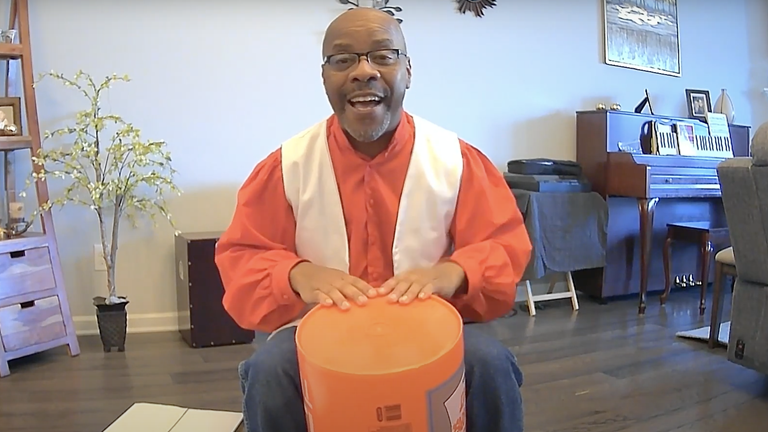
Teaching artist Armando Batista demonstrates how we can use creativity and pantomime to transform an everyday object into something completely different. 

Recommended for Grades K-12

In this resource you will:

  • Use your imagination to transform an everyday object into something else
  • Practice using pantomime to show what an object is and how it functions
  • Learn about the performance art of clowning

Explore our other video-based activities!

Getting Started

Vocabulary You Will Learn:

  • None in this video

Materials You Will Need:

  • A long, thin object, like a pencil, a spoon, or a paper towel roll

Watch the Video

Try It Yourself

How to Transform an Everyday Object

  1. First, take a look at the object you’ve selected to use for the activity. Look at its shape and size. Notice how much it weighs. What else could this object be if we use our imaginations?
  2. Let’s try turning the object into a fishing rod. First, mime putting the bait on the hook of the fishing rod. Hold it over your shoulder and then extend your arms out as if you are casting the fishing line into a lake. Wait a moment for the line and bait to settle in the imaginary lake.
  1. Next, pretend a fish is caught on the line. How big is the fish? If it’s a big fish, you’ll want to mime pulling really hard on the line! If it’s small, you can pull more gently. 
  2. Mime turning your reel to pull your fish in and grab hold of it. Keep in mind how big your fish is while you’re miming!
  3. Finally, mime taking your fish off the hook and throwing it back in the lake. 
  4. What else can this object become? What about a hiking stick or an oar to row a boat? Use your imagination!

Think About

In this video, Armando shows us how to take a common household object and transform it into something completely different. If you want to go even further, think about these questions: 

  • What other objects around your home could you transform into something else? Could you turn a scarf into a rope or a water bottle into a microphone? Use your creativity to dream up different possibilities!
  • Get together with a friend or family member and pass a household object back and forth, changing the object into something different each time it's passed between you. How many different things can one object become?
  • Can you collect a few different objects and create a scene using only these objects as props? Decide on a setting for your scene and see what the object can become to fit that setting.
  • Are there times in your life you can think of when you’ve had to take one object and use it as another? For example, have you gotten caught in the rain and had to use a book as an umbrella? Or had to use your hand as a notepad because you didn’t have any paper available?

Accessibility

Don’t forget that you can turn on “Closed Captioning” to view the YouTube video with English captions.


More about the Teaching Artist

Armando Batista (he/him/el/ello) has been a teaching artist for 15+ years both nationally and internationally, most recently in San Diego, California. He has taught theater arts (acting, improv, playwriting, movement) to students ages 5 to 75 and brings passion, curiosity, empathy, goofiness, and other idiosyncrasies to his teaching work. His teaching has always correlated with his artistry. Whether acting on stage or writing and performing poetry and plays, Armando has used creative experiences to bring a practical approach to teaching the arts and humanities.

Video Activity Credits

Resource Production: Kennedy Center Education

Additional Content: Laurie Ascoli

Copy Editing: Sandra Frey; Alyssa Kariofyllis

Revisions: Alice Doré

  • Teaching Artist

    Armando Batista

  • Curriculum & Media Development

    Kennedy Center Education

  • Content Editor

    Laurie Ascoli

  • Revised

    December 3, 2024

Related Resources

Media 1-2-3 Pantomime

Teaching artist Jamie Hipp demonstrates the basics of creating a convincing pantomime by making specific choices with gesture and facial expressions.

Media Mime and Pantomime

Teaching artists Keith Berger and Sharon Diskin teach some basic skills used in mime and pantomime and demonstrate two brief scenes involving the techniques learned.

Lesson Paint and Pantomime the Wind

In this 3-5 lesson, students explore the characteristics of the wind through poetry, paintings, and pantomime. Students will classify and measure the wind by studying the Beaufort Scale and building an anemometer. Then, they’ll reinterpret characteristics of the wind through pantomime or blow painting.

  • Grades 3-5
  • Theater Art
  • Visual Arts
  • Science

Kennedy Center Education logo


Kennedy Center Education provides resources and experiences that inspire, excite, and empower students and young artists, plus the tools and connections to help educators incorporate the arts into classrooms and learning spaces of all types.

Connect with us!

spacer-24px.pngyoutube.png    facebook.png    twitter.png    instagram.png    email.png

Sign up to stay informed!

Generous support for educational programs at the Kennedy Center is provided by the U.S. Department of Education.

Gifts and grants to educational programs at the Kennedy Center are provided by The Paul M. Angell Family Foundation; Bank of America; Capital One; The Morris and Gwendolyn Cafritz Foundation; Carnegie Corporation of New York; The Ednah Root Foundation; Genesis Inspiration Foundation; Harman Family Foundation; William R. Kenan, Jr. Charitable Trust; the Kimsey Endowment; The Kiplinger Foundation; Laird Norton Family Foundation; Lois and Richard England Family Foundation; Dr. Gary Mather and Ms. Christina Co Mather; The Markow Totevy Foundation; Dr. Gerald and Paula McNichols Foundation; The Morningstar Foundation; Myra and Leura Younker Endowment Fund; The Irene Pollin Audience Development and Community Engagement Initiatives;

Prince Charitable Trusts; Dr. Deborah Rose and Dr. Jan A. J. Stolwijk; Rosemary Kennedy Education Fund; The Embassy of the United Arab Emirates; The Victory Foundation; The Volgenau Foundation; Jackie Washington; GRoW @ Annenberg and Gregory Annenberg Weingarten and Family; and generous contributors to the Abe Fortas Memorial Fund and by a major gift to the fund from the late Carolyn E. Agger, widow of Abe Fortas. Additional support is provided by the National Committee for the Performing Arts..

The content of these programs may have been developed under a grant from the U.S. Department of Education but does not necessarily represent the policy of the U.S. Department of Education. You should not assume endorsement by the federal government.