Media Porgy and Bess
A quick overview of Gershwin’s 1935 quintessential American masterpiece.
Born
September 16, 1898
Died
July 11, 1937
Country
United States of America
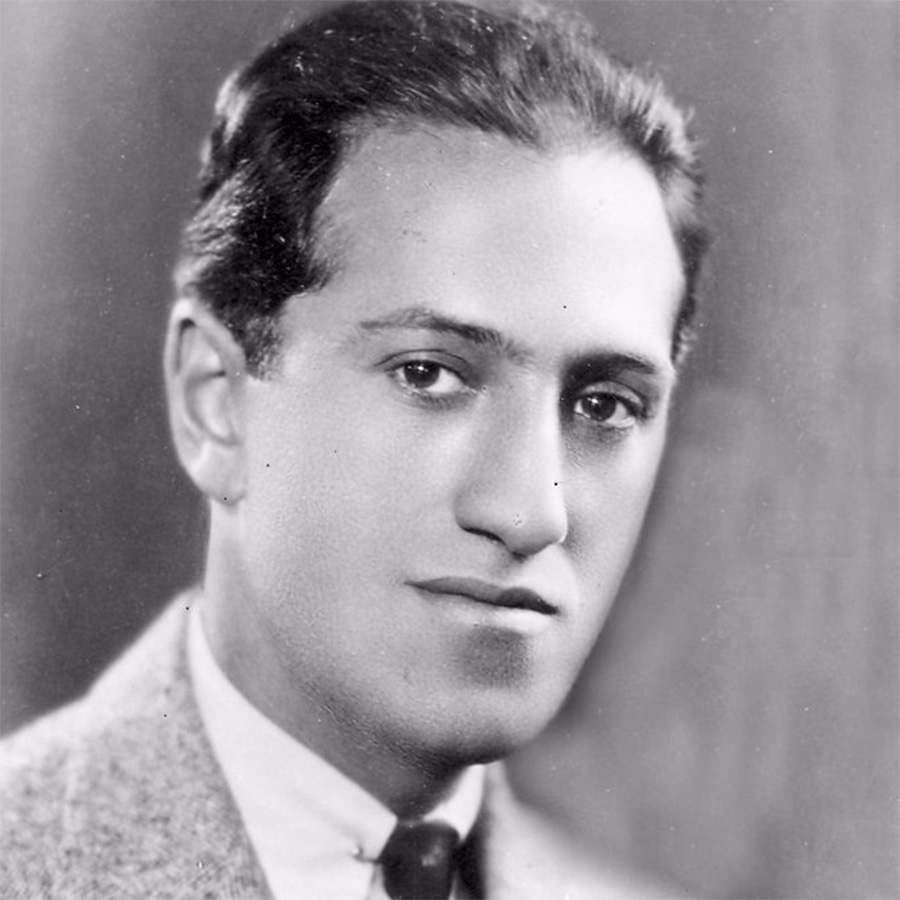
American composer George Gershwin was born in Brooklyn on September 26, 1898, to a non-musical family. He did not begin his formal musical training until age 12, when he began piano instruction. He left school at 15 to become a “Song Plugger” at the Tin Pan Alley music publishing firm of Jerome Remick. His job there was to play and sing newly published music for potential buyers. He began composing his own songs while he worked.
He also made piano rolls under a pseudonym. After four years with Remick, he left to travel the vaudeville circuit as a pianist. His first big song hit was “Swanee” (1917). It was introduced by Al Jolson and sold over a million copies. His first Broadway show was La La Lucille in 1919, which ran for 100 performances.
In the following years, his success as a composer of popular songs soared and he became equally successful as a man about town. With his brother, Ira Gershwin, and other lyricists, Gershwin wrote twenty-two of the most successful musical shows for Broadway during the 1920s and early 1930s; these shows starred most of the famous stage performers of the time, including Ruby Keeler, Fred Astaire, Jimmy Durante, Fanny Brice, and Gertrude Lawrence.
Of Thee I Sing, a brilliant political satire Gershwin wrote with George S. Kaufman and Morrie Ryskind, won the Pulitzer Prize for 1932, the first musical to win that prestigious award. Songs from most of his musical shows became standards of the popular music performing world.
Conductor Paul Whiteman commissioned Gershwin to write orchestral pieces utilizing jazz elements that were popular with the audiences attending concerts by Whiteman’s orchestra. These concerts first presented such enduring light classical standards as Rhapsody in Blue (1924) and An American in Paris (1928).
New York Symphony conductor Walter Damrosch commissioned Gershwin to write a piano concerto. The NYSO premiered Gershwin’s Piano Concerto in F in 1925, which is considered by many to be Gershwin’s finest orchestral work.
By 1935, Gershwin’s interests turned to more serious music. With his brother Ira and Dubose and Dorothy Heywood, he wrote wrote the “Black folk opera” Porgy and Bess based on the novel by DuBose Heywood. It was received with mixed reviews and excited some controversy, but has nonetheless remained a staple in musical theater repertory to this day.
After Porgy and Bess closed on Broadway in 1935, Gershwin went to California to begin writing scores for film musicals. Shall We Dance starred Fred Astaire and Ginger Rogers, and A Damsel In Distress featured Astaire, Joan Fontaine, and Gracie Allen.
By 1937, Gershwin was experiencing increasingly severe headaches and dizzy spells. He collapsed into a coma caused by a brain tumor on July 9 and died on July 11.
|
|
|
|
Video
A quick overview of Gershwin’s 1935 quintessential American masterpiece.
Consider this opera’s “Chaotic Neutral” era. You’ll discover 20th-century operas don’t typically celebrate good or evil: they relish the madness and ambiguity of the in between. Which means their musical storytelling will feel and sound vastly different, depending on who’s doing the telling.
Learn about musical theater using examples from Broadway, the history, structure and elements of musical theater, musical theater's role in social commentary, its legacy, and how you too can create a musical.
Foot thumping rhythms, crooning voices, soulful melodies – jazz is a music with a history as rich as its sound. Follow the great migration that lead African Americans to Harlem, meet jazz icons such as Bessie Smith and Charlie Parker, and stop by the Cotton Club and Apollo Theater on a journey through the past of this American art form.

Kennedy Center Education provides resources and experiences that inspire, excite, and empower students and young artists, plus the tools and connections to help educators incorporate the arts into classrooms and learning spaces of all types.


Generous support for educational programs at the Kennedy Center is provided by the U.S. Department of Education.
Gifts and grants to educational programs at the Kennedy Center are provided by The Paul M. Angell Family Foundation; Bank of America; Capital One; The Morris and Gwendolyn Cafritz Foundation; Carnegie Corporation of New York; The Ednah Root Foundation; Genesis Inspiration Foundation; Harman Family Foundation; William R. Kenan, Jr. Charitable Trust; the Kimsey Endowment; The Kiplinger Foundation; Laird Norton Family Foundation; Lois and Richard England Family Foundation; Dr. Gary Mather and Ms. Christina Co Mather; The Markow Totevy Foundation; Dr. Gerald and Paula McNichols Foundation; The Morningstar Foundation; Myra and Leura Younker Endowment Fund; The Irene Pollin Audience Development and Community Engagement Initiatives;
Prince Charitable Trusts; Dr. Deborah Rose and Dr. Jan A. J. Stolwijk; Rosemary Kennedy Education Fund; The Embassy of the United Arab Emirates; The Victory Foundation; The Volgenau Foundation; Jackie Washington; GRoW @ Annenberg and Gregory Annenberg Weingarten and Family; and generous contributors to the Abe Fortas Memorial Fund and by a major gift to the fund from the late Carolyn E. Agger, widow of Abe Fortas. Additional support is provided by the National Committee for the Performing Arts..
The content of these programs may have been developed under a grant from the U.S. Department of Education but does not necessarily represent the policy of the U.S. Department of Education. You should not assume endorsement by the federal government.
![Angel Blue and Eric Owens in Porgy and Bess, photo by Ken Howard. [Metropolitan Opera]](/globalassets/education/resources-for-educators/classroom-resources/artsedge/media/understanding-opera/porgy-and-bess-2-169.jpg?format=webp&width=768&quality=70)


