• Dancing
  • Media Arts
  • Contemporary Dance
  • Choreographers

Merce Cunningham + BIPED
Meet the artist through one of their most important works

Have you ever met someone who isn’t afraid to be different?  Someone who doesn’t care about being popular, but more about doing things they find interesting? Merce Cunningham was that kind of person. He was a dancer and choreographer who made dances that were often difficult to watch. BIPED is a haunting, provocative work that exemplifies Merce Cunningham’s perspective on choreography and life.

Recommended for grades 6-12

In this resource, you’ll:

  • Explore Merce Cunningham’s life and influences
  • Discover how BIPED exemplifies Cunningham’s style and approach to choreography
  • Unpack the elements of BIPED and how they contribute to the work’s timelessness and impact

Part of the Artist + Work collection.

Cunningham’s Style

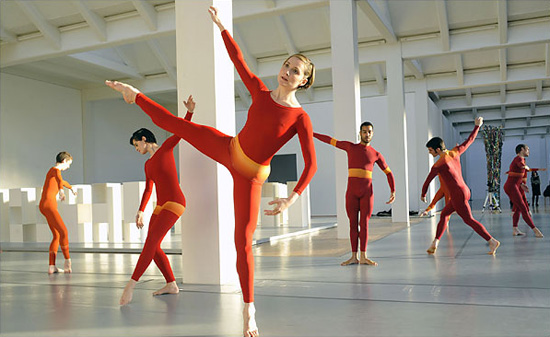
Cunningham technique looks a bit like ballet—with the same turned out position of the legs, quick footwork, and strong spine—but also differs in many ways.

  • Cunningham dancers utilize their torsos, bending sideways, forward and backward, and hold balances for long periods.
  • They often must be able to do two or three things at the same time, executing different rhythms and movements in the legs, torso, and arms simultaneously.
  • There are frequent changes of direction, and no rhythm from the music to count on. Cunningham’s work is both a physical and mental challenge.

cunningham-dancers.jpg

BIPED (1999) 
Music by Gavin Byars

“It’s when dancing gets awkward that it starts to get interesting.” —Merce Cunningham

Cunningham’s use of technology is one way in which he redefined dance. His masterwork BIPED demonstrates the evolution of Cunningham’s experiments with advancing technology. Many consider BIPED, created in 1999 when Cunningham turned 80 years old, to be the culmination of his use of computers to generate movement ideas.

Life Forms
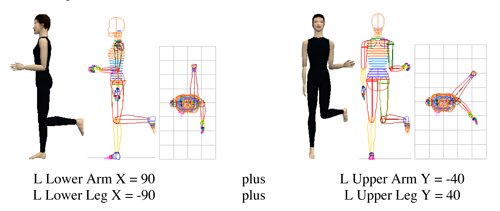
cunningham-diagram.jpg

Cunningham began choreographing on the computer in 1989 using a program called Life Forms created at Simon Frasier University, British Columbia, Canada. The Life Forms software portrayed outlines of the human figure in a three-dimensional space. The computerized figures had movable joints, and could be made to do all kinds of movements, including spins, jumps, leaps, reaches, and bends.

Cunningham used the program to experiment with choreographic ideas outside the studio. Once he had created a movement phrase with computer figures, he tried it out on his company to see how it worked. Often the sequences of movement were impossible for his dancers to execute, but they would lead to movement choices that he hadn’t expected or done before. That was what captivated Cunningham—pushing himself and his dancers outside of what was comfortable or habitual.

Cunningham was involved in the development team that redesigned and re-launched the Life Forms program, renamed Dance Forms. Every work Cunningham made after 1991, including BIPED, utilized movement generated on Dance Forms.

Motion Capture

Ever the innovator, Cunningham was drawn to further advances in technology. He collaborated with artists Shelley Eshkar and Paul Kaiser to create the décor for BIPED utilizing Motion Capture technology.

Motion Capture records human movement in a digital format, and is often used in animation to make the motions of cartoon characters more realistic. With sensors on their bodies, the Cunningham dancers performed phrases from BIPED recorded using Motion Capture. Eshkar and Kaiser then animated virtual figures—embodied in chalk-like sketches of human bodies—using the recorded movement phrases. The Motion Capture technology allowed the digital figures to perform the same dance phrases as the actual company members.
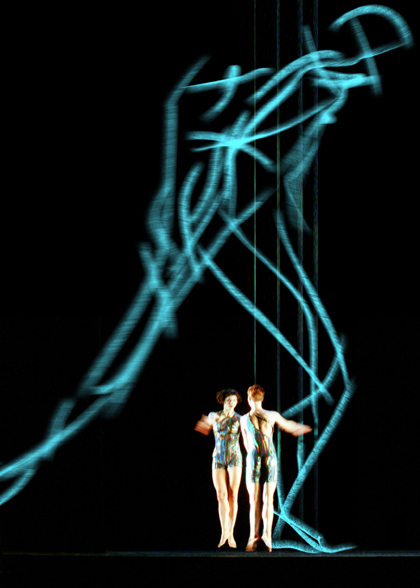
BIPEDBIPED is the first Cunningham work in which these virtual figures share the stage with the company. They are projected on a gauzy curtain in front of the stage, floating in front of and above the dancers. The dancers move through a dark world populated by the projected figures, floating digital beams of light and luminescent circles. At times, the virtual figures and décor fade or disappear, while the dancers do the same, emerging from blackness at the back of the stage, later engulfed by it again, and then disappearing from sight.

The digital décor for BIPED, the haunting electronic acoustic music by Gavin Byars, and the shiny, metallic body suits by Suzanne Gallo, all combine to create an otherworldly, almost underwater atmosphere for Cunningham’s movement. Since Cunningham didn’t ascribe meaning to his works, it is up to the audience to interpret this masterwork. What does it say to you? Do you see images of death and transcendence, like Alistair McCauley of the New York Times has suggested?

“BIPED” Trailer | Merce Cunningham at 100 at The Kennedy Center

“BIPED” Trailer | Merce Cunningham at 100 at The Kennedy Center

All of Cunningham’s work is open to individual interpretation. While it may prove puzzling, it is sure to promote thought and discussion. Cunningham inspired other artists and made people think about possibilities for performing dance. Contemporary dance owes a great deal to the endless innovation of Merce Cunningham.

Below is a discussion of BIPED from YouTube led by New York Times dance critic Alstair Macauley:

New York Times’ Alstair Macauley on BIPED

New York Times’ Alstair Macauley on BIPED

From the beginning, Cunningham made choices to push dance in new directions. It is helpful to see some of Cunningham’s choreography to understand how he redefined concert dance. You may want to:

  • Watch the excerpts from Cunningham’s BIPED and Ocean. After viewing them, take note of the following elements of Cunningham’s approach:
    • Dance itself is the subject of the dance: Cunningham reacted against the very personal and psychological choreography of Martha Graham. For Martha Graham, movement was full of meaning; for Cunningham, it was simply movement. He felt movement should be appreciated for what it was, rather than what it communicated. Dance itself became the subject of his dances.
    • Lack of central character and story: There is no main character or lead dancer in Cunningham’s work— every dancer is equally important. Likewise, there is no expression of obvious emotion. Dancers may be on stage together and even partner one another. Moments of tenderness or intensity can occur, but they come from the movement itself and not from any imposed storyline.
    • Leave it to chance: Cunningham experimented with organizing movement by chance. In some of his works, audience members would be asked to throw a coin to determine the order of different sections. Over time, Cunningham’s use of chance intensified, helping him try combinations of movement he wouldn’t have thought of on his own.
    • Use of space: Most concert dance is created so that performers face the audience. Cunningham felt all facings should be considered equally valid, and made choreography that explored different directions in space, sometimes determined by chance.
    • Elements all independent and equal: Often the dance, music and décor for a Cunningham performance only came together in dress rehearsal or in front of an audience. Cunningham created the movement, but not with a certain piece of music in mind. He did not dictate what the music or décor should be, leaving that to other artists with whom he collaborated. Often the only thing the dance and music had in common was that they began and ended at the same time. This was a radical departure, since dance and music are often tied together very closely.


  • Visit the Merce Cunningham web site (www.merce.org). There you can find personal information about Cunningham, as well as a chronology of his works. Check out the “Mondays With Merce” which are a series of webcasts that include interviews with Cunningham as well as with former dancers, and show the company at work in their studio. You can also read more about Cunningham’s unique legacy plan for his works. 


  • View the YouTube interview with Cunningham and John Cage, the composer who most influenced him: 

Chance Conversations: An Interview with Merce Cunningham and John Cage

Chance Conversations: An Interview with Merce Cunningham and John Cage

Even though the Merce Cunningham Dance Company no longer exists, there is a way for audiences to continue seeing some of Cunningham’s works.

The Merce Cunningham Trust will have a library of “Dance Capsules” or digital packages of information that will help to preserve some of Cunningham’s choreography. The capsules will contain video of the dance in performance, and information on the lighting, music/sound, costumes and décor (or set), as well as notes on how the work was created. Other dance companies can use these capsules to re-create the dance with their own performers.

Kennedy Center Logo

  • Writer

    Kirsten Bodensteiner

  • Editors

    Lisa Resnick
    TiffanyBryant

  • Producer

    Kenny Neal
    Ellie Pline

  • Updated

    March 2025

  • Sources


Related Resources

Collection Dance

What’s the difference between troika and hula? How can dance tell stories and preserve histories? Discover dance and its impact on culture by exploring Ancient Egyptian rituals and Native American legends. Learn how dance tells stories and poems through a language of movement and music, and pick up a few moves yourself.

  • Dancing

Collection Innovators, Inventors, & Explorers

Lewis and Clark explored the American West; Japanese artists Maywa Denki invent performance art “products.” These resources can help you discover the process of discovering.

  • Pioneers & Inventors

Media Dancing to Different Rules

They were rebels, they were American, and they dared to be different: the makers of modern dance.

  • Dancing
  • Contemporary Dance
  • Choreographers
  • Women in the Arts

Media Do You Wanna Dance?

Want to understand how dance works? Learn the five elements that make up the foundation of this art form: body, action, time, space, and energy.

  • Dancing

Media Alvin Ailey + Revelations

Learn about Alvin Ailey’s exploration of what he called “blood memories” through his magnum opus, Revelations.

  • Dancing
  • Contemporary Dance
  • Choreographers
  • African-American History

Media Martha Graham + Appalachian Spring

Martha Graham helped establish dance as a serious art form in America. Learn more about her and her 1944 ballet Appalachian Spring, with music by Aaron Copland.

  • Dancing
  • Contemporary Dance
  • Pioneers & Inventors
  • Choreographers
  • Women in the Arts

Media Agnes de Mille + Rodeo

Agnes de Mille’s Rodeo (1942), with music by Aaron Copland, revolutionized ballet through its use of tap and indigenous folk dance.

  • Grades 6-8
  • Dancing
  • Grades 9-12
  • Contemporary Dance
  • Musical Theater
  • Choreographers
  • Women in the Arts

Kennedy Center Education logo


Kennedy Center Education provides resources and experiences that inspire, excite, and empower students and young artists, plus the tools and connections to help educators incorporate the arts into classrooms and learning spaces of all types.

Connect with us!

spacer-24px.pngyoutube.png    facebook.png    twitter.png    instagram.png    email.png

Sign up to stay informed!

Generous support for educational programs at the Kennedy Center is provided by the U.S. Department of Education.

Gifts and grants to educational programs at the Kennedy Center are provided by The Paul M. Angell Family Foundation; Bank of America; Capital One; The Morris and Gwendolyn Cafritz Foundation; Carnegie Corporation of New York; The Ednah Root Foundation; Genesis Inspiration Foundation; Harman Family Foundation; William R. Kenan, Jr. Charitable Trust; the Kimsey Endowment; The Kiplinger Foundation; Laird Norton Family Foundation; Lois and Richard England Family Foundation; Dr. Gary Mather and Ms. Christina Co Mather; The Markow Totevy Foundation; Dr. Gerald and Paula McNichols Foundation; The Morningstar Foundation; Myra and Leura Younker Endowment Fund; The Irene Pollin Audience Development and Community Engagement Initiatives;

Prince Charitable Trusts; Dr. Deborah Rose and Dr. Jan A. J. Stolwijk; Rosemary Kennedy Education Fund; The Embassy of the United Arab Emirates; The Victory Foundation; The Volgenau Foundation; Jackie Washington; GRoW @ Annenberg and Gregory Annenberg Weingarten and Family; and generous contributors to the Abe Fortas Memorial Fund and by a major gift to the fund from the late Carolyn E. Agger, widow of Abe Fortas. Additional support is provided by the National Committee for the Performing Arts..

The content of these programs may have been developed under a grant from the U.S. Department of Education but does not necessarily represent the policy of the U.S. Department of Education. You should not assume endorsement by the federal government.