Beethoven Rocks!
Classical music's biggest rock star
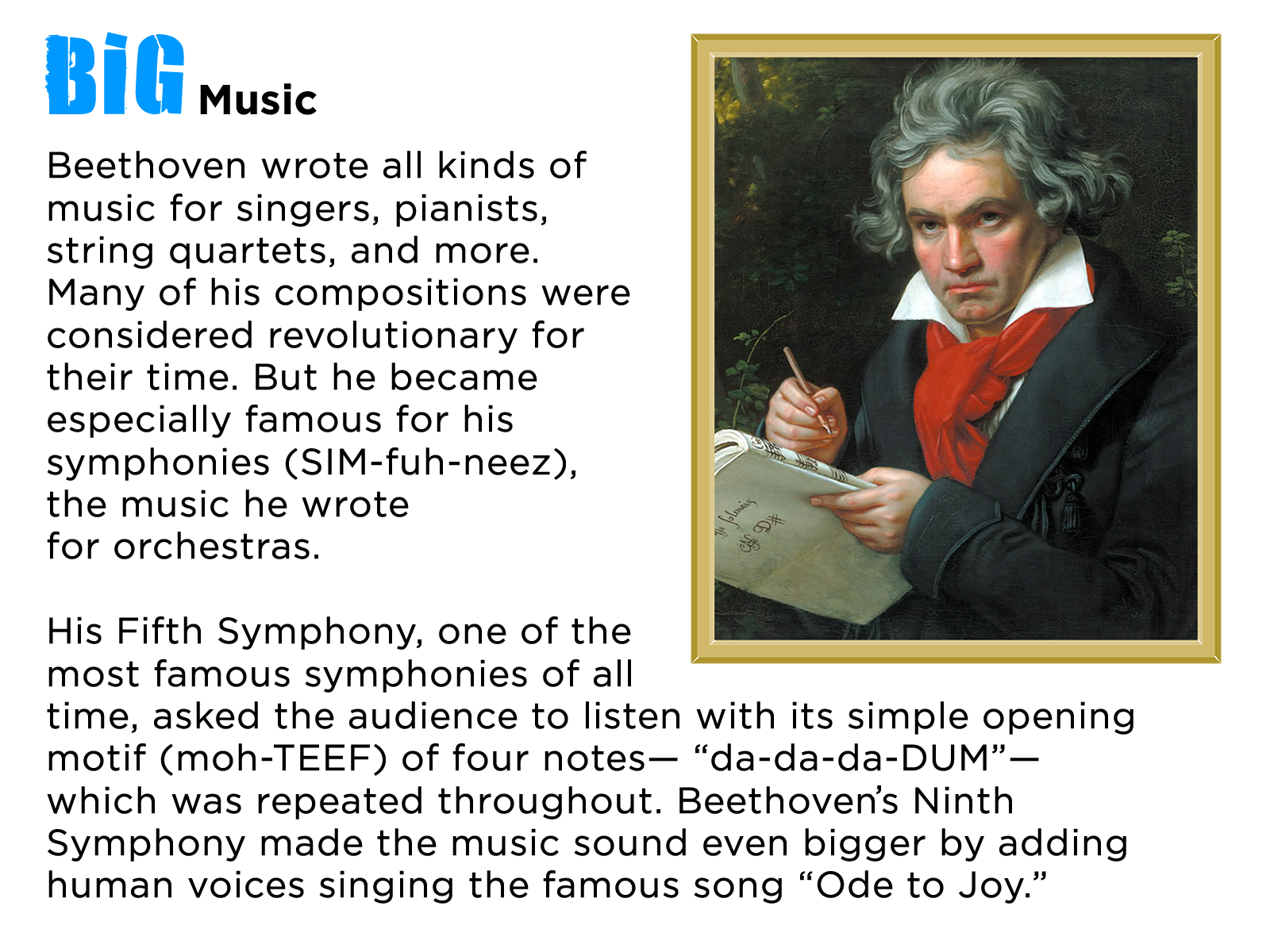
This multimedia series gives you an introduction to the life and work of the Classical music composer Ludwig van Beethoven. Beethoven’s greatest hits include Moonlight Sonata, Für Elise, “Ode to Joy,” and his famous Fifth Symphony. You might not recognize these titles, but you’re sure to know the melodies. You hear them today in movies, television, ring tones—and orchestral concert halls.
In Part 1, you’ll be introduced to Beethoven by listening to an audio story followed by a slides to help you get to know more about his life and work. Then Parts 2 through 4 will explore three of his most famous symphonies.
Bigger than You Might Expect
There’s a lot to cover when teaching about Beethoven and his music. The resources in this set contain information about composer Ludwig van Beethoven, and listening activities relating to three major symphonies (the 5th, 6th and 9th.) The activities are designed for grades 4 and up, and may be presented by the classroom teacher or music specialist.
The listening activities in this player were originally created to support the National Symphony Orchestra’s Young People’s Concert Beethoven Rocks! Some of the clips reference the concert— specifically the “Ode to Joy” sing-along practice track— but this will not impact most classroom uses.
Part 1: Meet Mr. Big
Get to know Classical music's biggest star
Beethoven: Meet Mr. Big!
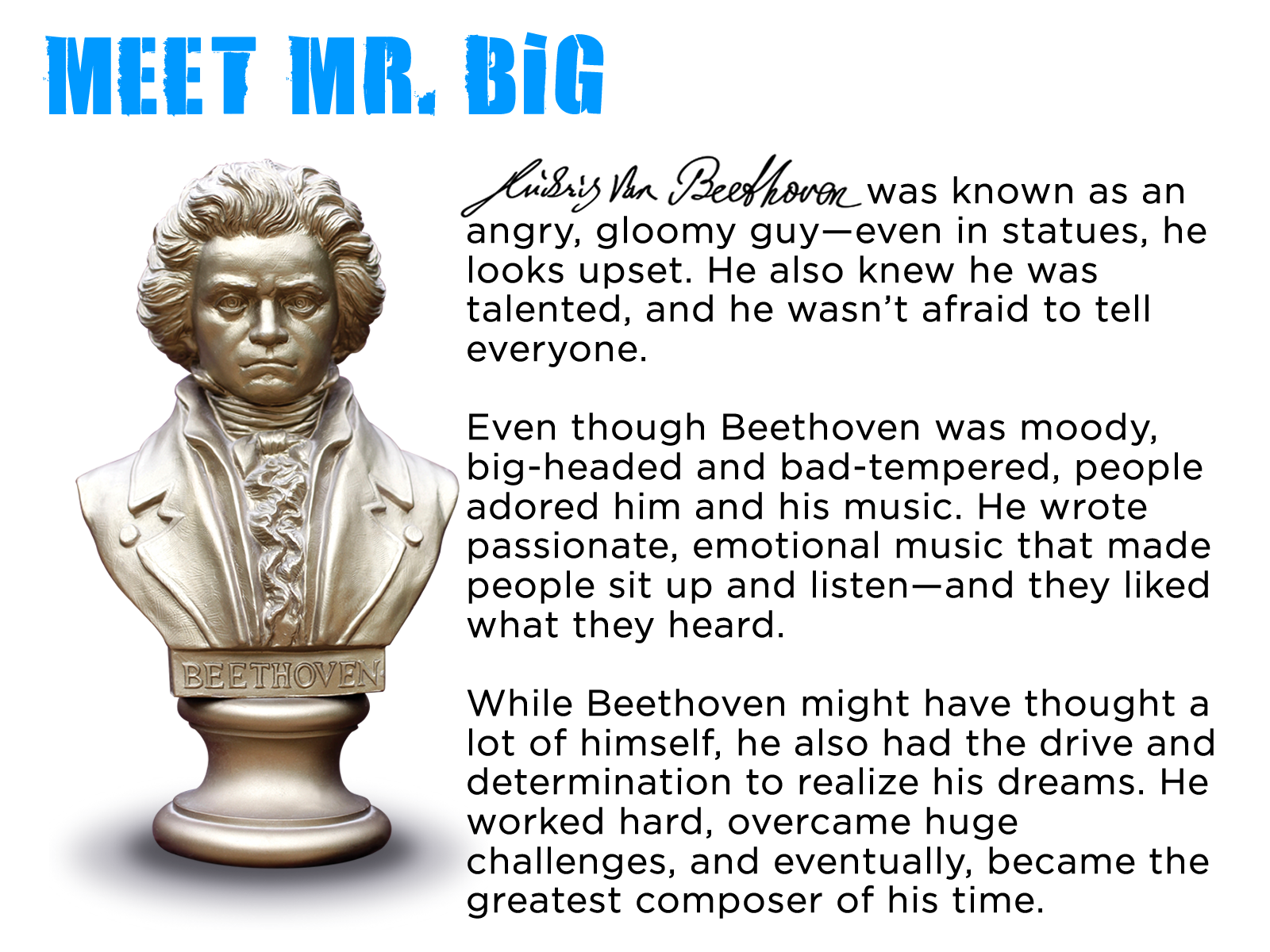
Did you know two hundred years ago, Ludwig van Beethoven was the world’s most popular rock star? And guess what? He’s still BIG!
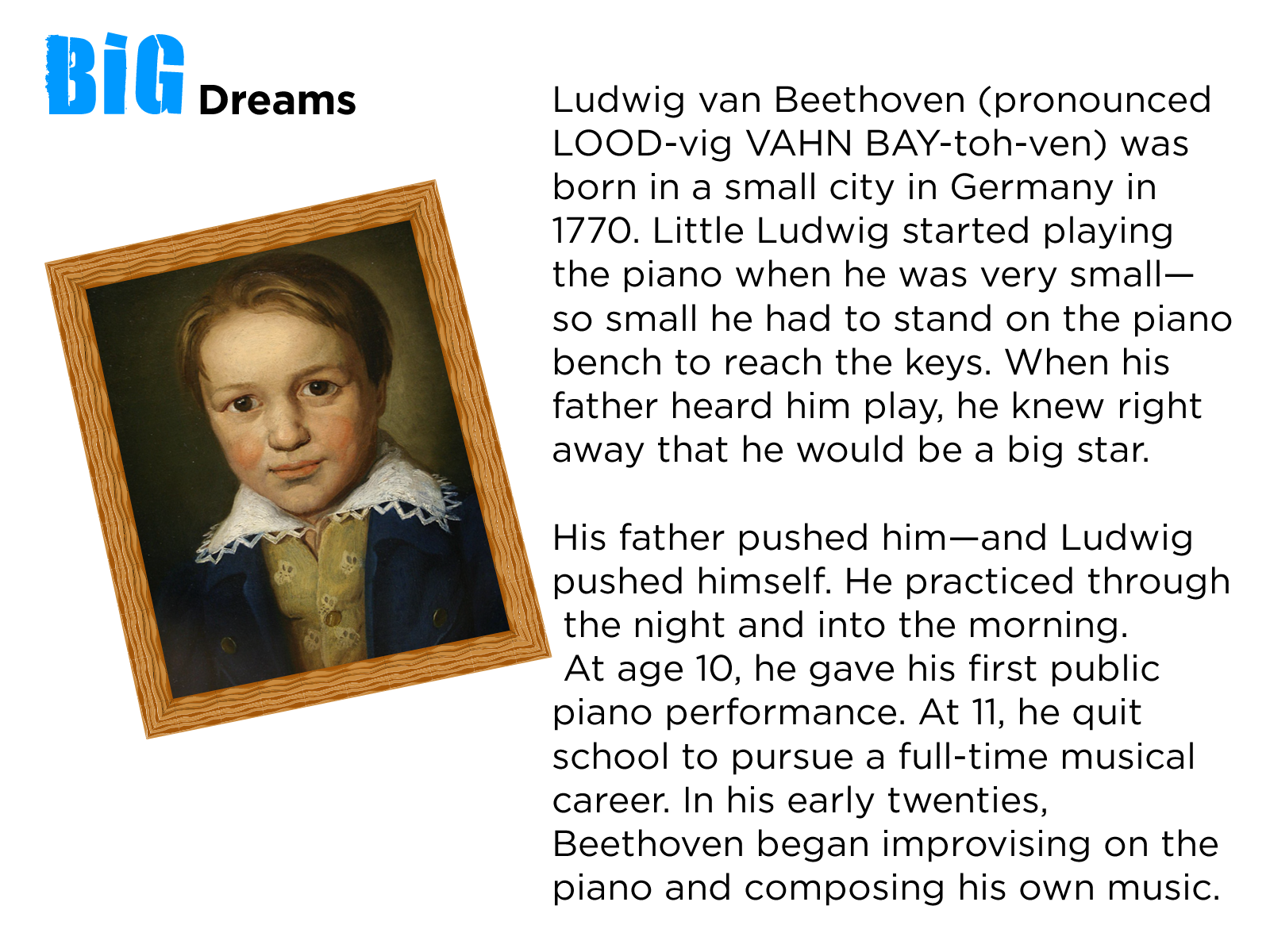
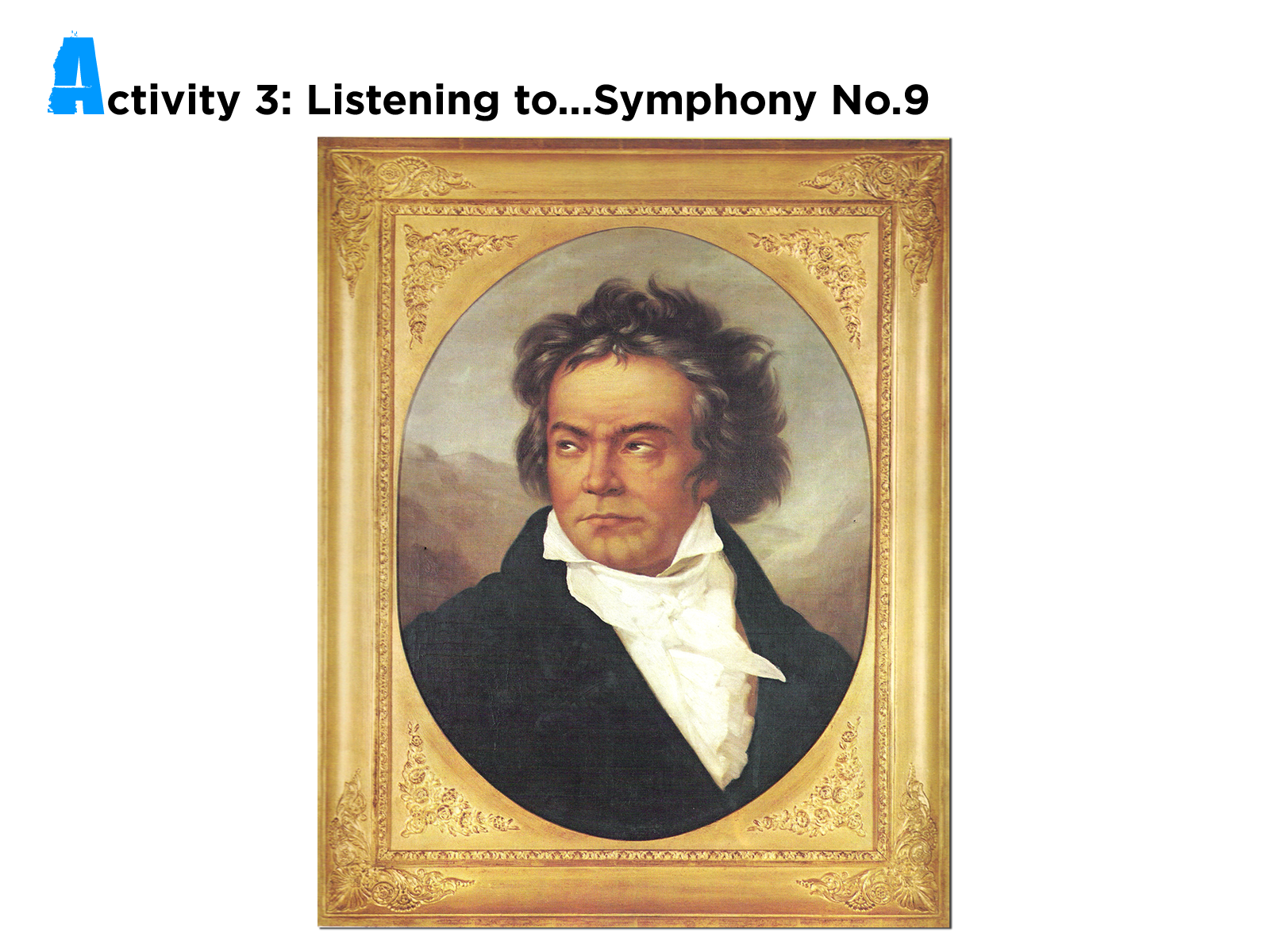
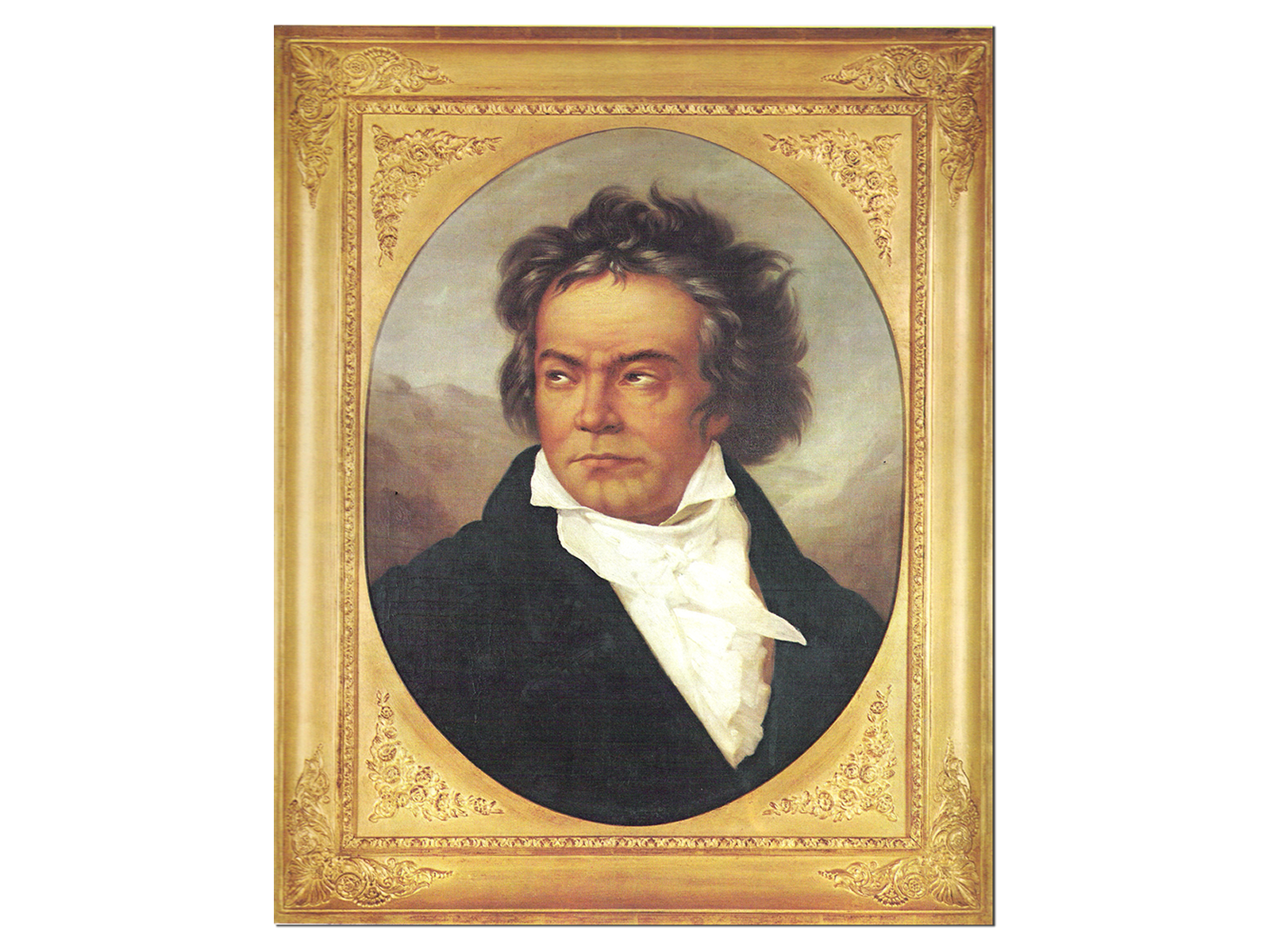
Ludwig van Beethoven (pronounced LOOD-vig VAHN BAY-toh-ven) was born in a small city in Germany in 1770. Little Ludwig started playing the piano when he was very small—so small he had to stand on the piano bench to reach the keys. When his father heard him play, he knew right away that he would be a big star.
To get to know the basics on Beethoven: First, listen to the audio story in the player below. If there were parts you found interesting (or may have missed), listen to the clip again. While you listen, click through the Slideshow. It has information about Beethoven’s life. When you're done with this section, move to the next slideshow.
Beethoven: Meet Mr. Big
Musical Terms You Should Know
Symphony: A long work for orchestra in three or four smaller parts called “movements.”
Motif: A short rhythmic or melodic idea that is repeated in a composition.
Sonata: A musical composition for one, two, or three instruments in three or four movements.
String quartet: A group of four musicians, usually two violins, a viola, and a cello.
After you have listened to the story and read the slides, talk or write about these ideas:
What does it mean to be “big”? How “big” can one person get? Does “being big” mean size only—or can it refer to impact? Can people do something “small” and still have a big impact? What is something “big” or “small” that students want to do with their lives?
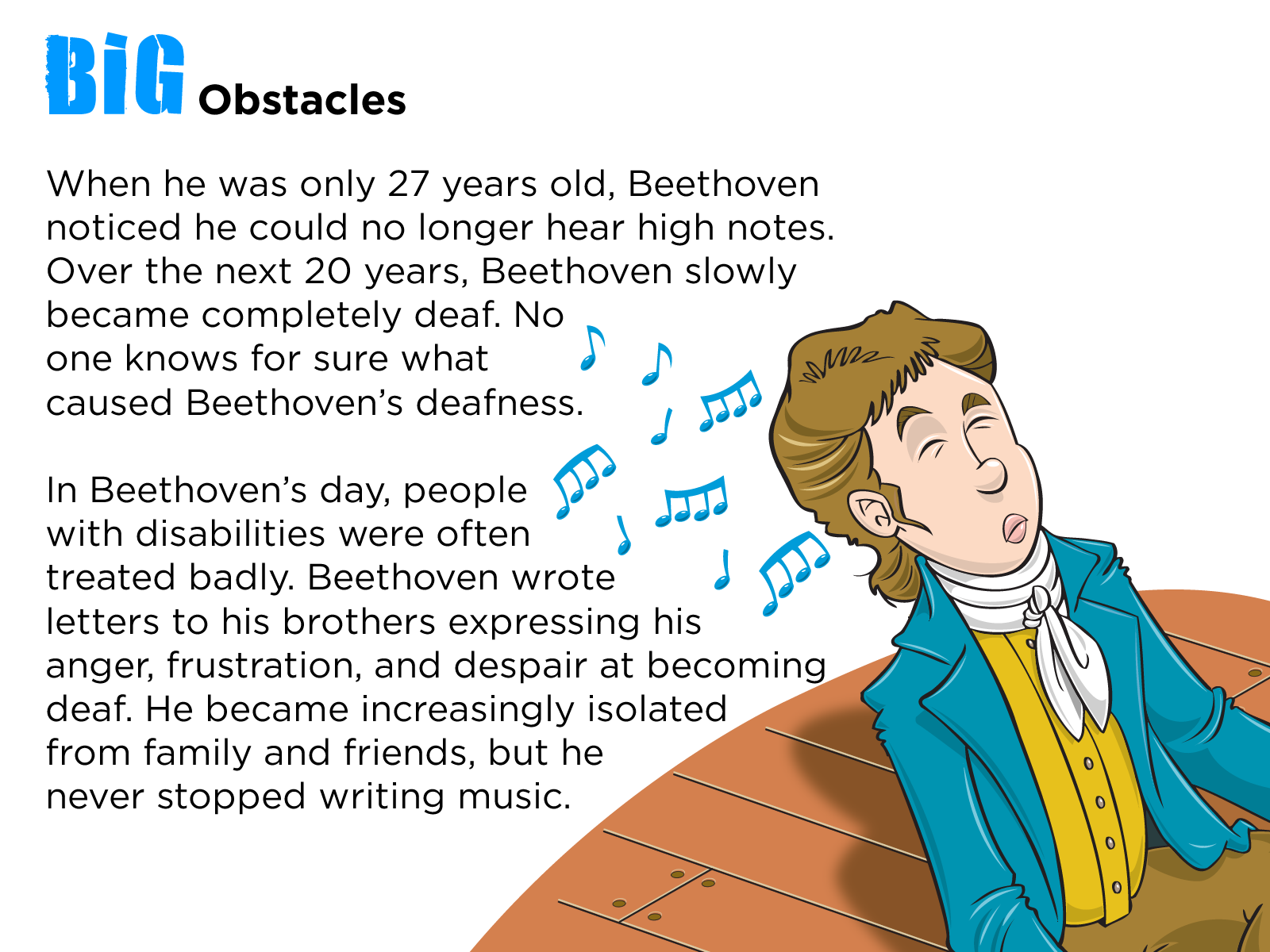
How does Beethoven’s deafness impact how we feel about his work? Beethoven’s disability affected his social life more than his music, since he was able to write truly great compositions after he lost all his hearing. Today, Beethoven’s deafness doesn’t make his great work any “greater,” but it does suggest the incredible dedication he applied to his life’s work.
Carousel Controls
Part 2: Listening to Beethoven's 5th Symphony
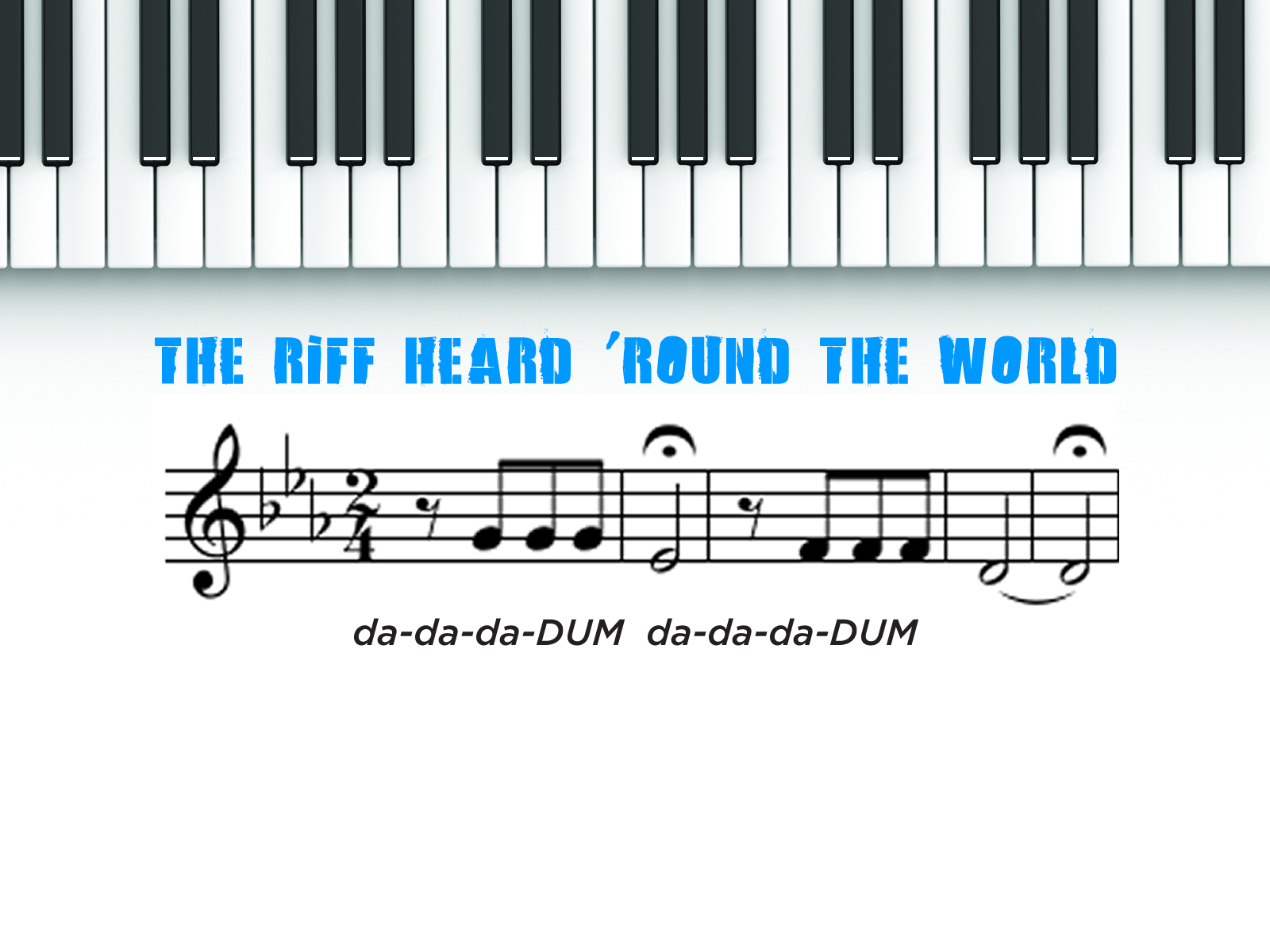
The riff heard ‘round the world
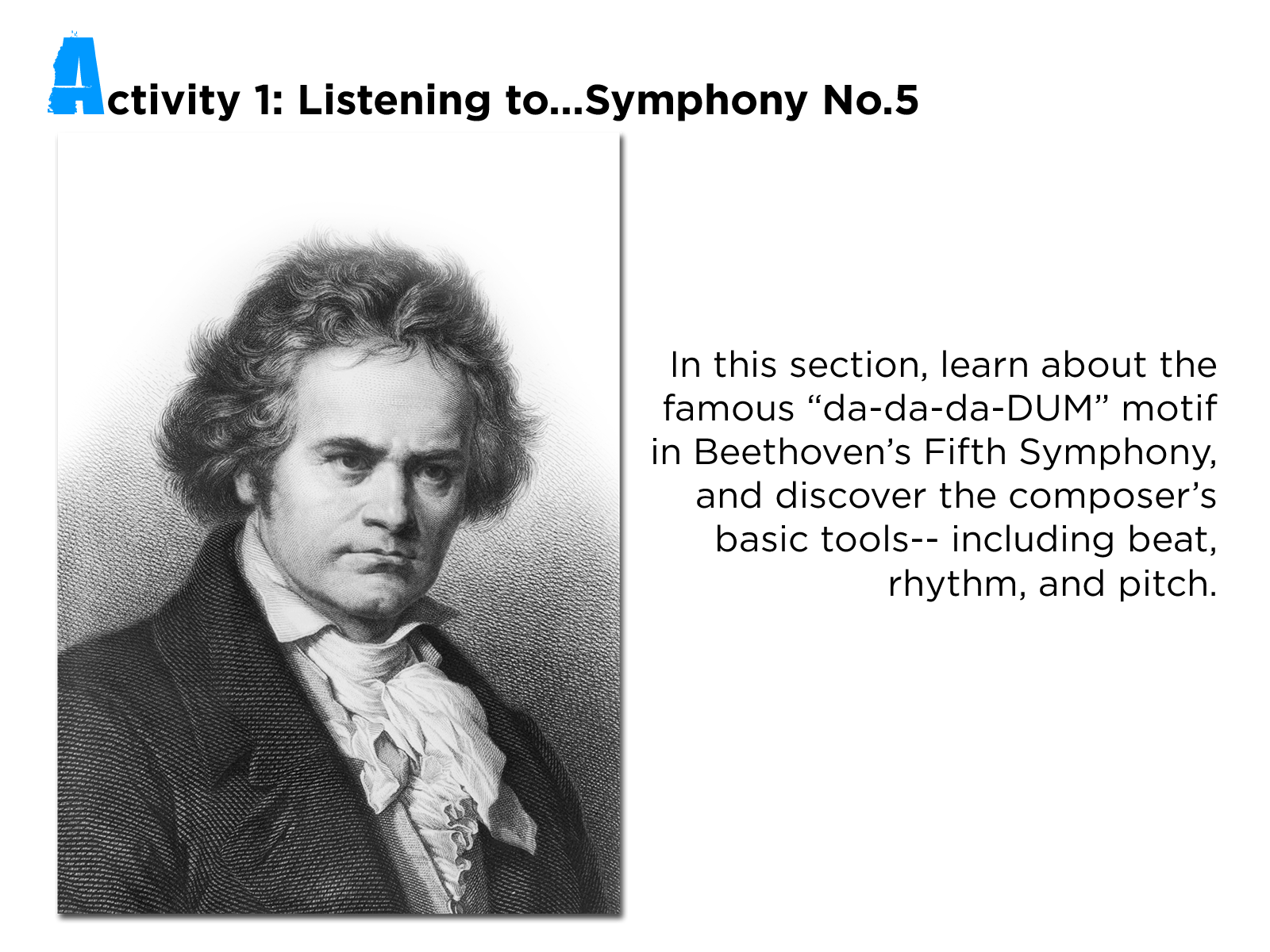
In this section, learn about the famous “da-da-da-DUM” motif in Beethoven’s Symphony No. 5 and the composer’s basic tools including beat, rhythm, and pitch. To guide and extend the learning...
Discuss how the opening notes of Beethoven’s Symphony No. 5 became the “riff heard ‘round the world.”
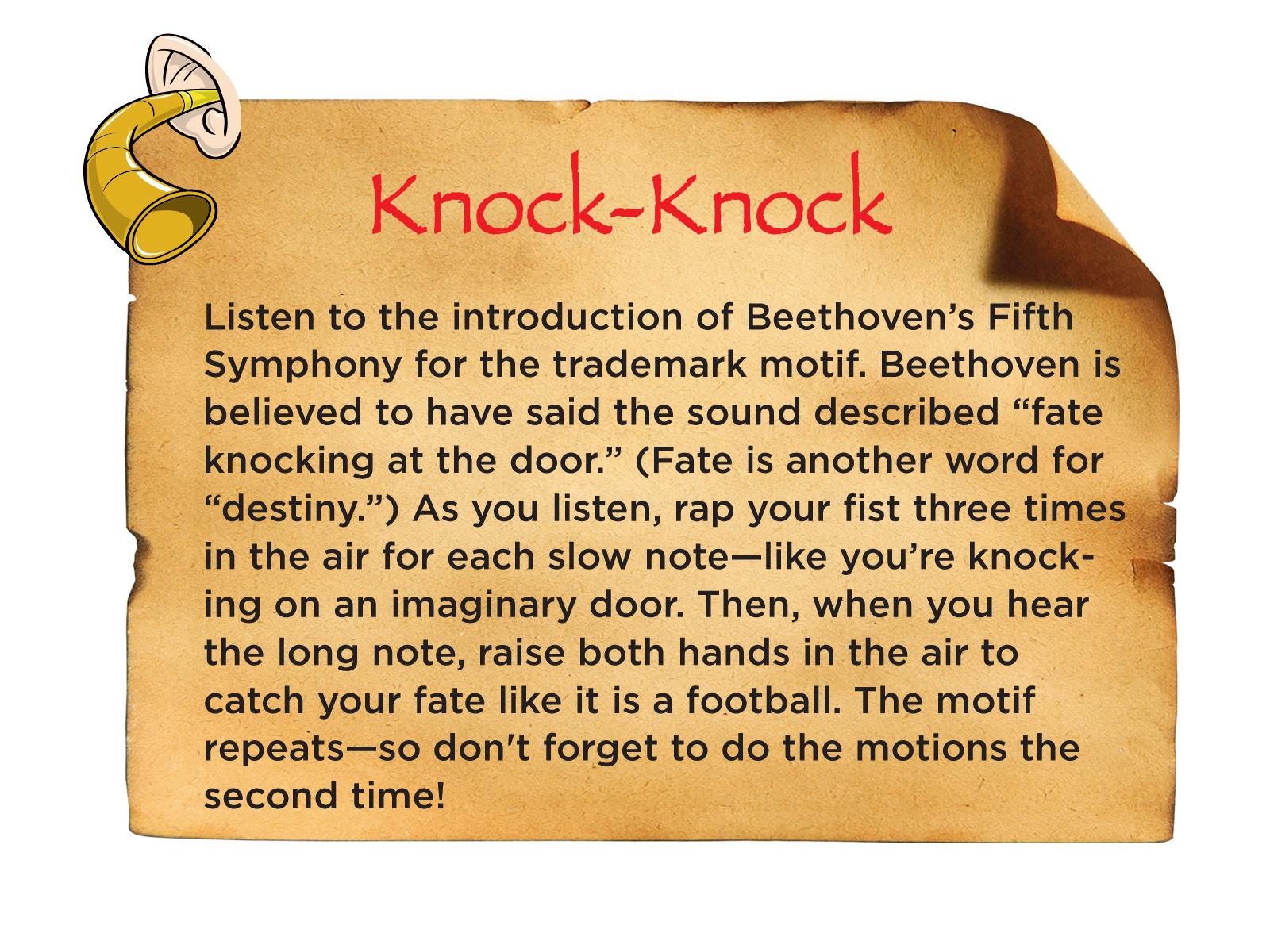
Try the “knock-knock-knock” activity, which provides a gestural exercise to perform as you listen to Beethoven’s short-short-short-long pattern. This exercise reinforces concepts of beat, rhythm, and pitch.
Share your understanding of pitch and rhythm.
Discuss the concept of “motif” and how it unfolds in the music.
The Riff Heard 'Round the World
Did you know two hundred years ago, Ludwig van Beethoven was the world’s most popular rock star? And guess what? He’s still BIG!
Part of the reason for that is his famous 5th Symphony. Seriously, it is so famous it even got sent into outer space, so that aliens can find it. In this media player you will learn about the famous “da-da-da-DUM” motif in Beethoven’s Symphony No. 5 and get to know the composer’s basic tools including beat, rhythm, and pitch.
Listening to Beethoven's 5th: Pitch & Rhythm
Listening to Beethoven's 5th: Motif & Keys
What do you think?
Those four notes and that short-short-short-long pattern sound simple enough, but in Beethoven’s music, they build into a big, majestic theme that people haven’t been able to get out of their heads for two hundred years.
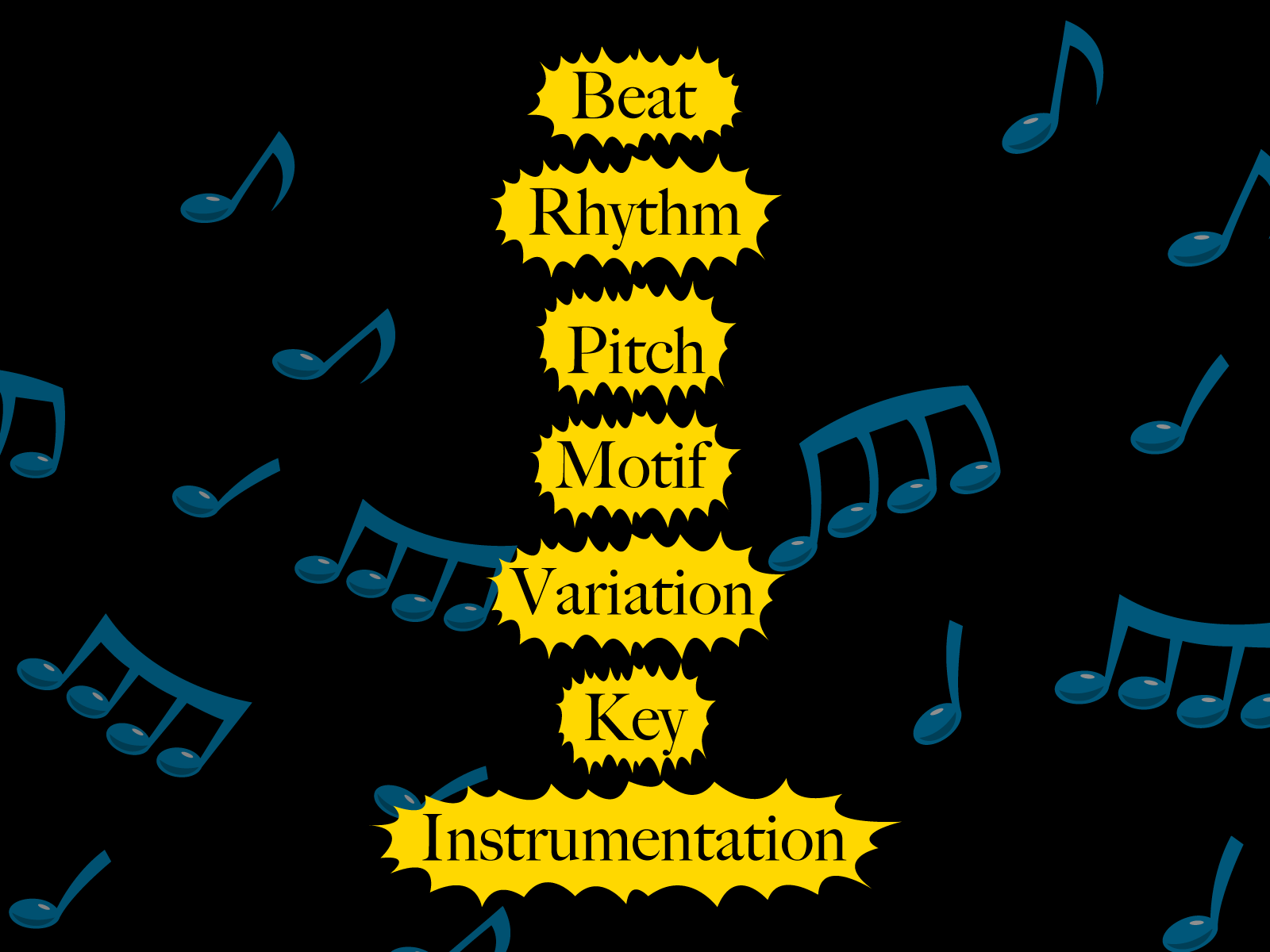
Beethoven plays around with a few key tools that are in every composer’s toolbox. What are they? How did he use them? As you listen to the excerpt on the next slide, think about these questions...
All music starts with a beat, a steady clock-like tempo that paces through the music. What is the basic beat of the 5th Symphony?
The rhythmis the series of short and long notes that lay on top of the beat. What rhythm do you hear? Can you follow it by tapping your fingers along with the music?
Music has high notes and low notes and where the note is placed is called the pitch. The pitch can move in steps to the next note right beside it, up or down— like when you sing “do-re-mi.” It can also jump or leap to a note several tones away -- like this: “do-mi-do -- do-so-do.” What does Beethoven do with pitch?
“da-da-da-DUM” is the big motifin Beethoven's Fifth. Each time the motif returns, it changes a little bit. It could be faster or slower; higher or lower—or it could be reversed. That’s the thing with a motif—it is a musical idea that returns or repeats— as a variation.
Sometimes the music is moved around the orchestra, so different instruments add their voices. What instrumentationdid Beethoven use as the motif repeats throughout the piece?
Beethoven's 5th Symphony (excerpt)
Carousel Controls
Part 3: Listening to Beethoven's 6th Symphony
Painting Pictures with Music
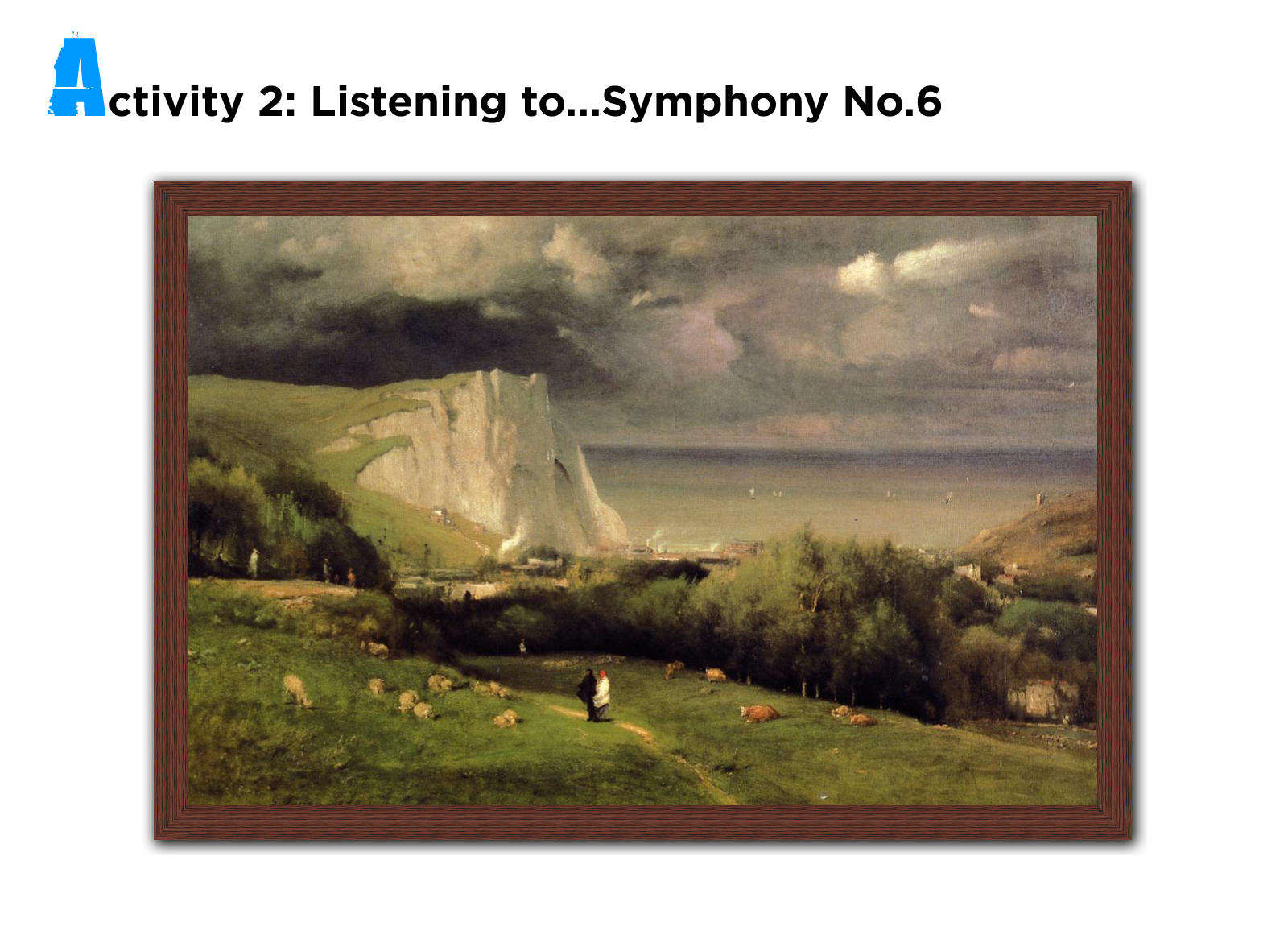
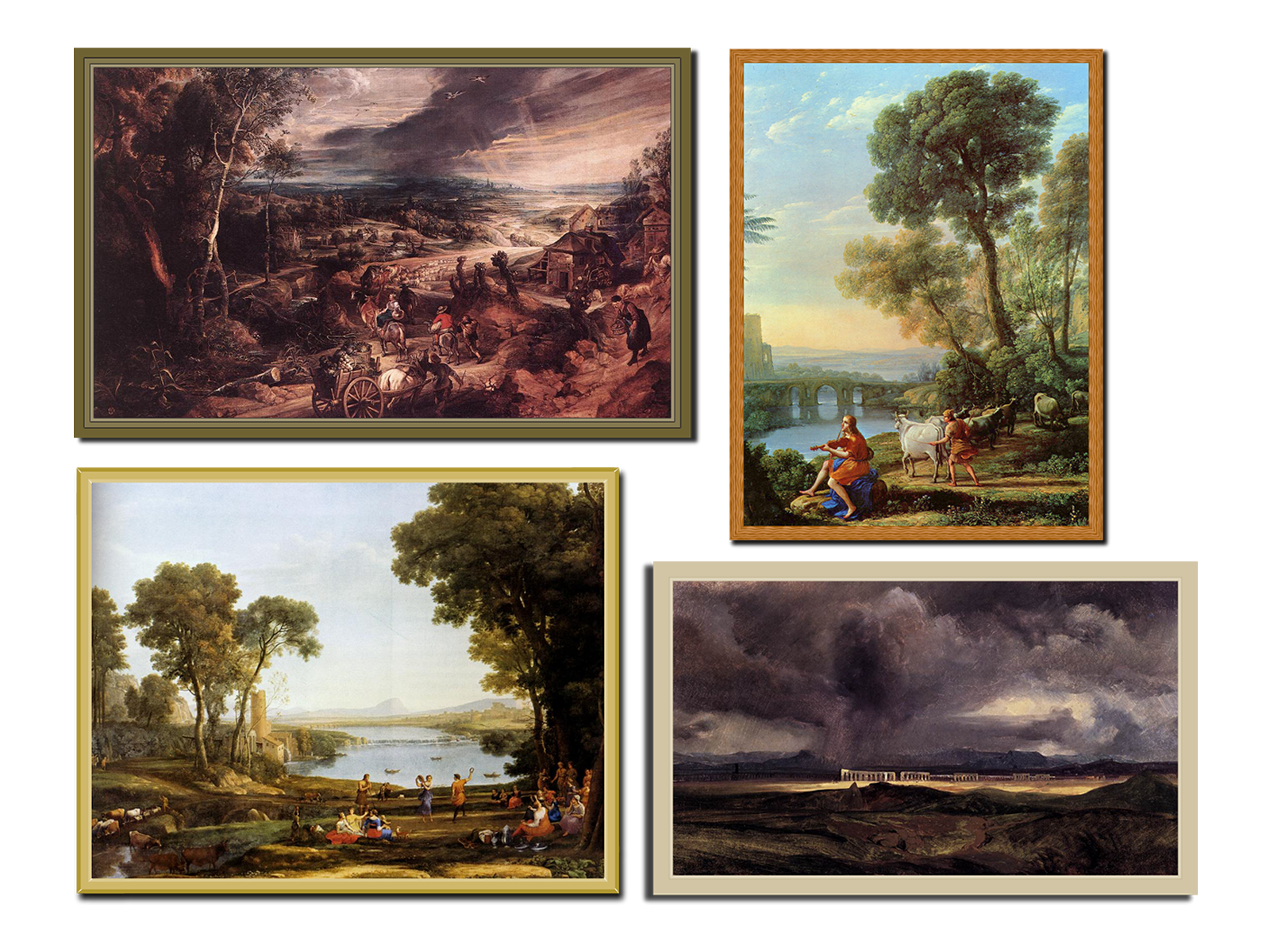
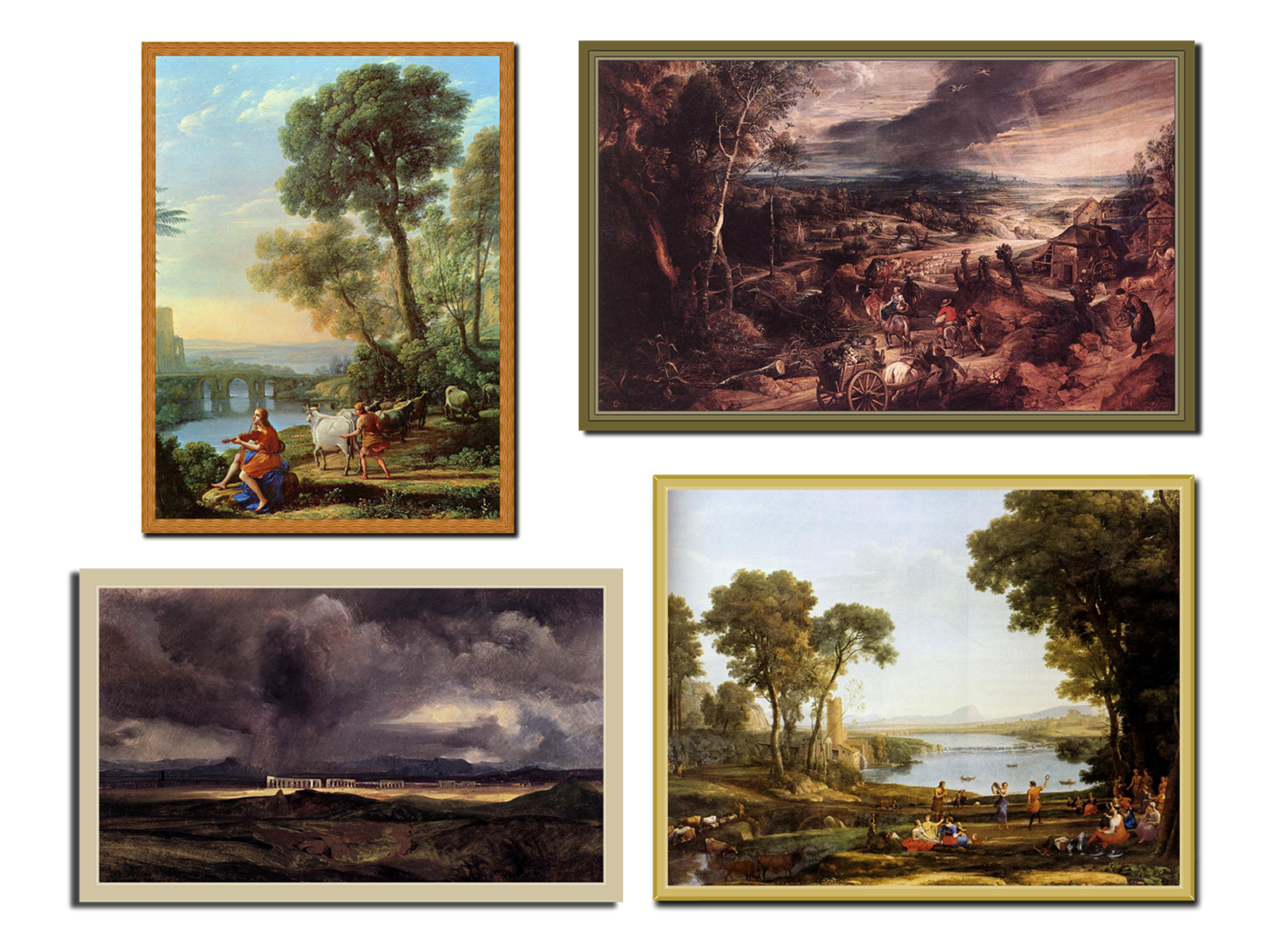
Beethoven purposefully painted pictures with his music in the Pastoral Symphony. Think about the nature you have around you, or places you have visited or seen on television-- like the woods, national parks, farm land and other places with trees, birds and rivers.
As you listen to this music, try to pick out the ways Beethoven created sounds of nature. Can you describe specific images to musical fragments (parts of the music)? For example, there might be musical fragments, or parts, that sound like birds, trees, creeks, sunshine, and other parts of nature.
In our audio story, we take a closer look at two parts of Beethoven’s Pastoral Symphony. One is a happy scene, called “Peasants’ Merrymaking,” when the farmers gather in a field for an afternoon of eating, dancing and relaxing. The other scene is “Storm”-- in which Beethoven paints a musical picture of a storm that brews in the distance, coming closer until it is right overhead.
Listening to Beethoven's 6th: The "Pastoral"
Picturing the Dance
During the first half of the story, you’ll hear music that sounds like people having a party. It starts slowly as people arrive, and picks up as the dancing begins. In the audio story, you’ll learn about how Beethoven used pitch and rhythm to illustrate these ideas.
One way to think about pitch is that it travels in steps, jumps, or leaps. During the "Peasants’ Merrymaking" section, listen for the parts when pitches travel in easy steps and small jumps. You can also...
Listen for a shifts in the beat and the playful quality of the rhythms. How does the music change? Does it change the way you feel?
How does the mood change with the shifts in key? Do you feel that a major key suggests a brighter mood?
Think about the types of instruments Beethoven used during this section. Which instruments can you hear? Why might he have chosen them?
Listening to Beethoven's 6th: "Peasants’ Merrymaking" (excerpt)
Picturing the Storm
In the second half of this exercise, the music changes from the happy mood of the "Peasants Merrymaking." The storm starts slowly, and then builds. Think about any storms you have seen-- do you remember seeing clouds in the distance, then getting closer? What happens as a storm gets closer?
During the "Storm" section, listen for pitches that take great leaps instead of small steps or jumps. Besides changes in pitch, think about how Beethoven used other tools to make this musical idea come to life:
Listen for the impact of a minor key. How does it make you feel?
How does the beat change? Listen for more aggressive beats and irregular rhythms.
Beethoven also used silence as part of the music. What do you think about the way Beethoven shifts from too soft to too loud? Does silence change the way you feel?
Compare and contrast the types of instruments Beethoven chose to perform during his storm.
Listening to Beethoven's 6th: "The Storm" (excerpt)
This activity helps students hear the sounds of nature incorporated into Beethoven’s score for the “Pastoral” Symphony. Students learn how Beethoven utilized musical dynamics and imagination to illustrate nature, focusing on two selections, “Peasants’ Merrymaking” and “Storm.”
Tell students that Beethoven purposefully painted pictures with his music in the Pastoral Symphony. Many children have limited experience with nature on such a grand scale; if this is the case with your students, warm up by asking students to share experiences of national parks, nature walks, etc.
Prior to listening, remind students that pitch travels in steps, jumps, or leaps. Ask them to listen to changes in pitch and describe these changes.
Discuss how shifts in key, as well as volume, instrumentation and silence, are tools for the composer.
(continued)
Beethoven's 6th Listening Activity
(continued)
While playing the Listening Activity, listen for the sounds of nature in Beethoven’s Pastoral Symphony. Encourage students to attach specific images to musical fragments and to consider the musical choices Beethoven made in each section. Musical phrases might suggest birds, trees, brooks, sunshine, etc.
After listening, lead a short reflection. Ask students to describe what they “saw” and heard. Discuss the tools Beethoven used to create mood in each selection and compare the two scenes.
If time allows, ask the winners to share specific “clues” from the music that helped them decide. Correct answers are: (1) a calm, sunny day in the country; (2) a storm brewing in the distance; (3) dancing peasants; (4) a heavy thunderstorm overhead. Students should listen for violins sounding like rain; the timpani for thunder; and cellos for the sound of wind.
Carousel Controls
Part 4: Listening to Beethoven's 9th Symphony
Ode to Joy
The Ninth Symphony is as big as Beethoven gets.
If you have read Meet Mr. Big, you already know that Beethoven became more and more deaf over time. By the time he wrote this symphony, he was near the end of his career—and he was also completely deaf.
What challenges did Beethoven overcome to write it?
Listening to Beethoven's 9th: Finding Joy
Finding Joy
Here are some things to think (and talk) about during and after you listen to the Finding Joy audio story:
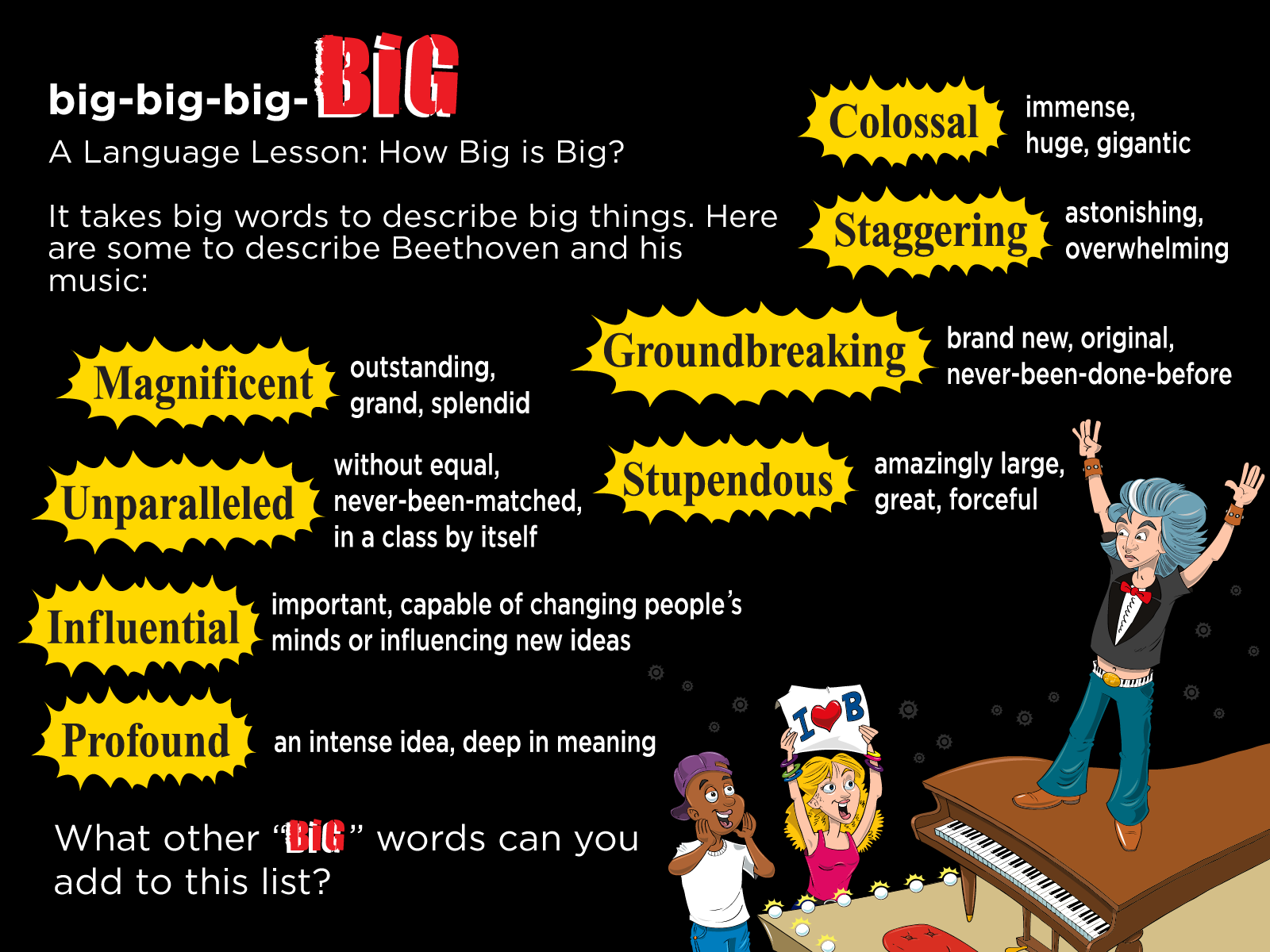
In this story, you only hear an excerpt, or section, of the 9th Symphony-- but this small part shows just how big this music can sound. What happens in the music to make it sound so big? Use music terms-- like pitch, dynamics and rhythm to describe how the music changes. You can also use any of the new words for “big” that you might have learned.
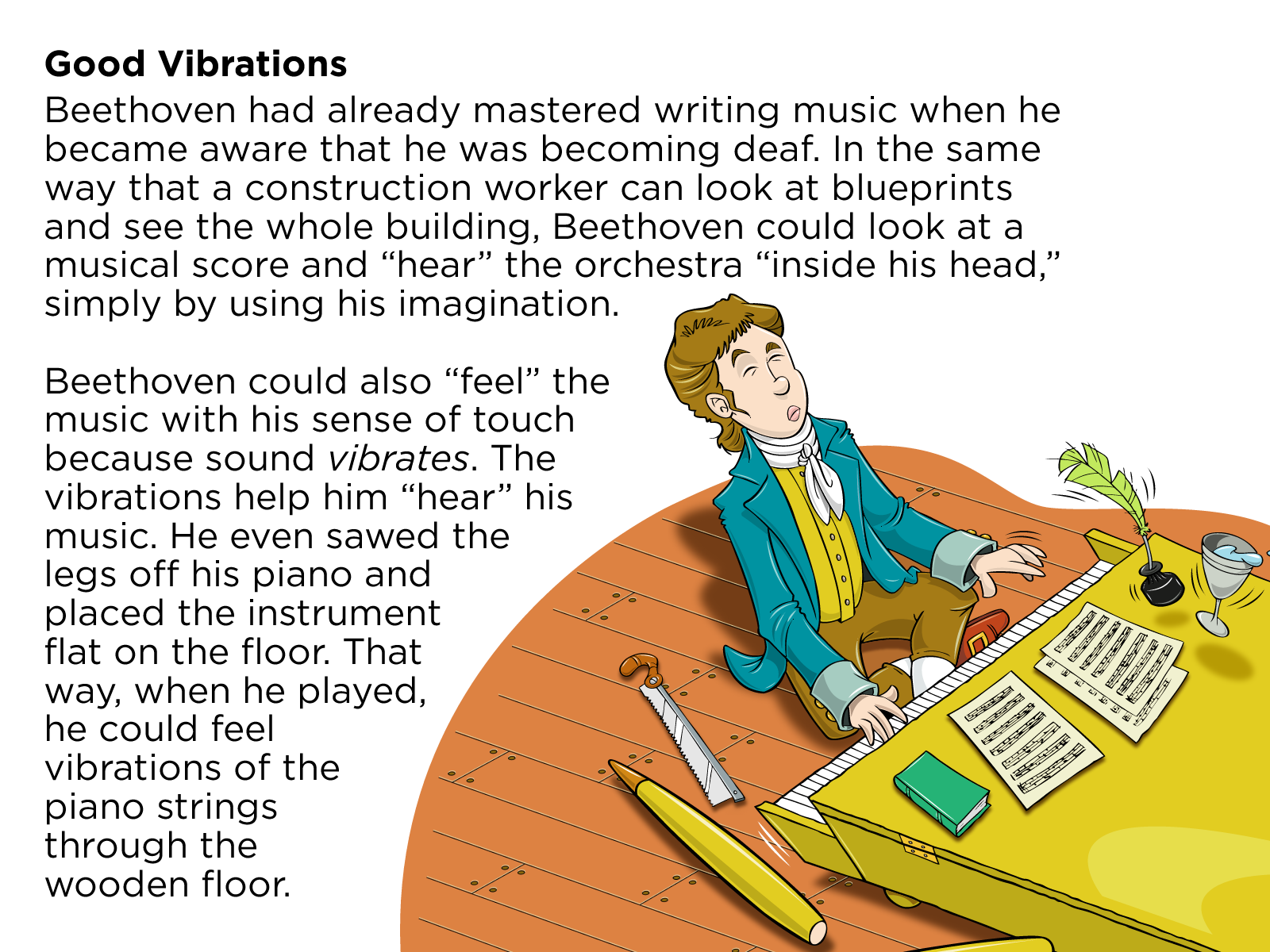
You may already know that after Beethoven became deaf, he sensed piano vibrations in order to “hear” the music he was creating. As you listen to the story about the symphony’s premiere, think about Beethoven appearing onstage for the concert. Being deaf, Beethoven was unable to hear the applause until he was turned to face the audience. How do you think he felt, both before and after he turned around?
Beethoven's 9th (excerpt)
“Ode to Joy” Sing-along
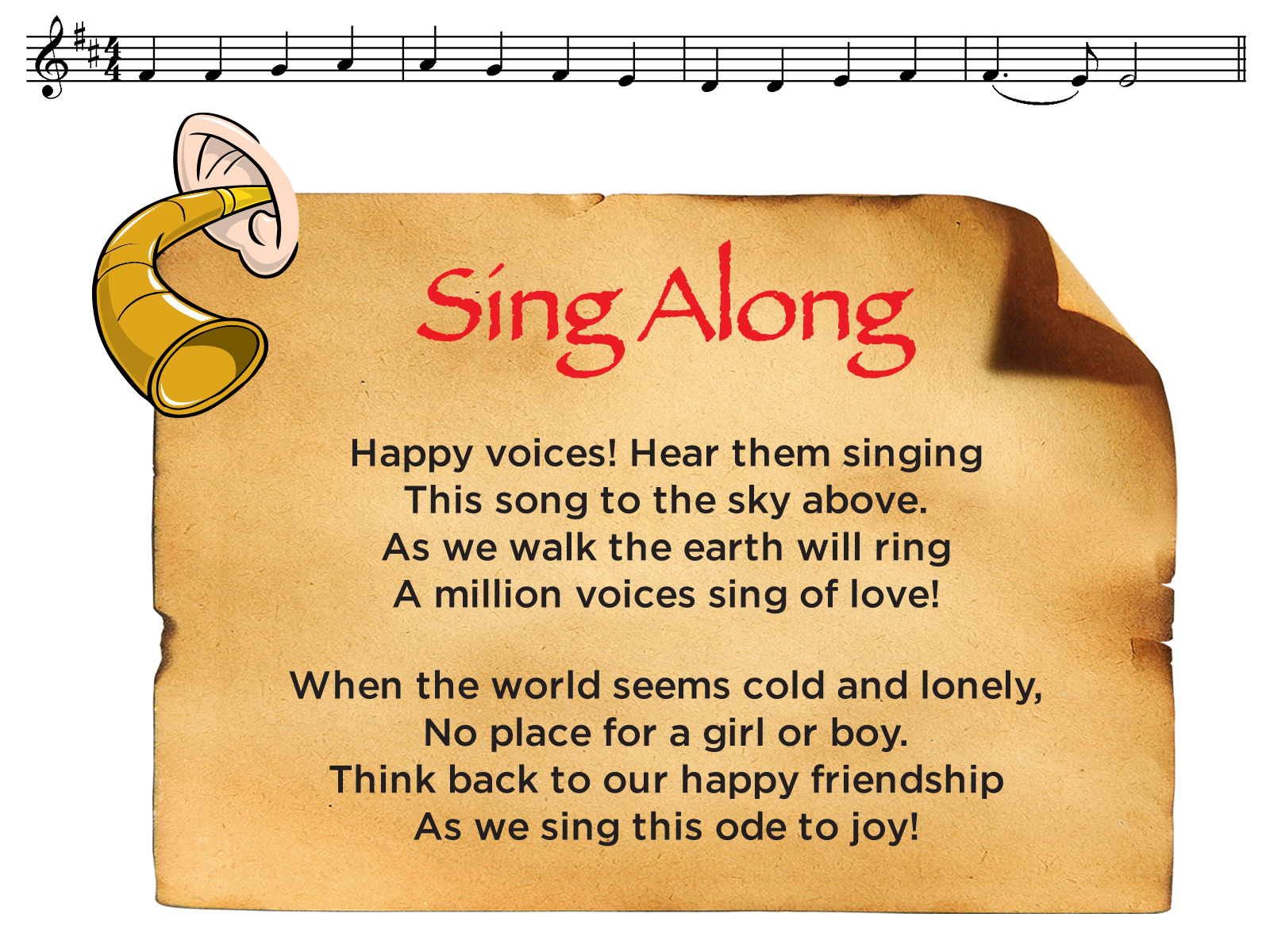
Beethoven made the big decision to add voices as nearly-equal members of the orchestra. Now you can add your voice to Beethoven’s music! The audio story lets you hear the music and melody together. We've also got clips of just the music so you can sing on your own!
If you want to join in, here are some tips for a great experience:
Read the lyrics aloud first so you can become familiar with the words before singing.
Listen to the recorded song once or twice. You don’t have to sing the whole thing; just sing along with parts as you go, adding new lines as you get more comfortable.
Ludwig van Beethoven was born in a small city in Germany in 1770 and started playing the piano when he was very small—so small he had to stand on the piano bench to reach the keys. When his father heard him play, he knew right away that he would be a big star.
Meet great composers, explore the vast musical world of the orchestra, study the science behind the instruments, and discover how classical music is anything but boring.
You might see some of these instruments when you come to the Kennedy Center, watch a performance by your school band, or at any other concert you attend! Click the slides to learn more about some of the most frequently spotted instruments in each family.
Music Art
Musical Instruments
Produced by
Kennedy Center Education Digital Learning
ARTSEDGE, part of the Rubenstein Arts Access Program, is generously funded by David Rubenstein.
Additional support is provided by the U.S. Department of Education.
Kennedy Center education and related artistic programming is made possible through the generosity of the National Committee for the Performing Arts and the President’s Advisory Committee on the Arts.
The contents of this Web site were developed under a grant from the U.S. Department of Education. However, those contents do not necessarily represent the policy of the U.S. Department of Education, and you should not assume endorsement by the Federal government.
Unless otherwise stated, ARTSEDGE materials may be copied, modified and otherwise utilized for non-commercial educational purposes provided that ARTSEDGE and any authors listed in the materials are credited and provided that you permit others to use them in the same manner.