Recommended for Grades 6-12
In this resource, you will:
- Learn the opera’s background and synopsis
- Meet the opera’s composer
Part of the Opera Overviews collection. Explore the history of opera with our resource Understanding Opera.
In this resource, you will:
Part of the Opera Overviews collection. Explore the history of opera with our resource Understanding Opera.
When Bizet’s Les pêcheurs de perles (The Pearl Fishers) premiered in Paris in 1863, the work was ill-received by critics though pleasing to audiences. The opera had a short run of only 18 performances before it closed. It was never again performed during Bizet’s lifetime. Indeed, The Pearl Fishers suffered a similar fate as Bizet’s most celebrated work, Carmen, which was initially denounced for its mature and immoral themes and consequently left out of the operatic repertoire for nearly a decade.
On a beach in Ceylon, the pearl fishers prepare to begin their work. They choose a leader, Zurga, and await the arrival of the consecrated virgin whose prayers will ward off storms while they are at sea. The hunter, Nadir, Zurga’s childhood friend, returns after a long absence. Together he and Zurga recall the night at a temple in Candi when they caught sight of a woman whose perfect beauty captured both their hearts.
Their love for her has driven the two men apart, but they swear to forget her in order to preserve their friendship. A veiled woman approaches. It is Leïla, the virgin priestess who will pray to protect the fishermen. She is led to a rocky perch, and her prayer is heard. Nadir recognizes Leïla as the woman from Candi and makes himself known to her.
Night falls. Nourabad, the high priest, reminds Leïla of her vow of chastity. Leïla tells him she knows how to keep her faith, recalling an incident from her childhood when she risked her life to protect a fugitive who gave her a necklace as a token of his gratitude. Nourabad leaves. Alone in the night, Leïla senses the presence of Nadir. Her reverie is answered by Nadir’s song.
He approaches and declares his love, and Leïla does not reject him. The howling and rumbling of a storm are heard. Nourabad returns with his guards, who seize Nadir and Leïla. When Zurga recognizes Leïla and realizes Nadir has betrayed him, he cannot contain his fury and condemns the pair to death.
Zurga is alone after the storm. He agonizes over his decision to condemn his friend. Leïla comes to ask him to spare Nadir, saying that she alone should die. This rekindles Zurga’s jealousy and he angrily rejects her supplication. As she’s being led away, Leïla requests that her necklace be returned to her mother. Zurga recognizes the necklace, for he was the fugitive whom Leïla saved.
A dance is performed in anticipation of the sacrifice of Leïla and Nadir. Suddenly Zurga rushes in to announce that someone has set fire to the pearl fishers’ camp. They disperse, abandoning the prisoners. Zurga tells Nadir and Leïla that he started the fire. He breaks their bonds and urges them to make their escape. He remains behind to face his impending death at the hands of Nourabad and the guards.
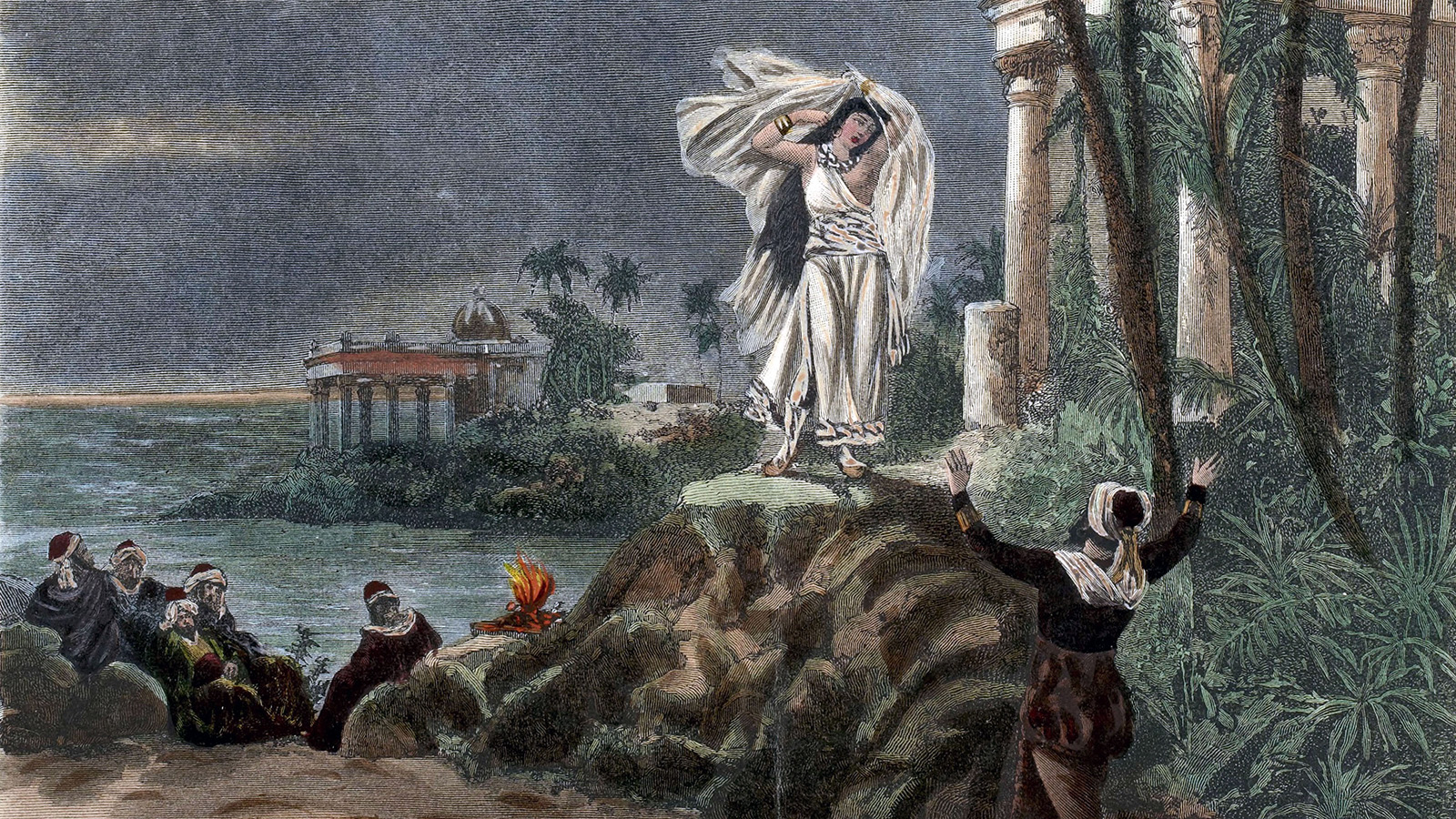 Antonio Bonamore (1845–1907), illustration published April 1886 in Il Teatro illustrato of Giovanni Zuccarelli’s (1846–1897), set design for the final scene of Act 1 (duet of Leïla and Nadir) in the opera Les pêcheurs de perles by Georges Bizet, as produced at La Scala on 20 March 1886, the Milan premiere. [Source]
Presented by Washington National Opera, host Saul Lilienstein takes you through the musical world of Bizet’s 1863 love triangle opera, The Pearl Fishers.
Rehearsal footage from the Met’s 2016 production of Bizet’s The Pearl Fishers, directed by Penny Woolcock and starring Diana Damrau, Matthew Polenzani, and Mariusz Kwiecien.

A quick overview of Bizet’s 1875 fiery tragic opera.
Journey through the first half of opera’s third historic “phase”: the Romantic period. Learn about the cultural, economic, and political upheaval that inspired opera’s emotional U-turn, and get to know some familiar works in the canon.
Uncover the driving forces behind opera’s fiercest era, including Europe’s semi-unhealthy obsession with death, desire, and nationalist identity—all of which sparked a wild streak of artistic innovation and some truly iconic music for the stage.
A beginner’s guide to some of opera’s most challenging female roles and a unique look at how opera does girl power.

Kennedy Center Education provides resources and experiences that inspire, excite, and empower students and young artists, plus the tools and connections to help educators incorporate the arts into classrooms and learning spaces of all types.


Generous support for educational programs at the Kennedy Center is provided by the U.S. Department of Education.
Gifts and grants to educational programs at the Kennedy Center are provided by The Paul M. Angell Family Foundation; Bank of America; Capital One; The Morris and Gwendolyn Cafritz Foundation; Carnegie Corporation of New York; The Ednah Root Foundation; Genesis Inspiration Foundation; Harman Family Foundation; William R. Kenan, Jr. Charitable Trust; the Kimsey Endowment; The Kiplinger Foundation; Laird Norton Family Foundation; Lois and Richard England Family Foundation; Dr. Gary Mather and Ms. Christina Co Mather; The Markow Totevy Foundation; Dr. Gerald and Paula McNichols Foundation; The Morningstar Foundation; Myra and Leura Younker Endowment Fund; The Irene Pollin Audience Development and Community Engagement Initiatives;
Prince Charitable Trusts; Dr. Deborah Rose and Dr. Jan A. J. Stolwijk; Rosemary Kennedy Education Fund; The Embassy of the United Arab Emirates; The Victory Foundation; The Volgenau Foundation; Jackie Washington; GRoW @ Annenberg and Gregory Annenberg Weingarten and Family; and generous contributors to the Abe Fortas Memorial Fund and by a major gift to the fund from the late Carolyn E. Agger, widow of Abe Fortas. Additional support is provided by the National Committee for the Performing Arts..
The content of these programs may have been developed under a grant from the U.S. Department of Education but does not necessarily represent the policy of the U.S. Department of Education. You should not assume endorsement by the federal government.


