Recommended for Grades 6-12
In this resource, you will:
- Learn the opera’s background and synopsis
- Meet the opera’s composer
Part of the Opera Overviews collection. Explore the history of opera with our resource Understanding Opera.
In this resource, you will:
Part of the Opera Overviews collection. Explore the history of opera with our resource Understanding Opera.
After the incredibly successful masterpiece Otello, librettist Arrigo Boito (1842-1918) and the legendary composer Giuseppe Verdi (1813-1901) began to discuss the possibility of collaborating once again. Boito suggested a comic opera based on the beloved drunkard, Falstaff, a character from William Shakespeare’s The Merry Wives of Windsor and Henry IV.
Initially, Verdi was uninterested in the idea, but within weeks, a critical interview was published which stated that Verdi did not have the skill necessary to compose a comic opera. Angered by the slight, Verdi took this as a direct challenge and immediately agreed to compose Falstaff, his first comic opera since Un giorno di regno (1840).
With the partnership renewed, Verdi and Boito began to work secretly in 1889. Though Verdi composed the entirety of Act I in little more than a week, distractions and personal losses kept him preoccupied, postponing the completion of the project until 1892.
Publicly, Verdi insisted that he was setting the play only to amuse himself and worked diligently to keep the project a secret; but, as interest in the work spread, La Scala commissioned the premiere in 1893. With Verdi on the podium for the first performance, the work was an immediate success and has remained a staple of the operatic repertoire ever since.
Recognized as one of the only operas whose brilliant libretto is as admired as its score, Verdi was careful to play the humor against a slight strain of melancholy, coming closer to the autumnal temper of Shakespeare’s plays than any other musical treatment. A masterful challenge to any critic, Falstaff is a perfect fusion of humanist realism and light-hearted fantasy—and the perfect testament to the multi-faceted genius of Giuseppe Verdi.
Sir John Falstaff is at the Inn when Dr. Caius bursts upon the scene and loudly accuses him of robbery. Falstaff dismisses the case, and the doctor angrily departs. Falstaff finds himself alarmingly low on funds and outlines a plan to fill both his pockets and his paunch by wooing Alice Ford and Meg Page, two wealthy wives of Windsor. Having written love letters to them both, he commands his henchmen Bardolph and Pistol to deliver them, but they decline claiming they have more honor. Falstaff gives the letter to a messenger.
In a garden of Ford’s House, Alice and Meg eagerly show one another their extraordinary and identical letters. Outraged—and thoroughly amused—the women agree that the villain must be punished and respond with a request for a rendezvous and tender greetings which they send with Mistress Quickly. After the women leave, Alice and Ford’s daughter Nannetta and Ford’s employee Fenton linger for a furtive meeting of their own. Meanwhile, Bardolph and Pistol warn Ford of Falstaff’s designs on his wife and his strong-box, They offer to help teach the old miscreant a lesson. Ford decides to meet Falstaff under disguise and an assumed name.
Mistress Quickly delivers the letters to Falstaff, assuring that neither Alice nor Meg know of his wooing of the other. Falstaff gloats in his triumph. Ushered in by Bardolph, “Master Brook” (Ford) seeks Falstaff’s help in courting Alice, and asks for his assistance in meeting with her. Falstaff declares that there is nothing easier as he already has an appointment with her, while her husband is away. Choked with astonishment and rage, Ford vows to catch and punish Falstaff and Alice.
While finishing their scheming, Meg, Alice and Mistress Quickly find out Ford’s plan to marry Nannetta to Dr. Caius. The women assure Nannetta such a ridiculous match will never be. Falstaff arrives and tries to woo Alice with stories of his younger years, but they are quickly interrupted with news that Ford is on his way back. Falstaff hides in a hamper, while Nannetta and Fenton profit from the confusion, and conceal themselves behind a screen. At Ford’s signal, the screen is toppled and the young lovers spring apart. Already furious at not finding Falstaff, Ford rounds on Fenton for his courtship of Nannetta and charges off to continue with his search. Alice orders the servants to toss the hamper out of the window, and Falstaff and the dirty laundry plummet into the Thames below.
Mistress Quickly returns to Falstaff at the Garden Inn. She assures him that the mishap of the laundry hamper was the servants’ fault and describes a heartbroken Alice whose only hope of consolation lies in another rendezvous with him. He is invited to a midnight assignation in Windsor Park, where he is to wait for Alice under Herne’s Oak, disguised as the Sable Huntsman, a phantom said to haunt the spot. Alice describes to the other women, Ford, Caius, and Fenton the supernatural plot with fairies, elves and imps to embarrass Falstaff in front of the entire village. Ford assures Caius that his marriage to Nannetta will be solemnized at the end of the masquerade. Caius will take the hand of the Queen of Fairies and Ford will bless the union. Quickly overhears their plot and warns the other women.
In the park, Falstaff’s attempts at wooing Alice are once again interrupted by warnings of goblins and witches. The elves and imp pinch and poke Falstaff, while the adults heap threats and insults on him, demanding that he mend his ways. Howling for mercy, Falstaff swears that he has learned his lesson. Ford announces that the masquerade will end with the betrothal of the fairy queen. As Caius joins hands with his intended, Alice presents another couple who wish to be united. After Ford has placed his benediction on all four, they unmask, and he finds that he has married his daughter to Fenton, while Caius’s bride turns out to be Bardolph. Falstaff steps forward to lead the entire assembly in pointing out the moral of the story: “Everything in the world comes down to jesting, and man was born to play the fool... But he who laughs last, laughs best!”
Synopsis by Francis Rizzo.
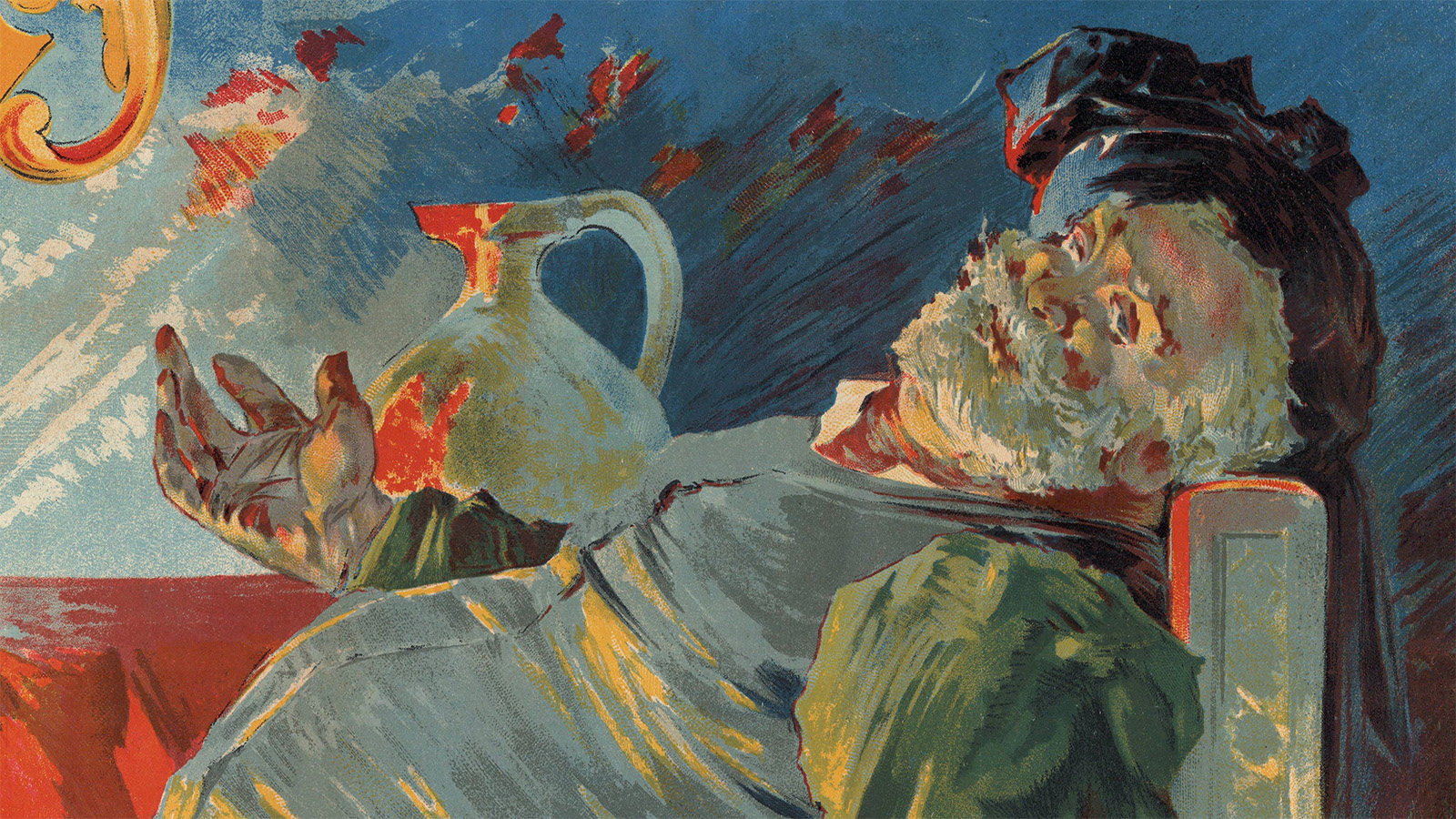 Adolfo Hohenstein (1854–1928), poster for the first French production of Giuseppe Verdi’s Falstaff, 1894 [Source].
Presented by Washington National Opera, host Saul Lilienstein takes you through the musical world of Verdi’s 1893 opera about Shakespeare’s larger than life character, Falstaff.
Watch

A quick overview of Verdi’s 1887 opera of Shakespeare’s tragedy.
A quick overview of Verdi’s 1847 opera of Shakespeare’s Scottish play.
A quick overview of Verdi’s 1853 tragic love story.
A quick overview of Verdi’s 1855 contribution to the French grand opera tradition.
A quick overview of Verdi’s 1842 opera named for Babylonian king Nebuchadnezzar II.
A quick overview of Verdi’s 1853 sprawling melodrama.
A quick overview of Verdi’s 1851 operatic masterpiece.
A quick overview of Verdi’s 1871 historical drama.
A quick overview of Verdi’s 1886 Italian translation of his 1867 passionate political love story.
Journey through the first half of opera’s third historic “phase”: the Romantic period. Learn about the cultural, economic, and political upheaval that inspired opera’s emotional U-turn, and get to know some familiar works in the canon.
Uncover the driving forces behind opera’s fiercest era, including Europe’s semi-unhealthy obsession with death, desire, and nationalist identity—all of which sparked a wild streak of artistic innovation and some truly iconic music for the stage.
A soprano is a soprano because they can sing high and a bass is a bass because they sing low, right? Not really...

Kennedy Center Education provides resources and experiences that inspire, excite, and empower students and young artists, plus the tools and connections to help educators incorporate the arts into classrooms and learning spaces of all types.


Generous support for educational programs at the Kennedy Center is provided by the U.S. Department of Education.
Gifts and grants to educational programs at the Kennedy Center are provided by The Paul M. Angell Family Foundation; Bank of America; Capital One; The Morris and Gwendolyn Cafritz Foundation; Carnegie Corporation of New York; The Ednah Root Foundation; Genesis Inspiration Foundation; Harman Family Foundation; William R. Kenan, Jr. Charitable Trust; the Kimsey Endowment; The Kiplinger Foundation; Laird Norton Family Foundation; Lois and Richard England Family Foundation; Dr. Gary Mather and Ms. Christina Co Mather; The Markow Totevy Foundation; Dr. Gerald and Paula McNichols Foundation; The Morningstar Foundation; Myra and Leura Younker Endowment Fund; The Irene Pollin Audience Development and Community Engagement Initiatives;
Prince Charitable Trusts; Dr. Deborah Rose and Dr. Jan A. J. Stolwijk; Rosemary Kennedy Education Fund; The Embassy of the United Arab Emirates; The Victory Foundation; The Volgenau Foundation; Jackie Washington; GRoW @ Annenberg and Gregory Annenberg Weingarten and Family; and generous contributors to the Abe Fortas Memorial Fund and by a major gift to the fund from the late Carolyn E. Agger, widow of Abe Fortas. Additional support is provided by the National Committee for the Performing Arts..
The content of these programs may have been developed under a grant from the U.S. Department of Education but does not necessarily represent the policy of the U.S. Department of Education. You should not assume endorsement by the federal government.


![Luigi Morgari (1857–1935), Il Trovatore poster, 19th century. Color lithograph. [Source]](/globalassets/education/resources-for-educators/classroom-resources/artsedge/media/understanding-opera/il-trovatore-169.jpg?format=webp&width=768&quality=70)

![1908 poster for Verdi's Aida, performed by the Hippodrome Opera Company of Cleveland, Ohio [Source]](/globalassets/education/resources-for-educators/classroom-resources/artsedge/media/understanding-opera/aida-2-169.jpg?format=webp&width=768&quality=70)


