The U.S. Army Strings 75th Anniversary Celebration
The U.S. Army Strings 75th Anniversary Celebration
Page Navigation
Thu. Sep. 18, 2025 7:30p.m.
Terrace Theater
-
Runtime
approx. 90 minutes
-
Price
Free
-
Ticket Limit
4
-
Program
- Jessie Montgomery: Starburst
COL Bruce R. Pulver, conductor - George Meyer: In the Wild
CPT Bonnie Alger, conductor - Tchaikovsky: Serenade for Strings in C Major, Op. 48, 1st movement
LTC Randall Bartel, conductor - Sheridan Seyfried: Homeward
COL Bruce R. Pulver, conductor - Florence Price: Andante moderato from String Quartet No. 1 in G Major
MSG Catherine Gerhiser, violin 1
SFC Judy Cho, violin 2
SSG Rebecca Barnett, viola
SFC Hrant Parsamian, cello - Rogers/Hammerstein: My Favorite Things
MSG Rob Martin, violin
SFC Jan Knutson, guitar
SSG Patrick Spallinger, bass - David Balakrishnan: Skylife
SFC Sergey Prokofyev, violin 1
SSG Jordan Hendy, violin 2
SSG Erica Schwartz, viola
SFC Aaron Ludwig, cello - Trad. Danish: Sekstur from Vendsyssel / The Peat Dance arr. Danish String Quartet
SFC Lisa Park, violin 1
SGM Matthew Evans, violin 2
SSG Austin Simmons, viola
MSG Benjamin Wensel, cello - Kurt Weill: September Song arr. SGM Alex Smith
- Carlos Almerán: Historia de un Amor arr. SGM Manny Bobenrieth
- Reinhard Mey: Über den Wolken arr. SFC Jan Knutson
SSG Peter Walker, bass - Tetsuji Hayashi: Mayonaka No Door / Stay With Me arr. SFC Jan Knutson
SSG Virginia Lafean, soprano - Samuel A. Ward: America the Beautiful arr. SFC Jan Knutson
Patrons are requested to silence cell phones and other electronic devices during performances.
The taking of photographs and the use of recording equipment are not allowed in this venue.
Terms and Conditions
All events and artists subject to change without prior notice.
This event is an external rental presented in coordination with the Trump Kennedy Center Campus Rentals Office and is not produced by the Trump Kennedy Center.
Meet the Artists
Meet the Artists
-
Colonel Bruce R. Pulver hails from Melbourne, Fla.. He holds a Bachelor of Music Education degree from the University of Southern Mississippi, where he studied conducting with Dr. Thomas Fraschillo, and a Master of Music Education degree from Old Dominion University in Norfolk, Va., where he studied with Dennis Zeisler.
Colonel Pulver has served the Nation in uniform for over 30 years. He has represented the Army in 37 countries and territories around the world, as well as in 44 of the contiguous U.S. States, plus Hawaii and Alaska.
As Leader and Commander of The United States Army Band “Pershing’s Own,” Colonel Pulver regularly performs for Presidential events at the White House, Congressional events at the U.S. Capitol, for Senior Military Leaders at the Pentagon, and Memorial services and ceremonies at the Tomb of the Unknown Soldier in Arlington National Cemetery. He led “Pershing’s Own” in historic events, including the State Funeral for President Jimmy Carter, the 60th Presidential Inauguration, the NATO 75th Anniversary Summit, and the Army’s 250th Birthday.
From 2008-2012, Colonel Pulver was Deputy Commander of the U.S. Army Field Band. During his tenure there, he performed on over a dozen national tours, at the Midwest Band & Orchestra Clinic, at the American Bandmasters Association, in a joint 4th of July concert with the Boston Pops, and at the 56th Presidential Inauguration.
From 2012-2015, Colonel Pulver commanded the U.S. Army Europe Band & Chorus in Germany. In that capacity, he performed for major international events across the European continent, including the 70th Anniversary of D-Day at Omaha Beach in Normandy, France.
From 2015-2022, Colonel Pulver served as Commandant of the U.S. Army School of Music. There, he led the Staff & Faculty in developing and delivering training to over 3,000 new Soldiers in the Active Army, Army Reserve, and Army National Guard, as well as NCO and Officer advanced courses. In 2021, Colonel Pulver was named Chief of Army Bands, responsible for overseeing all Army Bands worldwide.
Colonel Pulver has been awarded the Legion of Merit, five Meritorious Service Medals, two Army Commendation Medals, and numerous other military decorations, including the NATO Medal, the National Defense Medal with Bronze Service Star, the Outstanding Volunteer Service Medal, and the Humanitarian Service Medal. Additionally, he has earned the Air Assault Badge, Parachutist Badge, and German Schützenschnur Marksmanship Badge in Gold.
Before entering military service, he taught in the Mississippi public schools as a high school and middle school band and choral director.
Colonel Pulver and his wife, Dianne, have two children. Their daughter is a music educator in Houston, Tex., and mother to their two grandchildren. Their son is a Captain in the U.S. Army Corps of Engineers. -
A native of Marshall, Missouri, Lieutenant Colonel Bartel began his military service in 1996 with the United States Marine Corps, serving for six years as a trumpet instrumentalist with the Quantico Marine Corps Band in Quantico, VA. He holds a Bachelor of Music Education degree from Central Methodist University and a Master of Music degree in Wind Band Conducting from the University of Missouri, and served for four years as the Director of Bands at Elsberry Public Schools near St. Louis, MO.
Prior to this assignment, Lieutenant Colonel Bartel was the Commander of the United States Army Europe and Africa Band and Chorus in Germany for four years. During this time he was responsible for 700 events across 45 countries, strengthening relationships and connections over two continents, and building partnerships with 26 allied and partner militaries. He led the Band and Chorus as it performed for the 75th and 78th anniversaries of D-Day in Normandy, France, culminating with musical support for the commemoration at Normandy-American Cemetery, hosted by the Presidents of the United States and France.
Prior to this position, Lieutenant Colonel Bartel was the Commander of the United States Army Training and Doctrine Command Band at Joint Base Langley-Eustis, VA; Associate Bandmaster, The United States Army Band “Pershing’s Own”, Joint Base Myer-Henderson Hall, VA; Band Programs Officer, United States Forces-Iraq, Camp Victory, Iraq; Staff Bands Officer, U.S. Army Forces Command, Fort McPherson, GA; and Executive Officer and Associate Conductor, Army Ground Forces Band, Fort McPherson, GA.
Lieutenant Colonel Bartel attended Officer Candidate School at Fort Benning, Georgia, receiving his commission as a Distinguished Military Graduate in 2005. He was the honor graduate and recipient of the President Benjamin Harrison Medal at the Adjutant General Officer Basic Course at Fort Jackson, South Carolina, and is a graduate of Captain’s Career Course, Army School of Music and Command and General Staff College, Fort Leavenworth, KS.
His military awards include the Bronze Star Medal, Meritorious Service Medal (fourth award), Army Commendation Medal, Joint Service Achievement Medal, the German Armed Forces Proficiency Badge (Gold) and the Norwegian Militaere Marsjmerket (Bronze).
His wife of 25 years is Regina, a Personal Trainer and Fitness coach, and they have two sons, Kody, 25, and Ethan, 22
-
Captain Bonnie Alger is the Officer in Charge of The U.S. Army Chorus, the first female director in the ensemble’s history. A native of New Milford, Connecticut, she holds a doctorate in conducting from the University of Maryland - College Park, where she was a graduate assistant in the orchestra program and performing arts center. While at Maryland she sang with the University of Maryland Concert Choir in performances with the Baltimore and National Symphony Orchestras. Alger also holds a master’s degree in music education from the University of Southern California, a master’s degree in conducting from the University of Northern Iowa, and a bachelor’s degree from Lawrence University. Her dissertation focuses on the history and culture of women’s orchestras outside of the United States.
Alger has led performances with The United States Army Band “Pershing’s Own” at Fort Myer, Virginia; The United States Army Field Band at Fort Meade, Maryland; and the Training and Doctrine Command Band at Fort Eustis, Virginia. She previously served as Executive Officer for the 1st Cavalry Division Band at Fort Hood, Texas.
Prior to joining the Army, Alger maintained an active schedule as a freelance conductor, singer, violinist, clinician, educator, and arts administrator throughout the D.C. metro area, the Midwest, and Los Angeles. She also spent two years as the Director of Choral Activities at GEMS American Academy in Abu Dhabi, where her students were invited to sing at an international honor choir festival in Stavanger, Norway, as well as participate in collaborations with Philadelphia-based Orchestra 2001 and the legendary recording artist Quincy Jones. She has served as both a cover conductor and music librarian for the National Symphony Orchestra, an adjudicator for the Association of Music in International Schools, and a clinician for universities and high schools across the United States. -
Composer Sheridan Seyfried’s melodic, accessible style connects with listeners of many different musical backgrounds. Firmly grounded in classical tradition, it is also influenced by styles such as New Age, Celtic, and folk. Seyfried's orchestral, chamber, and solo works have been performed at major venues around the world (including Carnegie Hall) and have been played by some of classical music's most renowned performers, including violinists Ray Chen and Ida Kavafian, cellist Jonah Kim, pianist Orli Shaham, and clarinetist David Shifrin.
Seyfried's 2017 Double Concerto, written for violinists Nikki and Timothy Chooi, has been performed by many orchestras, including the Santa Fe Symphony and the Evansville Philharmonic (IN). It has also been broadcast nationally nearly a dozen times on American Public Media's Performance Today. His cello and piano duo Dancing in the Eye of the Storm (written for Jonah Kim) debuted in 2022 at Festival Mozaic (CA), where a reviewer called the piece “the audible incarnation of the thrilling.” Seyfried’s Sextet for clarinet, piano, and strings is frequently performed around the world, including by Belgian clarinetist Roeland Hendrikx.
Born in Philadelphia, Pennsylvania in 1984, Seyfried grew up playing violin in the Philadelphia Youth Orchestra and studying composition with James Grant. He received an ASCAP Young Composers Award in 2001, and went on to study at the Curtis Institute of Music with Richard Danielpour. Upon graduating, he received awards for excellence in both composition and music theory. Seyfried completed graduate studies at the Manhattan School of Music with Nils Vigeland. He currently lives outside Philadelphia.
-
Violinist/violist/composer George Meyer is equally interested in classical music and fiddle playing, and the music he writes draws on both sources. He has performed his own compositions in a wide variety of settings, from the Telluride Bluegrass Festival to the 92nd Street Y. He has been commissioned by Chamber Music Northwest, Katie Hyun with Astral Artists, Mike Marshall and Caterina Lichtenberg, the Aizuri Quartet, the New York Classical Players, and Bravo! Vail.
2024-2025 highlights include the premiere of a Triple Concerto for two violins and viola with Emma Frucht, Brian Hong, and George as soloists with the New York Classical Players and Dongmin Kim in four NYC concerts. Upstream, a duo project with pianist-composer Will Healy, made its Carnegie Hall debut and recorded an album of 11 original co-compositions for release Fall 2025.
Other projects include a duo with his father, bassist Edgar Meyer. They perform traditional, original, and co-written works and have also toured with Sam Bush and Mike Marshall. They will join Marshall again to tour in 2026.
He holds degrees from Harvard College and the Juilliard School, and he is faculty at Juilliard’s Extension Division. He is from Nashville, TN.
-
SSG Virginia Lafean was born in Fairfax, Virginia; following a move in 2007 to Basking Ridge, New Jersey, she completed high school at Ridge High School. She attended Indiana University Jacobs School of Music pursuing a Bachelors degree for three years when a 3-month study abroad in Scotland became a transfer to the Royal Conservatoire of Scotland in Glasgow, from which she received her Bachelors of Music and her Masters of Music in Vocal Performance. Lafean is trained in opera and classical singing, her most notable roles being Belinda (Dido and Aeneas), Adina (L’Elisir d’Amore), and Susanna (Le Nozze di Figaro). She has received several awards for her musicality and technical ability, such as the Tillet Trust Bursary Award and the Norma Grieg French Song Prize, and has sung in masterclasses with renowned singers such as Dame Ann Murray and Elizabeth Llewelyn. Lafean’s classical training serves as a foundation through which she can enjoy singing a variety of styles with sound technique; she loves performing musical theatre, art song, pop, soul, and rock, as well as many others. She is honored to serve her country as a member of the United States Army Chorus.
-
Described as a "commanding" singer by a recent Boston Globe review, and "rich voiced" and "vivid" by the New York Times, SSG Peter Walker performs with the GRAMMY-nominated Skylark Ensemble, GRAMMY-nominated Handel + Haydn Society, GRAMMY-nominated Clarion Society Choir, Kuhmo Kamarimusiiki, Staunton Music Festival, Early Music New York, Blue Heron, Texas Early Music, Pomerium, and other ensembles, and is a founder and member of Chapter House, a duo exploring the connections between storytelling and music. He is also active as a researcher of early music ranging from the Middle Ages through the eighteenth century, and has presented lectures of medieval and renaissance music at Vassar College and Case Western. Peter holds degrees from Vassar College and McGill University, where he studied with Drew Minter and Sanford Sylvan.
-
Element Leader
SGM Matthew Evans joined The U.S. Army Strings in 2007. A native of State College, Pennsylvania, he studied with James Lyon at Penn State University, and Christophe and Judy Bosua at the Ecole Suzuki School in Lyon, France. SGM Evans earned his bachelor's degree in violin performance from the University of Louisville where he studied with Peter McHugh and Paul York and was concertmaster of the UofL Symphony Orchestra under the direction of Kim Lloyd. He has been featured soloist with the Williamsport Symphony, Nittany Valley Symphony, Louisville Symphony, Sewanee Summer Music Festival Orchestra, and the United States Army Orchestra. Highlights of SGM Evans’ Army career have been performing with the Joint Forces Orchestra for President Obama's inaugural concert at the Lincoln Memorial, featuring alongside acclaimed fiddler and jazz violinist Mark O'Connor, performing the Theme from Schindler's List for six National Holocaust Museum’s Days of Remembrance Ceremonies at the U.S. Capitol, and leading the Strolling Strings during the NATO 75th Anniversary Summit in Washington, DC. Throughout his Army career, SGM Evans has held roles as strings’ adjunct librarian, supply liaison, budget NCO, Stroll Leader, and Group Leader. He currently serves as Element Leader for The U.S. Army Strings.
-
Section Leader
A native of Atlanta, GA, MSG Annette Barger began studying the violin at age 3. She joined The U.S. Army Band “Pershing’s Own” in 2005. Prior to joining, she held positions with the Hartford Symphony, the Rhode Island Philharmonic, and the New Haven Symphony. She was a violin fellow with the New World Symphony in Miami, FL, and attended numerous music festivals including the Tanglewood Music Center, Norfolk Chamber Music Festival, Kneisel Hall Chamber Music Festival, Pacific Music Festival in Sapporo, Japan, and Spoleto Festival in Charleston, SC. Barger has been a featured soloist with The U.S. Army Band and Orchestra including performing John Williams’ “Schindler’s List” in the Capitol Rotunda for the “Days of Remembrance” Holocaust ceremony, Mozart’s Sinfonia Concertante, Bach’s Concerto for Two Violins, and Vivaldi’s Four Seasons.
-
Group Leader / Stroll Leader
A native of Gulph Mills, PA, MSG Robert Martin began violin studies at age three with Rochelle Walton, a former teaching assistant to famed pedagogue Ivan Galamian. He later studied with Julian Meyer and Sylvia Davis Ahramjian at Temple University's Center for Gifted Young Musicians. At age 12 he won the Albert M. Greenfield Competition and made his solo debut with the Philadelphia Orchestra. MSG Martin went on to study with Zvi Zeitlin at the University of Rochester’s Eastman School of Music where he served as Concertmaster of the Eastman Philharmonia and performed regularly with the Rochester Philharmonic Orchestra. He has been a resident artist at the Music Academy of the West in Santa Barbara, California, and at the Bravo! Vail Valley, Skaneateles, and Vermont Mozart festivals. A member of The U.S. Army Strings since 2011, MSG Martin has performed at numerous high level diplomatic, political, and military events in Washington, D.C. During his time at the U.S. Band “Pershing’s Own” he has held positions as Concertmaster of the U.S. Army Orchestra, Adjunct Librarian, Training NCO, Combatives Instructor, and Section Leader. MSG Martin currently serves as Group Leader and Stroll Leader for the U.S. Army Strings. He serves concurrently as Concertmaster of the Maryland Symphony Orchestra where he has appeared many times as soloist, and previously served as Principal Second Violin of the Chamber Orchestra of Philadelphia.
-
Section Leader
MSG Catherine Gerhiser, a native of Savannah, Georgia, received her bachelor’s degree from the Juilliard School in 2005, and her Master’s in 2007, studying with Masao Kawasaki. Prior to her time at The Juilliard School, she attended the Cleveland Institute of Music Young Artist Program, studying with Linda Cerone. Her many inspiring coaches and teachers include Michael Tilson Thomas, Joseph Kalichstein, Joel Smirnoff, Bonnie Hampton, and John Mack, among others. Gerhiser has performed with the Tanglewood Music Festival, Music Academy of the West, National Repertory Orchestra, and Spoleto Festival Orchestra. Gerhiser has appeared as soloist with the Savannah Symphony, the Hilton-Head Philharmonia, the National Repertory Orchestra, The New World Symphony, and the US Army Orchestra. Prior to joining the Strolling Strings, Gerhiser spent four years in Miami, Florida, playing with the New World Symphony, where she met her husband, Gene. Gerhiser loves exploring DC with her husband and three sons.
-
SFC Judith Cho actively performs in the Washington, DC Metropolitan area on violin and viola. She studied with Itzhak Perlman and Masao Kawasaki at Brooklyn College and the Graduate Center of the City University of NY. She worked with violist Emanuel Vardi at the Manhattan School of Music and SUNY Purchase. She has done orchestral, chamber and solo concerts at Carnegie Hall, Avery Fisher Hall and at the Kennedy Center. With cellist husband, David Cho, she collaborates in chamber and concerto performances. They reside in McLean, Virginia with their two children.
-
SFC Sergey Prokofyev was appointed to his position in The U.S. Army Band "Pershing's Own" in 2015. Originally from Saint Petersburg, Russia, he began his violin studies there at the age of 5 with notable teacher Irina Svyatlovskaya of the St. Petersburg Conservatory. In 1998, Prokofyev and his family immigrated to the United States where he continued his studies in New York City, first attending Kaufman Center’s Special Music School, and later graduating from LaGuardia High School of Music & Art and Performing Arts, and the Juilliard School’s Pre-College Division. He received his Bachelor of Music in Violin Performance from the Aaron Copland School of Music at Queens College in Flushing, New York, where he studied under Professor Daniel Phillips.Prior to joining “Pershing’s Own”, Prokofyev pursued an active and versatile career as a freelance musician in New York. He served as Concertmaster of the New Amsterdam Symphony Orchestra, was a member of the string ensemble Bachanalia led by world renowned violinist Nina Beilina, and is a charter member of the Tsenov Chamber Ensemble. He has performed concerts with the New Britain Symphony Orchestra (CT) and the Musical Olympus Festival Orchestra (NY). In 2014, Prokofyev toured Europe and Russia as a guest member of New York’s BARD College Conservatory Orchestra under the direction of Leon Botstein. Earlier that year, he toured China as a member of the Manhattan Symphonie Orchestra under the direction of Gregory Singer. Prokofyev recently made his new music debut with InnoVax, a contemporary music ensemble based in New York, and made his international debut in 2015 at the National Concert Hall in Taipei, Taiwan.
-
SFC Lisa Park received a B.A. in Psychology and was awarded the Hastings Prize in Musical Performance at Harvard University. Park performed with the Ying Quartet at Harvard and studied at the Eastman School of Music for one year. She received an M.M. from Rice University and a Performer’s Diploma from Southern Methodist University while serving as undergraduate violin instructor. Her teachers include Roman Totenberg, Emanuel Borok and Cho-Liang Lin. She has served as concertmaster of ensembles including the Castleton Festival Orchestra under the late Lorin Maazel, National Orchestral Institute under David Robertson, Arlington Philharmonic, New Orchestra of Washington, and Rockville Bach Academy. Park has performed as featured soloist with the New England String Ensemble on the Boston Esplanade, The U.S. Army Orchestra, Harvard Bach Society Orchestra, Wellesley Symphony, and Boston Civic Symphony. Park received fellowships from the Aspen Music School, Kneisel Hall Chamber Festival, Moritzburg Academy, and was artist-in-residence at Atlantic Music Festival. As a proponent of new music, she has performed with contemporary ensembles including the 21st Century Consort at the HirshhornMuseum. Park was the first placing violinist in the USA International Music Competition and New England String Ensemble Competition and was recipient of the Volkswagen Prize for Best Chamber Music Performance (Moritzburg Academy). Prior to joining the U.S. Army Strings in 2015, Park served as Professor of Violin and Music Theory at Richland College in Dallas, TX. An active educator, Park has served as an adjudicator at local concerto competitions. She is a member of the Pi Kappa Lambda music honor society.
-
SSG Patrick Lin was born in Buffalo, NY, and grew up in Fargo, ND, where he began studying violin at the age of 7 with Mary Weisser and Jane Linde Capistran. He continued his studies at The Florida State University (Bachelor of Music 2015) with Dr. Benjamin Sung and the Cleveland Institute of Music (Master of Music 2018) with William Preucil. Patrick joined The U.S. Army Strings in February of 2019. Previously, he lived in Honolulu, HI, where he was a member of the Hawai'i Symphony Orchestra and performed with Hawai'i Opera Theatre and Ballet Hawai'i. Patrick has also performed with the Baltimore Symphony, Charleston Symphony, and Louisiana Philharmonic Orchestras and has attended festivals around the country, including the Britt Music and Arts Festival (OR), Lexington Bach Festival (MI), National Repertory Orchestra (CO), and Spoleto Festival USA (SC).
-
Assistant Concertmaster
SSG Jordan Hendy was born in Chertsey, England, and grew up in Berkeley Heights, NJ where he started playing the violin and piano at age 7. He received both his bachelor's and master's degrees from The Juilliard School, studying violin performance under Li Lin and Naoko Tanaka. Hendy attended numerous music festivals including the Heifetz International Institute, New York String Orchestra Seminar, and the Tanglewood Music Center from 2017-18 before joining The U.S. Army Strings in 2019. Hendy enjoys teaching violin, piano and viola at his private studio in Springfield, Virginia. He also loves playing tennis and collaborating in chamber performances.
-
Concertmaster
SSG Charles Gleason grew up in Columbus, OH, where he studied violin extensively with Stephen Sims, adjunct professor at the Cleveland Institute of Music, and Christian Howes, Columbus-based jazz violinist. He later pursued his bachelor’s degree at the Cleveland Institute of Music, studying with David Updegraff and later Joan Kwuon. As a participant in CIM’s Intensive Quartet Seminar, led by Peter Salaff and the members of the Cavani Quartet, his quartet was a semifinalist in the Fischoff National Chamber Music Competition and performed as part of the Kennedy Center Conservatory Project in Washington D.C. Gleason went on to pursue his master’s at Rice University’s Shepherd School of Music, studying with Cho-Liang Lin. Apart from school, he has participated in summer festivals and workshops that include the Verbier Festival Orchestra, the Lucerne Festival Academy, the Madeline Island Chamber Music Festival, and the Juilliard String Quartet Seminar. Gleason graduated from Rice in 2020, and after a year away from school, he joined the U.S. Army Strings in June of 2021.
-
SSG Freya Liu grew up in San Jose, CA, where she studied violin with Wei He. She earned her bachelor’s at Boston University, where she studied with Bayla Keyes, founding member of the Muir String Quartet. Liu went on to pursue her master’s at Yale University, studying with Tai Murray. Before joining the band, she was a violin fellow at the New World Symphony in Miami Beach, FL, and has been a part of numerous summer festivals and workshops, including the Lucerne Festival Academy, Music Academy of the West, the Spoleto Festival in Charleston, SC, and the Schleswig-Holstein Musik Festival.
-
SSG Erica Schwartz is originally from Albany, New York. She holds a B.M. from the New England Conservatory, B.A. in Political Science from Tufts University, and a Master of Music from Rice University. An active orchestral musician, she has appeared as a substitute violist with the National, Houston and Baltimore Symphonies and the Washington National Opera. She was the winner of a contract with the Des Moines Metro Opera Orchestra prior to joining "Pershing’s Own". Career highlights include performances of the solo viola role in Strauss’s Don Quixote at Rice University, and participation in the New York Philharmonic Global Academy Program, which allowed her to perform as a substitute with the New York Philharmonic. Schwartz has appeared at festivals such as the Pacific Music Festival, Tanglewood Music Center, Kneisel Hall, Bowdoin and the Banff Centre Chamber Music Residency. In addition to performing, Schwartz has held several administrative positions, including internships with the early music ensemble Handel and Haydn Society and at the Massachusetts State House. She maintains a private studio in Northern Virginia. Her primary teachers include Roger Tapping, Dimitri Murrath, Ivo-Jan Van der Werff and Joan DerHovsepian. In her free time, Schwartz enjoys hiking, reading, photography, and cooking with friends.
-
SSG Rebecca Barnett, from Baltimore, Maryland, joined the U.S. Army Strings in 2022. She received her bachelor's degree from the University of Maryland, College Park in 2018, and her master's Degree from Rice University in 2020. Her primary teachers were Katherine Murdock and Ivo Jan van der Werff. Barnett has performed as a soloist, chamber musician, and orchestral musician at concerts all over the United States. She has appeared at music festivals such as the Kneisel Hall Chamber Music Festival, Bowdoin International Music Festival, Innsbrook Summer Academy and Festival, National Symphony Summer Music Institute, Mendocino Music Festival, Colorado College Music Festival, and the Texas Music Festival. In addition, she has made multiple appearances at the Kennedy Center for various chamber music performances. As a soloist, she performed Mozart’s Sinfonia Concertante with the Montgomery College Orchestra. Further, she was a finalist in the University of Maryland Concerto Competition in both 2016 and 2017, for her performances of the Bowen and Rozsa viola concertos. She was also a prize winner in the 2015-16 EnKor International Music Competition for Strings. Barnett maintains an active private teaching studio from her home studio in Maryland. In her spare time, Barnett loves cooking, gardening, and walking.
-
SSG Austin Simmons grew up in Arlington, Texas, so he is both pleased and amused that fate led him to a career in Arlington, Virginia. Before joining The U.S. Army Strings in 2022, Simmons earned both his Bachelor and Master of Music degrees in viola performance from Rice University in Houston, Texas, where he studied with Ivo-Jan van der Werff. Throughout his musical education, Simmons enjoyed a number of artistic collaborations. Most notably, as a seasoned string quartet musician, he was invited to join Madeline Island Chamber Music’s Quartet in Residence program in 2018, where he performed the works of Hadyn and Britten across the Twin Cities. Additionally, with musical interests branching outside the realm of classical music, Simmons has played alongside artists such as Hungarian pianist Balázs Havasi and Colombian singer Fonseca. When he isn't making music, Simmons enjoys cooking, lifting weights, and dabbling in game design.
-
SSG Julia Clancy joined The U.S. Army Band “Pershing’s Own” in 2024 after serving as acting section violist in the San Diego Symphony. Prior to this appointment, she performed as a regular substitute in the Nashville Symphony, Fort Worth Symphony, and Dallas Symphony. As a member of the West Eastern Divan Orchestra, she performs across the globe under the direction of Daniel Barenboim. Prior to the 2020 pandemic, she was serving a two-year contract at the Deutsche Staatsoper in Berlin, performing opera, ballet, symphonic and chamber music. She can be heard on multiple albums with the Boulez Ensemble, Konzerthaus Orchestra, Staatskapelle Berlin, and Aldeburgh Ensemble. As a soloist, she has performed at 92Y, TheGreene Space, National Sawdust, LACMA, and venues across Germany, Austria, Switzerland, and Spain. After winning the Cleveland Institute of Music’s concerto competition, she performed with the school’s orchestra as a soloist. She has acted as principal violist in Krzysztof Penderecki’s festival orchestra, Britten-Pears Orchestra, Yale Philharmonia, Sarasota Festival Orchestra, CityMusic Cleveland, Moritzburg Festival Orchestra, and Lorin Maazel’s Castleton Festival Orchestra. Julia’s early musical education began at the Juilliard School’s Pre-College program. She holds a degree in medical anthropology from Case Western Reserve University and a degree in music from the Cleveland Institute of Music where she studied with Jeffrey Irvine, Lynne Ramsey and Robert Vernon. Julia received her master’s and doctoral degrees from Yale University, where she was a two-time winner of the Georgina Lucy Grosvenor Memorial Prize.
-
Section Leader
A native of Western New York, MSG Benjamin Wensel earned degrees from the Cleveland Institute of Music and Eastman School of Music, where he served as assistant to renowned pedagogue Alan Harris. Equally important to his musical education were performances in seminars and master classes for members of the Cleveland, Guaneri, Juilliard, Miami and Ying quartets; chamber music studies with Peter Salaff and members of the Audubon and Cavani Quartets; and solo master classes with David Soyer, Clemens Michael Hagen, Steven Isserlis and Michel Strauss. Wensel has performed with the Baltimore Symphony Orchestra, National Symphony Orchestra, ProMusica Chamber Orchestra, Rochester Philharmonic, Syracuse Symphony, and has been a member of The U.S. Army Strings, Orchestra and String Quartet since 2003. Additionally, Wensel appears with many of the fine local ensembles in the National Capital Region. Dedicated to the creation and promotion of new music, Wensel performed the world premieres of more than 20 works written by established and emerging American composers as a founding member of the Tarab Cello Ensemble and participated in the ensemble’s residencies at Princeton University, Stetson University, and the University of South Florida. He currently coaches for the 9th Street Chamber Music, Quartet Intensive program as well as maintaining a private studio in Fairfax, Virginia. Grateful to be an active member of the innovative arts community of the Capital region, Wensel performs regularly as the cellist of the Mellifera Quartet. He can be heard on recordings produced by Bridge, Delos, Harmonia Mundi, RM Records, and Summit.
-
SFC Hrant Parsamian has been a prize winner in international competitions including the Houston Symphony Ima Hogg Competition, the Montgomery Symphony Fellowship, the Olga Koussevitzky Competition, the HAMS Cello Competition, and the Hudson Valley String Competition. He has appeared in venues such as Weill Recital Hall, Alice Tully Hall, Banff Center for the Arts, and the Orford Festival. His collaborations include Hans Graf, Carlos Prieto, Vladimir Ashkenazy, Zakhar Bron, Natalya Shakhovskaya, Franz Helmerson, Richard Watkins, and Oxana Yablonskaya. Parsamian is a member of the Arsenal Trio together with violinist Benjamin Sung and pianist Jihye Chang Sung. As a teacher he has given studio and master classes at Yale University and The William Blount-Slawson Competition, among others. Born in Bulgaria, Parsamian started the cello at an early under the guidance of his mother. His first recital was at the age of six. Two years later he gave his debut as a soloist performing C.P.E. Bach’s Cello Concerto. Parsamian holds bachelor degrees from The Hochschulle fur Music in Wien, The Juilliard School, and received his Masters of Music from Yale School of Music where he studied with world renowned cellist Aldo Parisot. In 2010, Parsamian won a position with The U.S. Army Band "Pershing's Own" and married pianist Tatjana Parsamian. He is the proud father of a son, Benjamin.
-
From St. Louis Missouri, SSG Aaron Ludwig’s varied career includes performing chamber and orchestral music with some of the world’s leading musicians. As a fellow of the New World Symphony, Ludwig performed as principal cellist of the orchestra with conductors including Michael Tilson Thomas, Stéphane Denève and Osmo Vänskä. For the Tanglewood Music Center Orchestra, Ludwig served as principal cellist for the 75th anniversary performance of Mahler's Eighth Symphony, conducted by Boston Symphony's Andris Nelsons. As a chamber musician, Ludwig co-founded Trio Lunaire, a piano trio that performed and competed internationally including ARD Munich's Piano Trio Competition in Germany. He also performed Beethoven's "Archduke Piano Trio" with Yefim Bronfman.Before joining the Army Strings, Ludwig had a unique position with the Arkansas Symphony and Rockefeller String Quartet that involved performances at schools and performance spaces all around the state of Arkansas. While living in Arkansas, Ludwig was an Instructor at Hendrix College.
-
SSG James Hettinga, an Ohio native, began studying cello at four years old. Throughout his childhood, he performed regularly in his community alongside his four older siblings, giving him a love for sharing music with others. Hettinga was a member of the Cleveland Orchestra Youth Orchestra during high school with whom he made his concerto debut at Severance Hall. In his junior year, Hettinga joined the prestigious Young Artist Program at the Cleveland Institute of Music where he studied with Dr. Melissa Kraut. Through this program, Hettinga’s quartet won the Silver Medal in the Junior Division at the 2018 Fischoff National Chamber Music Competition. Hettinga was a prizewinner of both the renowned Klein International String Competition and the Mondavi Center National Young Artist Competition in 2019. He also was a winner of the CIM Concerto Competition and was given an honorable mention in the 2020 Schadt String Competition. He completed his bachelor’s degree at CIM with academic honors in the spring of 2021. Hettinga has had the privilege of performing with distinguished musicians including Jinjoo Cho, Matthew Allen, members of the Cavani and Ariel String Quartets, and cellists of The Cleveland Orchestra. In his free time, he enjoys hiking, playing guitar, and exploring the D.C. area with his wife.
-
Principal Arranger
SFC Jan Knutson, guitarist, has been a member of The U.S. Army Band “Pershing’s Own” since August 2018. Prior to joining “Pershing’s Own” at the age of 19, he attended the Manhattan School of Music as a student of Rodney Jones. He also studied with Steve Abshire, Frank Vignola, Martin Taylor, Peter Bernstein and Paul Wingo. At the age of 15, he recorded his solo CD album, “Out of Nowhere.” At the age of 16 he was selected as a Strathmore Artist in Residence and presented several concerts throughout the year and recorded his second album, “Looking Both Ways,” featuring guitarist Steve Abshire, bassist Tommy Cecil, and mandolinist Danny Knicely. Knutson has been a featured artist at several jazz festivals including Richmond Folk Festival, True Blue Jazz Festival, Syracuse JazzFest, and Savannah Folk Festival. Knutson has also performed at premier venues such as the Kennedy Center Millennium Stage, The Iridium, and the Capitol Theatre in Salt Lake City. He has performed with some of the world’s greatest guitarists including Julian Lage, Bucky Pizzarelli, Frank Vignola, Gene Bertoncini, and Martin Taylor. Knutson is a native of Berwyn Heights, MD, and graduated from the Science and Technology Program at Eleanor Roosevelt High School.
-
Born and raised in Lansdale, Pennsylvania, SSG Pat Spallinger joined The U.S. Army Band “Pershing’s Own” in August of 2024. Formerly an active freelancer in the greater Pittsburgh region, he has performed regularly with the Wheeling, Canton, and Johnstown Symphony Orchestras. He enjoys exploring the role of the bass in many different genres and has been a member of the funk quintet Pryzem and half of the folk/bluegrass duo MonRye. He has also recorded a pair of albums with Pittsburgh-based worship leader and songwriter Daniel Snoke. Pat has degrees from Duquesne University, Carnegie Mellon University, and most recently Indiana University, studying primarily with Jeffrey Mangone, Micah Howard, and Jeffrey Turner. When not playing the bass, he enjoys attending church, drinking good whiskey, walks in the woods, and enthusiastically supporting his hometown Philadelphia sports teams with his wife.
-
SFC Kristopher Keeton is a percussionist with The U. S. Army Concert Band. Prior to joining “Pershing’s Own,” Keeton held the position of Coordinator of Percussion/Assistant Professor of Music at both the University of North Carolina at Greensboro and at Virginia Commonwealth University. As a performer and soloist, he has appeared at Carnegie Hall, at numerous Percussive Arts Society International Conventions and in Europe with the virtuoso Swedish percussion ensemble, Global Percussion Network. He is a former percussionist with the Winston-Salem Symphony, Eastern Philharmonic Orchestra, Civic Orchestra of Chicago, Owensboro Symphony Orchestra and Phantom Regiment Drum and Bugle Corps. As an educator and clinician, Keeton has appeared throughout the U.S. and in Europe, including music festivals and conferences, universities, the Percussive Arts Society International Convention and state Days of Percussion, as well as the internationally renowned Midwest Clinic. Keeton received a Doctorate of Music and a Master’s degree in Percussion Performance from the Northwestern University Beinen School of Music. His bachelor’s degree is in Percussion Performance from Western Kentucky University. He has studied with acclaimed percussionists Christopher Norton and Michael Burritt, James Ross of the Chicago Symphony, and drum set artists Chester Thompson and Paul Wertico.
Program Notes
The U.S. Army Strings
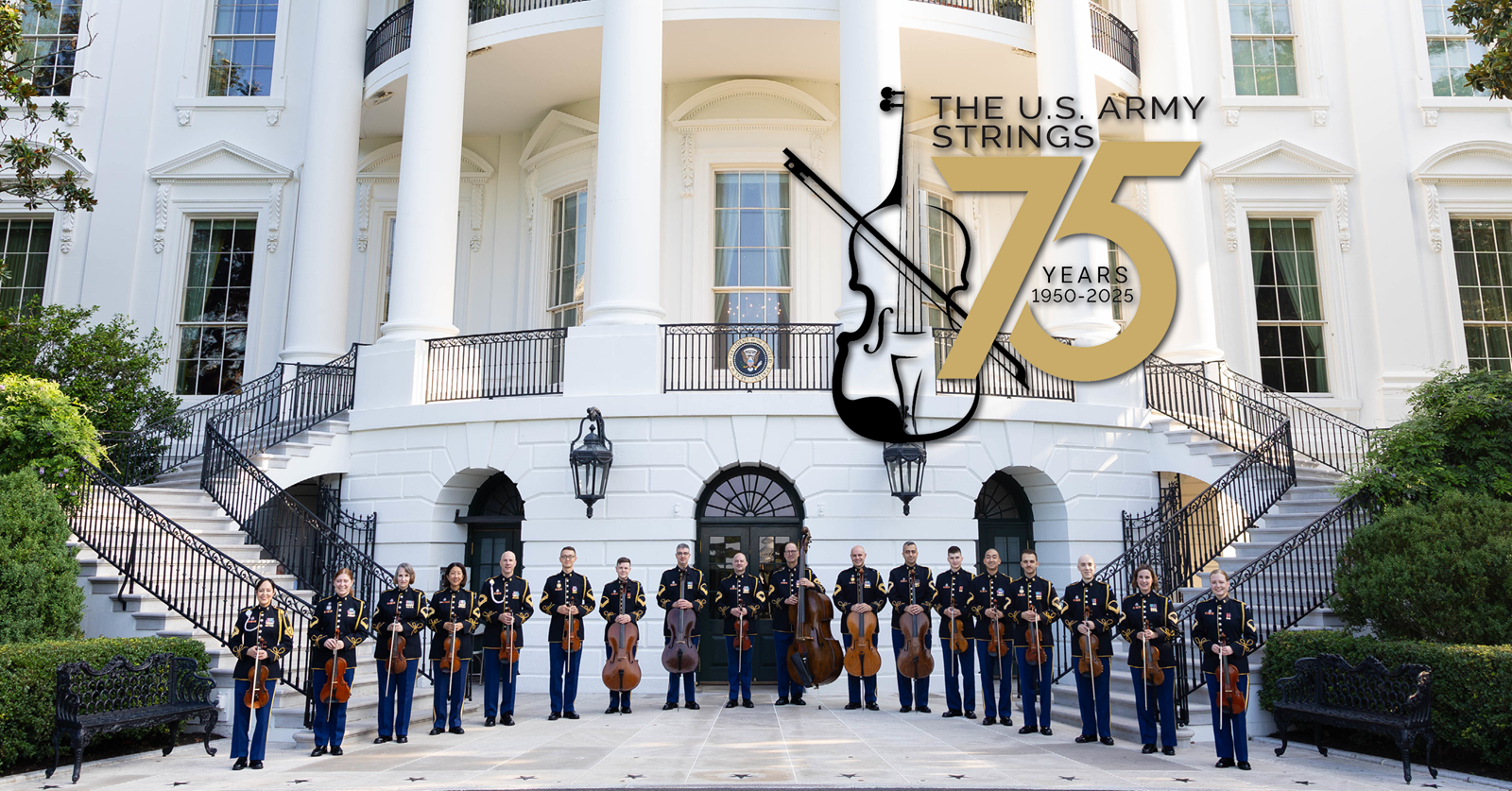
The U.S. Army Strings, a premier ensemble of the U.S. Armed Forces, provide a musical backdrop for many of the country’s most notable events. Their mission is to serve as musical ambassadors for high-level military and government events at home and abroad, as well as in concert for public audiences. The Soldiers who comprise this ensemble have been trained at the most prestigious music conservatories and universities in the country. This versatile ensemble performs as The U.S. Army Strolling Strings, in mixed chamber ensembles, and as The U.S. Army Orchestra.
The U.S. Army Strolling Strings are one of the most requested musical ensembles by our nation’s military leadership. Since its inception during the Eisenhower administration, the group has provided musical entertainment at the White House for every president. Missions include performing for the Department of Defense, the U.S. Capitol, the Supreme Court, kings, queens, and heads of state from countries worldwide. The Strolling Strings offer audiences the unique perspective of being within the ensemble as Soldiers elegantly move about the venue playing their instruments. The Strolling Strings offer a wide array of memorized repertoire, including patriotic, classical, international, jazz, Broadway, bluegrass, and exclusive music arrangements for special guests and events.
Chamber music is a core element of The U.S. Army Strings’ mission. String quartets provide a backdrop for significant official functions as well as public performances. Duos, trios, quartets, and mixed chamber ensembles perform in venues throughout the National Capital Region.
The U.S. Army Strings join with Soldiers from other elements of The U.S. Army Band “Pershing’s Own” to form The U.S. Army Orchestra. This group performs musical works from a diverse repertoire at some of the nation’s finest venues, including the John F. Kennedy Center for the Performing Arts in Washington, DC, Lincoln Center in New York City, the Music Center at Strathmore in Bethesda, Maryland, the Clarice Smith Performing Arts Center at Maryland, College Park, and the Rachel M. Schlesinger Concert Hall and Arts Center in Alexandria, Virginia.
Jessie Montgomery: Starburst
Commissioned by the Sphinx Organization, Jessie Montgomery wrote Starburst in 2012. This one-movement piece for string orchestra is a brisk and exuberant trek through the cosmos. While grounded in the classical tradition, Starburst takes fresh and unexpected detours. Montgomery describes the work as a “play on imagery of rapidly changing musical colors” inspired by the phenomenon of a starburst--the rapid formation of new stars in a galaxy. Taking off with a low growl in the cellos, the line quickly ascends to the reaches of the violin’s upper register. The sparkling ostinato in the upper strings depicts travel through time and space. Montgomery’s study of film scoring reveals itself in this work: so illustrative of outer space, the listener isn’t merely looking through a telescope, she is soaring amongst the stars.
George Meyer: In the Wild (2025)
From the composer:
Sam Bush is one of my favorite fiddle players, and the opening of this piece puts a little of what I've learned from his playing into practice. I tried to borrow from and imitate his powerfully, joyfully rhythmic use of the bow, and what I understand of his superior note choice informs mine. I also borrowed a small melodic idea from Richard Thompson's "1952 Vincent Black Lightning," a song I grew up hearing in the extraordinary Del McCoury Band recording from 2001.
It is wonderful to work with the fine players of the Army Strings, with whom I share a love for all kinds of American music. I am honored to present this piece in celebration of their 75th Anniversary.
Tchaikovsky: Serenade for Strings in C Major, Op. 48, 1st movement
Tchaikovsky wrote the Serenade for Strings in the fall of 1880 and was already an internationally celebrated composer with symphonies, concertos, operas, and a great variety of other pieces to his credit. He wrote to his patroness, Nadezhda von Meck: “My muse has been so kind that in a short time I have got through two long works: a big festival overture for the Exhibition, and a serenade for string orchestra in four movements. I am busy orchestrating them both.” The first piece was the bombastic 1812 Overture known for its programming on 4th of July concerts; the second was the charming Serenade for Strings, which he described as “a piece from the heart.” From its early sketches, Tchaikovsky believed the work would take shape as a symphony or string quartet but diverted the undertaking to a string serenade. At the time, a “serenade” was commonly known as an “evening piece” to be performed on quiet and pleasant nights for aristocrats, much like Mozart’s famous Eine Kleine Nachtmusik. He confided in Nadezhda von Meck that the first movement of the Serenade was his “homage to Mozart; it is intended to be an imitation of his style, and I should be delighted if I thought I had in any way approached my model.” Tchaikovsky went on to conduct the work throughout Europe, with performances in Prague, Paris, London, Geneva, and Berlin, and multiple times during his 1891 tour of America.
Sheridan Seyfried: Homeward (2025)
From the composer:
It's often the case that, when composing, I write the music first and only come up with the title afterwards. Instrumental music seems to have its own sort of internal logic - its own language that doesn't need justification by other means. However, I don't object to a title if it gives the listener a reasonably good metaphor by which to comprehend the music. As I searched for such, I went over the piece many times, noticing its qualities: a feeling throughout of pulsing energy and excitement, a hint or two of danger along the way, a tranquil episode in the middle (perhaps a meadow scene?) and, eventually, a joyous conclusion. I imagined the piece could represent a journey home - motivated by a desire to be reunited with loved ones, or to see a cherished place again, we press on with determination in the face of challenges, and with joy in our hearts.
Florence Price: Andante moderato from String Quartet No. 1 in G Major
In 2009, while renovating a long-abandoned house outside of Chicago, a couple uncovered boxes of music manuscripts bearing the name “Florence Price.” Curious about the unfamiliar name, they investigated and discovered that their summer home had once belonged to a trailblazing composer: the first black woman to have a work performed by a major American orchestra, the Chicago Symphony. Hidden for over half a century, the manuscripts revealed a courageous artist who carved a path through the barriers of her time, leaving behind a trove of work only now beginning to receive its due. Price had grown up in the relatively cosmopolitan Little Rock, Arkansas, where a vibrant Black community thrived despite the increasingly oppressive reign of Jim Crow laws. She attended the New England Conservatory, one of the only major music schools that accepted black students at the time. After a brief period of study at the Chicago Musical College, Price recognized the city as a place where she could both advance her musical ambitions and escape the escalating racial violence in Little Rock—including lynchings and attacks that had reached her own neighborhood. In 1927, she and her family joined the Great Migration, part of the vast movement of black Americans fleeing the oppression of the South in search of safety and opportunity in the North. She arrived in the Windy City on the cusp of the Black Chicago Renaissance, a flourishing of black cultural and intellectual life that would shape the city for decades to come.
Tonight you will hear the “Andante,” movement of her first quartet, written shortly after settling in Chicago. All four instruments open the movement warmly, like sunshine slowly unfurling. The mischievous middle section hearkens a summer night of dance and stargazing. We return where we started: somewhat heartsick, yet content.
Rogers/Hammerstein: My Favorite Things
While the durability of My Favorite Things may be attributed to the success of the 1965 film The Sound of Music, the steady stream of artists recording their own renditions of the work have kept it both alive and relevant.
Hammerstein wrote the lyrics over the course of a few days in 1959, for the original Broadway musical. With Rodgers’ melody, timeless yet malleable, the song began to genre-bend. John Coltrane recorded an album in 1960 with his own jazz rendition of the tune. It became a Christmas staple in 1964, when pop singer Jack Jones became the first to feature it on a Christmas album, at the urging of film executives hoping to generate buzz ahead of the movie’s release. Their suggestion: “Just add sleigh bells.”
The jazz trio’s rendition of “My Favorite Things,” is effervescent and cool; the tunes’ long phrases unleash improvisations that demonstrate how a show tune can be stretched into a canvas for jazz exploration.
David Balakrishnan: Skylife
Skylife is a genre-blurring single-movement work for string quartet composed by David Balakrishnan, founder of the Turtle Island String Quartet. Written in the early 1990s, this groove-driven piece draws on Balakrishnan’s diverse musical background, blending elements of jazz, classical, folk, and world music. Skylife embodies the quartet’s mission to expand the string quartet tradition beyond its European classical roots.
The piece begins with a solitary violin laying down a syncopated rhythmic figure, soon joined by a wicked viola solo that sounds like it’s doing its best impression of an electric guitar. Unconventional techniques and stylistic shifts challenge the performers both technically and expressively, pushing the boundaries of what a string quartet can sound like. Though fully notated, Skylife maintains a spontaneous energy that evokes the feel of a jazz combo, with each instrument contributing its individual voice to the ensemble’s musical dialogue.
Sekstur from Vendsyssel - The Peat Dance
This piece comes from Wood Works, an album of Nordic folk tunes arranged and performed by The Danish String Quartet. Though the ensemble describes itself as “first and foremost a classical string quartet,” they exploded in popularity after digging into the roots of their local folk music tradition. Wood Works marked their first foray into this folk-inspired repertoire, bringing a fresh sound to the concert stage by pairing old Nordic fiddle melodies with newly imagined accompaniment.
The first part of this piece is based on Den Topped Høne (The Topped Hen), which is one of the most popular tunes from the Vendsyssel area of Northern Denmark. It’s a Sekstur (six tour), which is a jaunty dance bearing a close resemblance to the Irish jig. The second section is based on Tørvedansen (The Peat Dance), which is a Danish reel from the Roskilde area near Copenhagen.
September Song
September Song is a ballad composed by Kurt Weill with lyrics by Maxwell Anderson. Originally written in 1938 for the Broadway musical Knickerbocker Holiday, the song was created specifically for actor Walter Huston, whose limited vocal range shaped its slow, deliberate style. Though Knickerbocker Holiday itself had a modest run, September Song quickly outshone the show, becoming a beloved standard in the Great American Songbook. The lyrics use the metaphor of the changing seasons to convey the urgency of love in life’s later years. The song’s most famous line, “Oh, it’s a long, long while from May to December, but the days grow short when you reach September,” captures a bittersweet awareness of life’s brevity and the desire to make the most of the time that remains. This arrangement, by Army Strings alumnus and accordionist Alex Smith, is a favorite in our repertoire for its ability to evoke the elegant, sophisticated sound for which the Strolling Strings are known.
Historia de un Amor
Historia de un Amor ("Love Story") is a bolero written in 1955 by Panamanian songwriter Carlos Eleta Almarán. The song was inspired by personal tragedy, as Almarán composed it following the death of his brother’s wife. The lyrics tell the story of a man mourning the loss of a great love, capturing the raw anguish of heartbreak with lines such as: “And if I can’t see you anymore, why did God make me love you? To make me suffer more.” The song first gained international recognition as part of the soundtrack to the 1956 Mexican film Historia de un Amor, starring Libertad Lamarque, and it has since been translated and performed in dozens of languages around the world. This version of the song was arranged by alumnus and accordionist Sergeant Major (ret) Manuel Bobenrieth, and it is a classic of our repertoire.
Über den Wolken
Released in 1974 by German singer-songwriter Reinhard Mey, Über den Wolken ("Above the Clouds") is one of the most popular modern folk songs in the German-speaking world. Its iconic chorus line, “Über den Wolken muss die Freiheit wohl grenzenlos sein” (“Above the clouds, freedom must be limitless”) has become a well-known phrase in Germany. Mey, who earned his pilot’s license in 1973, was inspired to write the song based on the feelings of peace and perspective he experienced while flying. The lyrics describe how “all fears and sorrows … are hidden below [the clouds] and then everything that had appeared so big and important suddenly feels vain and small.”
SFC Jan Knutson wrote this arrangement for a private diplomatic event recently, during which the Chief of Staff of the Army, General Randy A. George, hosted German military leaders at his residence in Fort Myer. Sung by SSG Peter Walker, Über den Wolken served as a fitting tribute to our guests and its uplifting message helped set the stage for strong diplomatic relations between America and Germany.
Mayonaka No Door / Stay With Me
Mayonaka no Door, known to Western audiences as “Stay With Me,” is the 1979 debut single of Japanese singer Miki Matsubara. The song’s music was composed by Tetsuji Hayashi, working in the then-emerging style of “new music,” a genre which took inspiration from Western pop, jazz, funk, and disco. With its infectious groove and soulful vocals, Mayonaka no Door has long been a favorite in Japan, but in 2020, it experienced a global resurgence when it went viral on social media, making it an international hit 41 years after its release.
Army Strings guitarist SFC Jan Knutson wrote this arrangement for a private diplomatic dinner hosted by the Chief of Staff of the Army, General Randy A. George at his quarters in Fort Myer, VA in honor of Japanese military leaders. Sung by SSG Virginia Lafean, Mayonaka no Door is an excellent example of the Army Strings’ unique mission as musical diplomats supporting an atmosphere of connection between America and counterpart countries.
America the Beautiful
The lyrics for America the Beautiful were written in 1893 by Katharine Lee Bates, a poet and professor who was inspired by the sweeping views from Pikes Peak in Colorado. Her words reflect a deep reverence for the country's physical grandeur as well as the ideals of unity, humility, and grace. The music, composed by Samuel A. Ward in 1882, was originally intended for a hymn titled Materna. When paired with Bates’ poem several years later, the result was a hymn-like anthem that quickly captured the American imagination. Unlike the more martial tone of The Star-Spangled Banner, America the Beautiful offers a more contemplative vision of patriotism. This arrangement by SFC Jan Knutson brings a fresh artistic perspective to the classic. Sophisticated harmonies and delicate voicings lend the piece a subtle dreamy atmosphere. Knutson’s use of powerful tonal shifts gives the familiar melody new depth, inviting listeners to hear the song not just as a patriotic anthem, but as a heartfelt meditation on the country’s beauty and promise.
Staff
Staff for U.S. Army Strings
ProducerMSG Robert Martin
Assistant ProducerSFC Lisa Park
Director of Marketing and Public AffairsMs. Jennifer Maly
ProtocolSSG Keeton Webb, SSG Esther Kang
LibrarianSFC Christina Wensel
Technical DirectorMSG Andrew Maynard
Lead Stage ManagerSFC Matthias Bleicken
Stage ManagerSSG Kate Walsh
Lead AudioSFC Alex Righter
AudioSSG Alan Schmiedl
Video ProductionSFC Todd Gerlach
Video PlaybackMSG Clark McDaniel
PhotographerSFC Brittany Primavera
The Trump Kennedy Center Executive Leadership
Executive DirectorMatt Floca
Chief Financial OfficerDonna Arduin
Acting General CounselElliot Berke
Vice President of Human Resources LaTa’sha M. Bowens
Senior Vice President, MarketingRobin Osborne
Vice President, Public RelationsRoma Daravi
Vice President, EducationJordan LaSalle
Vice President, ProductionGlenn Turner
Interim Chief Information Officer Bob Sellappan
Staff for the Terrace Theater
Theater Manager Xiomara Mercado*
Head Usher Randy Howes
Production Manager Kate Roberts
Master Technicians Richard Haase and Susan Kelleher
Box Office Treasurer Ron Payne

*Represented by ATPAM, the Association of Theatrical Press Agents and Managers.

The box office at the Kennedy Center is represented by I.A.T.S.E, Local #868.
Steinway Piano Gallery is the exclusive area representative of Steinway & Sons and Boston pianos, the official pianos of the Kennedy Center.



The technicians at the Kennedy Center are represented by Local #22, Local #772, and Local #798 I.A.T.S.E., AFL-CIO-CLC, the professional union of theatrical technicians.