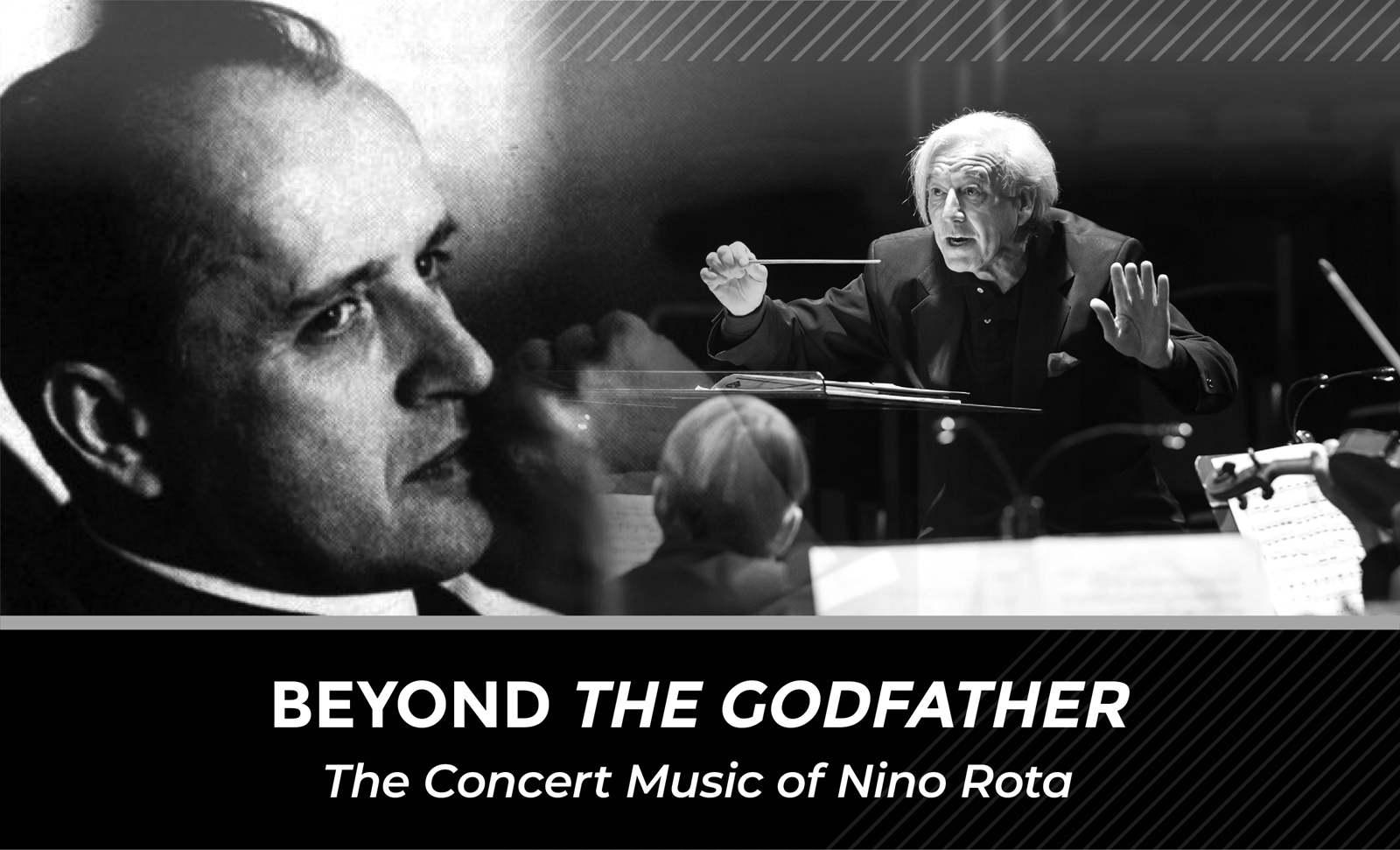
Nino Rota (1911-1979), a brilliant and versatile film composer with 158 movie scores to his credit, is most widely remembered for his haunting melodies for Francis Ford-Coppola’s The Godfather and Zeffirelli’s Romeo and Juliet, three films by Visconti, and all of Fellini’s movies from 1953 to 1979, including La Strada, Nights of Cabiria, 8 ½, La Dolce Vita, and Amarcord. But no less astonishingly, he also wrote eighty-four orchestral and chamber works, ten operas, five ballet scores, and incidental music for ten plays. These concert works, like regional wines too delicious to export, have long remained a well-kept secret outside of Italy. The PCE now presents the prodigiously diverse charms of all of Rota.
Giovanni Rota Rinaldi was born into a well-off and highly musical Milanese family. He was a child prodigy whom the press enjoyed comparing to Mozart. He began composing at age 8, and at 11 he wrote an oratorio (The Childhood of Saint John the Baptist), which saw performances in Milan and northern France. He studied at the Milan Conservatory, and then, still a teenager, he studied composition with Ildebrando Pizzetti and then with Alfredo Casella. Both Pizzetti and Casella belonged to what’s known as the “Eighties Generation”--a group that took inspiration from pre-19th-century Italian composers and rejected the excesses of Romanticism, and who at the same time embraced contemporaries such as Fauré, Ravel, Stravinsky, even Schoenberg. Among Rota’s pieces performed today, this tendency toward a spare, neoclassical style can be particularly felt in the stately and restrained Concerto per archi and in the ingeniously witty theme-and-variations from the Nonetto.
During a two-year stay in the US, while a student at the Curtis Institute of Music in Philadelphia, Rota encountered American popular music and absorbed its sounds. He would develop a legendary facility with a wide variety of musical idioms. Surprisingly little is known about his personal life: he never married, and if he had love relationships, he kept them to himself. We might imagine him as either discreetly gay (biographer Richard Dyer’s hunch), or so wholly wedded to music that there was little room for a human partner.
Alongside his prolific composing, Rota taught music at the Liceo Musicale in Bari in southern Italy (Riccardo Muti, who studied there, considers Rota his greatest mentor), and served as the conservatory’s director for thirty years.
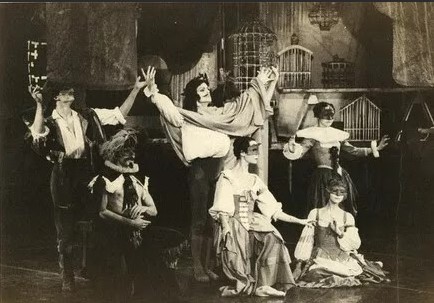
In 1976 Rota teamed up with choreographer Maurice Béjart for the comédie-ballet Le Molière imaginaire, a danced fantasy on the life and death of the great 17th-century playwright. (The ballet’s title itself playfully borrows from the title of Molière’s play Le Malade imaginaire.) Our program includes one of the music’s loveliest themes: the ballet opens with a woman, Death, sitting down at a piano and playing it as a sinuous minor tune. The same melody is heard in various guises through the ballet, including its major-key incarnation--a fanfare to announce the splendid arrival of King Louis XIV. Incidentally, Béjart, born Maurice Berger, took his professional name as a tribute to Molière’s partner in life and theater, Madeleine Béjart. Molière later married Armande Béjart, who was either Madeleine’s sister or her daughter, and whom Molière in his day was scandalously accused of having fathered.
Rota composed concertos for just about everything; the Castel del Monte (1974) magnificently shows off the specific qualities of the French horn. The horn’s opening salvo with a haunting minor motif could have emerged from some melancholy hunting party in a forest long ago. Soon Rota introduces another motif that we expect to be a major arpeggio, but the anticipated fifth is an augmented fifth instead. Rota loved these changes by a half-step that changed everything, and it works so beautifully here that by the end, that dissonance sounds not jarring but normal and interesting. The piece traverses many moods in its ten minutes, like a movie score following the changing imagery. It’s a favorite in Italy, often in a reduced version for horn and piano.
How we think about film music differs from how we think about concert music. Any music heard in a film becomes film music—it interacts with the story on the screen, with the images and their rhythms, with the characters’ emotions and our emotions about the characters. What makes “good” film music? It ought to be essential to the way we experience the film. The plunking of an out-of-tune banjo might be the perfect music for a given scene. Rota’s genius was to write intrinsically wondrous music which gave meaning and beauty to the story onscreen at the same time.
Rota based his La Strada ballad on the score he had already completed for Federico Fellini’s 1954 film. This music is more polished than the film score, and of course, its form doesn’t have to follow the irregular rhythms and lengths of movie scenes. We hear a lovely trumpet melody from the film—a melody that accrues resonance as it recurs through Fellini’s film. Gelsomina encounters the Fool, a high-wire circus performer. He teaches her that everything has a purpose, even a single pebble on the beach; and yes, she has a purpose too. He plays the melody on a tiny violin. Later, Gelsomina plays the Fool’s tune on her trumpet; and at the end, a woman sings it, having learned it from Gelsomina. The transfer of the Fool’s melody from character to character becomes the transfer of consoling wisdom, a spiritual understanding.
Some of the movie music selections here conform with standard Hollywood strategies of emotional identification; others are closer to what I suspect was Rota’s sensibility whereby the musical score maintained a more distanced kind of empathy. The score for Franco Zeffirelli’s Romeo and Juliet (1968) follows the Hollywood tendency with a memorable theme that makes us believe in the rightness of the doomed love. The main theme that runs through The Godfather (I and II) is likewise etched in cultural memory but bears a more complex, even ironic relationship to the movie’s characters and story. The genius of Rota’s slow minor waltz lies in its evocation of Sicilian-ness: it paradoxically bestows a heritage, a dignity, a code of honor on the ruthless New York killers, with whom the film thereby encourages us to identify. Listening to it fifty years later, I’m also struck by its tonal indeterminacy: my brain first thinks it’s in one key, but it turns out to be in another—and as soon as that seems settled, it goes into yet another key a step higher. It’s deceptively tricky, just like the boundaries of the Godfather’s moral universe.
Rota-Fellini was a marriage made in heaven. Rota’s main theme for Amarcord (1973), Fellini’s imaginative memoir of his childhood in Fascist Italy, captures its nostalgia with a warm, popular theme punctuated with snare drum and a discreet slide trombone. From La Dolce Vita (1960) we hear the selection Parlami di me, in a slow waltz-time with those characteristic, almost loopy half-steps Rota loved. It’s not one of La Dolce Vita’s main themes but rather comes as a pause in the frenetic exposé of Rome’s decadent nightlife. Likewise, the suite from La Strada (1954) doesn’t include the film’s main theme—an expansive, romantic piece representing the characters’ physical and emotional journey; it is well worth re-watching the film itself to appreciate how Rota’s deployments of music help shape it.
The sound most intimately associated with Rota-Fellini is the sound of the circus. In Fellini’s frenetic, hilarious masterpiece 8 ½ (1963), Mastroianni is Guido, a famous movie director in crisis, totally blocked while trying to make his new film. Hounded by producers and writers and actors, he desperately seeks inspiration from religious figures, from his fantasies and his childhood memories, his wife, his lover, his dreams. Finally, following a nightmarish press conference (“he has nothing to say!”), he gives up on the entire bloated project. But suddenly, the music strikes up, a curtain opens, and every real or imagined character from the film we’ve watched appears; they all link hands and dance. The end. It's a testament to the magic of creation, the dialectic of failure and acceptance, the circle, and the circus of life.
Special thanks to
Dr. Francesco Lombardi, nephew of Nino Rota, whose early consultations buoyed our confidence in the planning of this project. Congratulations to Dr. Lombardi for his recently published biography of Rota, Nino Rota: Storia del mago Doppio e della fata Giglia (Feltrinelli Editore, November 2024).
Francisco Rocca, archivist at the Istituto per la Musica della Fondazione Giorgio Cini in Venice, for his guidance on musical editions of Rota’s work.