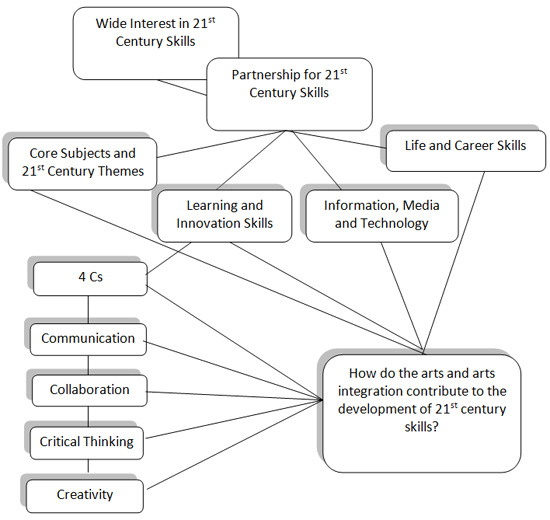
Core Subjects and 21st Century Themes
The arts are one of the core subjects in 21st century learning. To demonstrate how learning in and through the arts builds 21st century skills, P21 has also collaborated with six arts education professional organizations to create a Skills Map for the Arts12 that provides examples of how the four arts areas (dance, music, theatre, and visual arts, which collectively include the media arts) help develop many 21st century skills and outcomes including curiosity, imagination, creativity, and evaluation skills. The introduction to the Skills Map states:
“Collectively, the examples in this document demonstrate that the arts are among society’s most compelling and effective paths for developing 21st Century Skills in our students.”13
The Arts Skills Map also describes how all the 21st Century Themes (global awareness; financial, economic, business and entrepreneurial literacy, civic literacy, health literacy and environmental literacy) are supported by arts learning.
Learning and Innovation Skills/4Cs
One of P21’s central goals is to fuse the core subjects with the 4Cs: communication, collaboration, critical thinking, and creativity. This “fusing” suggests an interdisciplinary approach to teaching and learning. Arts integration is inherently interdisciplinary; it demonstrates ways to accomplish this “fusion.” Through arts integration, students develop dual content knowledge (in both an art form and another area of the curriculum) as well as develop skills in the 4Cs.
Communication
The first C in the P21 Framework, learning to communicate, is central to arts integration. Students communicate their emerging understandings through an art form. The medium for communication is the art form itself. Each art form has a language and symbol system through which students interpret information and communicate their ideas. For example, acting, storytelling, puppetry, and performance poetry develop skills in oral communication. Students develop written communication skills through such art forms as playwriting and poetry and develop non-verbal communication skills through dance, music, theater, and the visual arts. Additionally, arts integration engages students in metaphorical thinking, which enlarges the power of their communication.
Collaboration
The Framework’s second C is collaboration. When students engage in arts integration they usually collaborate in small groups to solve problems. Even when students work individually, they also draw on peer input. In all cases, students enlarge their understandings when they see how others think and react to their thinking. Arts integration provides opportunities for students to learn to be open and responsive to diverse perspectives, work respectfully with their peers, make necessary compromises, and share and accept responsibility.
Dennie Palmer Wolf’s research has documented the extensive collaboration (and communication) inherent in arts experiences. The research found that when students create original operas they were engaged in “more sustained and coherent collaboration over time”14 than when they were involved in other curriculum areas.
“…students progressively develop judgments about how well their work is expressing what they want to say and they find ways to talk to one another about it and to make decisions about how to adjust the work to enhance the quality.”15
Critical Thinking
The Framework’s third “C” is the ability to reason effectively, make judgments and decisions, and solve problems, among other things. When students are involved in arts integration, they develop critical thinking skills as they make judgments about how to solve problems that have no single right answer.
Creating in the arts involves critical thinking and “sophisticated intellectual engagement:”16
“The arts are not just expressive and affective. They are deeply cognitive. They develop essential thinking tools: pattern recognition and development; mental representations of what is observed or imagined; symbolic, allegorical, and metaphorical representations; careful observation of the world; and abstraction from complexity.”17 –David Sousa
Creativity
The Framework’s fourth “C” is the ability to think creatively, work creatively with others, and implement innovations, among other things. Creativity is a hallmark of arts integration. Students engage in the creative process as a way to construct and demonstrate what they know and understand. The creative process requires students to solve problems by imagining a wide range of solutions; by exploring and experimenting with the most promising solutions; by creating a product (e.g., dance, musical composition, collage, digital story, poem); by reflecting on, assessing and revising their products; and sharing them with others.
Judy Willis, in her Whole Child blog, points to research that shows that creativity correlates with the brain processing associated with the highest forms of cognition. She states:
“…neuroscience and cognitive science research are increasingly providing information that correlates creativity with intelligence; academic, social, and emotional success; and the development of skill sets and the highest information processing (executive functions) that will become increasingly valuable for students in the 21st century.”18
Although the creative process exists in many fields, the arts are one of the most accessible and powerful ways to build the creative mind in the classroom. Stanford University’s Elliot Eisner makes the case that our encounters with the arts are critically important because the arts are a way to cultivate our imaginative abilities, offer a variety of means for representing our imagination in material form (inscription), and provide opportunities to edit and adjust the representation to achieve the quality, precision, and power for effective communication.19