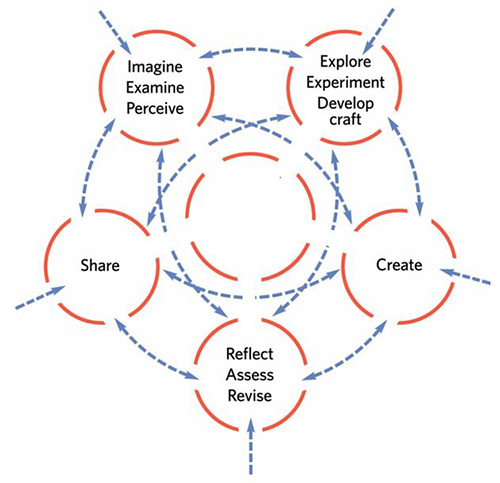
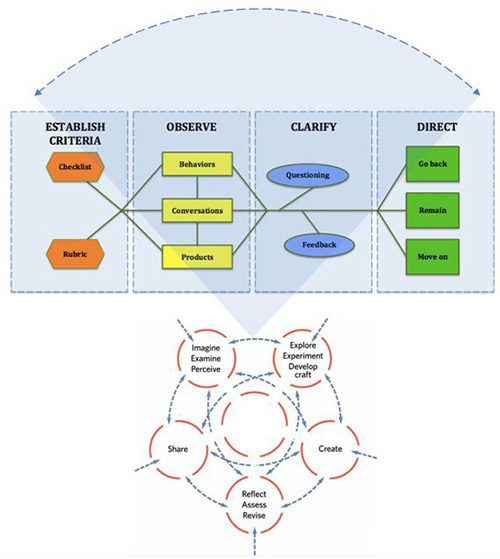
The Formative Assessment Process
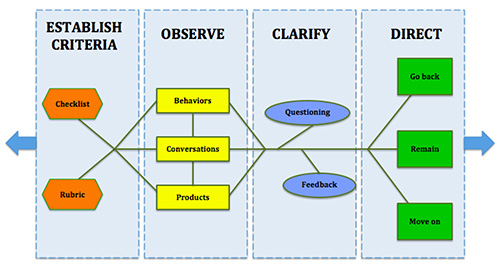
How do we engage in formative assessment during arts integration? The Formative Assessment Process for arts integration includes four main parts:
- Establish Criteria
- Observe
- Clarify
- Direct
Part 1: Establish Criteria
The first part of the Formative Assessment Process is to establish clear and concrete CRITERIA for the task. Students need to know the lesson’s learning goals and what they need to do to achieve them. These are called performance criteria—“the basis for judging the quality of the performance on the task.”3
In arts integration, teachers generally use two strategies for establishing performance criteria: checklists or rubrics. These are the same strategies used in any performance assessment.4 (As students become familiar with the criteria, they also are able to play a role in assessing their progress.)
Part 2: Observe
The second part of the Formative Assessment Process is OBSERVE.
We collect evidence of learning by observing small groups or individual students at work in the following ways:
- Observe students’ behaviors—what they do.
We observe how students are interacting with the content (e.g., on task/disengaged) and on their social/emotional behaviors (e.g., collaborative/withdrawn.)
- Listen to and engage students in conversations—what they say.
We listen to students’ conversations and engage them in purposeful talk. We may have brief impromptu discussions with them to assess understanding and diagnose the reasons for any misunderstandings or misconceptions.
- Look at the products they create.
We observe what students create and listen to what they say about it.
Part 3: Clarify
The third part of the Formative Assessment Process is CLARIFY.
Sometimes what we observe—what students do, say, or create—provides clear information that helps us direct them to the most appropriate place in the creative process.
Sometimes, however, we need to clarify what students mean by what they do, say, or create. We need further information to help us know how to guide them.
There are two options for clarifying: We can ask questions and we can provide feedback.
- Questions
We use questioning to verify or extend our observations. Questions help us avoid making assumptions or inappropriate interpretations.
Examples:
- “Why hasn’t your group completed the task in the allotted time?”
- “What is so challenging about this step?”
- “You look frustrated. What is causing you to feel that way?”
- “I notice no group has moved on to step 3. Why not?”
Sometimes asking a question is all that is needed to clarify what students know or are able to do. Other times, asking a question leads to giving feedback.
- Feedback
When we give feedback to students, we share an observation about the extent to which they have met one or more criteria. The feedback is descriptive and based on the criteria included in the checklist or rubric. It is not praise. Sometimes we involve students in self-assessment prior to receiving feedback.
The observation we make during the feedback can be followed by an open-ended directive or asking a question.
Observation + Open-Ended Directive
Our feedback is delivered as an observation and a direction to an action. The direction, however, has more than one possible solution.
Example
Assume that the criteria for a enacting a scene is that every actor’s face must be visible so that the audience can see the range of emotions at every moment.
- Feedback: “I didn’t see John’s face in that scene.”
- Open-Ended Directive: “Consider how you might reposition him.”
We should avoid following an observation with a closed directive. We should avoid taking over the decision-making and removing the opportunity for students to solve the problem.
- Feedback: “I didn’t see John’s face in that scene.”
- Closed Directive: “Turn his chair so he is facing the audience.”
Observation + Question
This feedback includes an observation followed by a question.
Example
Feedback: “I didn’t see John’s face in that scene.”
Question: “Was that intentional?”
If the response is “No,” we would follow up with an open-ended directive.
Open-Ended Directive: “Find a way to solve it.”
If the response is “Yes,” we would follow-up with a probing question:
Probing question: “What are you trying to achieve by having John’s back to the audience at that moment?”
Part 4: Direct
The fourth part of the Formative Assessment Process is DIRECT.
We make a decision about whether students are ready to proceed to another step in the creative process. (As students become experienced in self-assessment, they may play a role in this decision-making.)
We have three choices for directing students in their learning. We may:
- Send students back to a previous step (redo/reexamine)
- Keep students in the same step for an extended time (remain/revise) or
- Move students ahead to the next step (progress).
Sometimes the evidence we collect tells us that our instruction has not been clear enough. In those cases, we step back and adapt or change our instruction to better meet students’ needs.