Article Developing an Artistic Eye for the Math Classroom
Middle school math teachers will unlock students’ “artistic mathematical eye” with arts objectives, lesson openings, essential questions, and student choice.
Explore how math and art go hand in hand through a study of Aesop’s fables, Tibetan art practices, and music composition.
Middle school math teachers will unlock students’ “artistic mathematical eye” with arts objectives, lesson openings, essential questions, and student choice.
Math and music might seem like an odd couple. But when we take a closer look, they have more in common than you might think.
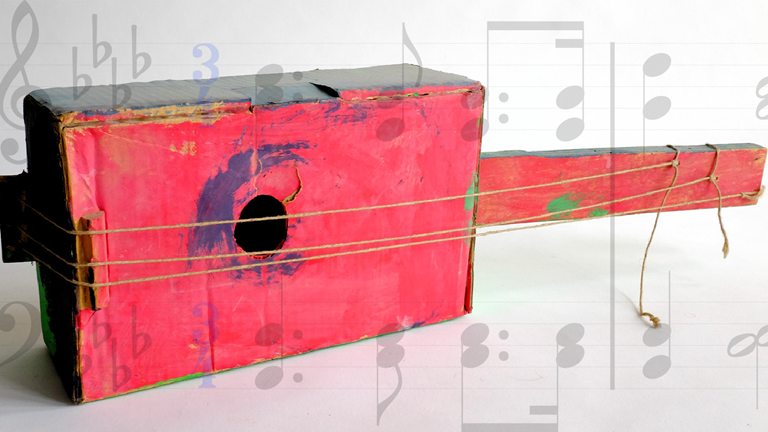
In this 3-5 lesson, students will explore non-traditional music instruments and review basic music theory. Students will learn 4/4 and 3/4 time signatures, then compose original melodies. They will rehearse and perform their compositions on a non-traditional instrument for an audience.
In this K-2 lesson, students will construct patterns using visual arts designs and math manipulatives. They will identify patterns existing in the natural and man-made world, art, math, and science.
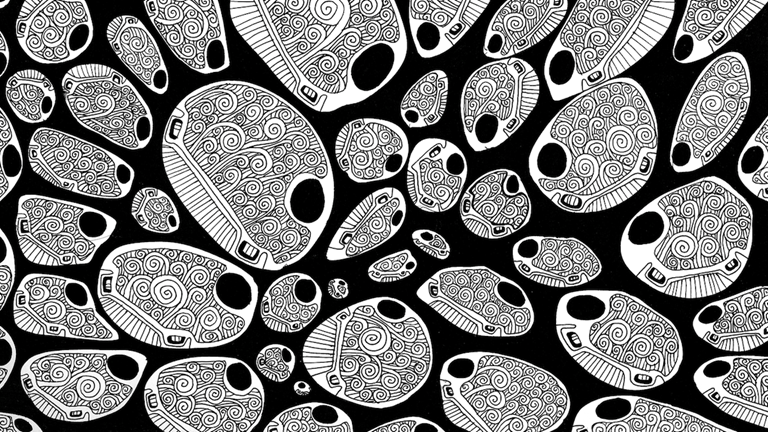
In this 6-8 lesson, students examine living cells to create original pattern art. Students will calculate cell divisions and find patterns in graphed results. They will further explore patterns and repetition in nature to generate ideas for their visual art piece.
In this 6-8 lesson, students will create mandalas using mathematical concepts and skills. They will explore symmetry as well as the natural and man-made shapes found in mandalas. They will design a mandala, then analyze other students’ creative work for style and message.
In this 6-8 lesson, students will apply mathematical, science, and engineering concepts to experiment with balancing levers. They will learn to classify types of levers to design and build a simplified mobile. Students will explore suspended and standing mobiles by sculptor Alexander Calder and engage in class discussions about the effectiveness of his work.
In this 3-5 lesson, students will infer the moral of a story and compare two mediums of Aesop’s fable, “The Crow and the Pitcher.” Each student will design their own puppet to act out the fable using pebbles and water in containers. Students will make predictions about Crow’s strategy then make comparisons with their findings.
In this 9-12 lesson, students will explore the Fibonacci sequence in nature and art. Students will investigate the golden mean/ratio and golden spiral as an important concept in art history. Students will photograph architecture, art, nature, and personal cultural artifacts that include the Fibonacci sequence.
In this 3-5 lesson, students will examine comic strips as a form of fiction and nonfiction communication. Students will create original comic strips to convey mathematical concepts.
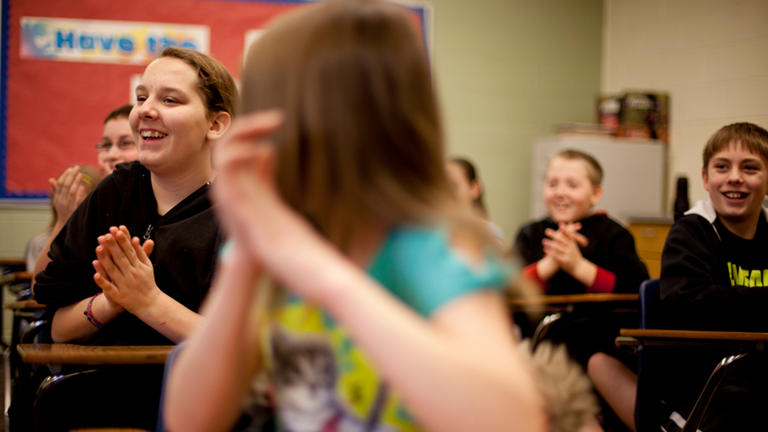
In this 3-5 lesson, students will clap rhythm sequences and compose an eight-measure composition. Students will explore rhythm concepts, including the names and symbols associated with music notation. They will also compare rhythmic sequences to math concepts.
In this 9-12 lesson, students will discover the Fibonacci sequence of numbers, the concept of recursion, pattern, Phi, and the Golden Ratio. They will analyze the structure of music and compose an original musical phrase using the Fibonacci sequence. Students will participate in a jam session, adding instruments or lyrics to their performance.