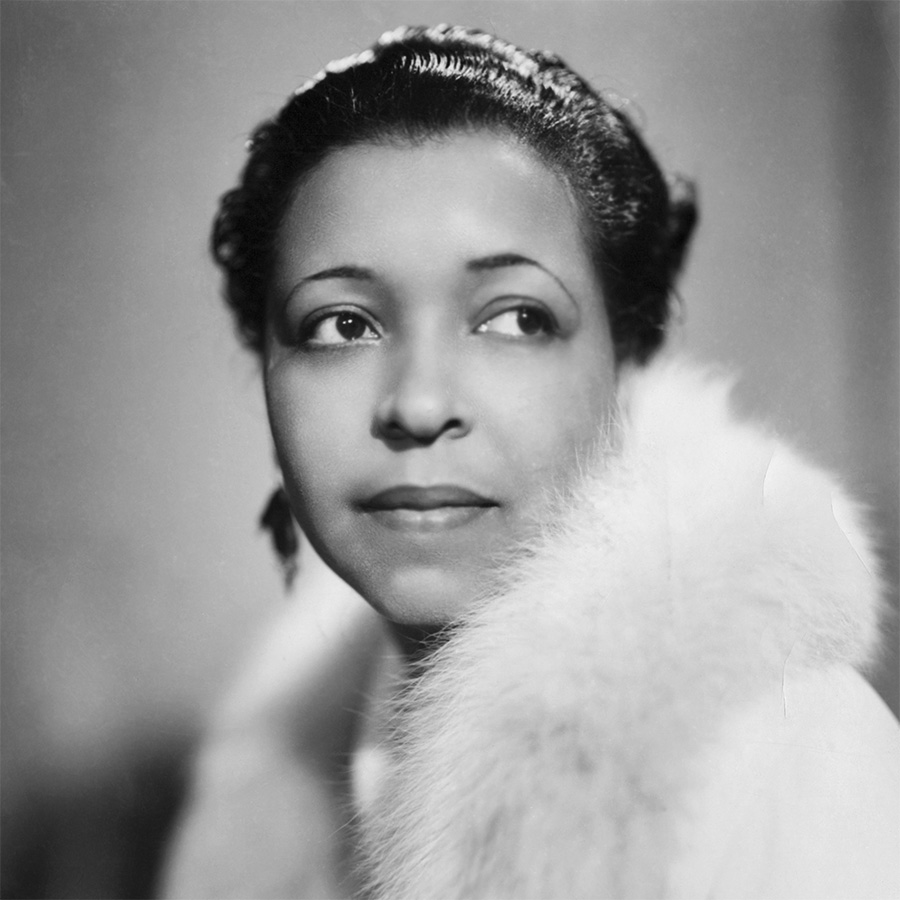
Known as “Sweet Mama Stringbean” for her slender figure, Ethel Waters could sing the blues beyond compare. Her soft, refined voice, theatrical style, and signature shimmy captivated Black and white audiences alike.
Waters grew up in the chaotic misery of a Philadelphia slum. “No one raised me,” she recalled. “I just ran wild.” Waters gladly put it all behind her to tour on the vaudeville circuit. She ended up in New York City, performing on the stages of both the Lincolnand Lafayette Theatres.
In 1919, she became one of the first Black artists hired by Black Swan Records. The commercial success of two 1921 recordings—“Down Home Blues” and “Oh, Daddy”—landed Waters a touring gig with Fletcher Henderson and the Black Swan Troubadours.
The Music of Ethel Waters
[click a title below to play]
“Down Home Blues”
“Oh Daddy”
“Stormy Weather”
“You’ve Seen Harlen at its Best”
Her recording career was heating up, but Waters refused to let her theater work cool down. In 1927, she made her Broadway debut in Africana. Her rendition of Harold Arlen’s “Stormy Weather” at the Cotton Club in 1933 (he had written the song expressly for her) moved composer Irving Berlin to cast Waters in the musical comedy As Thousands Cheer. When the show toured the South, she snared top billing alongside her white cast members—a first for any Black actress.
Waters’ stage credits eventually surpassed those she had notched as a singer. Her numerous Broadway hits included At Home Abroad (1936), Mamba's Daughters (1939), Cabin in the Sky (1940), and Member of the Wedding (1950).
Waters effected a mid-career makeover as a dramatic screen actress, appearing in nine feature films. In 1949, her turn as Granny in Pinky earned her an Oscar® nomination for Best Supporting Actress.
August Wilson was one of America’s most significant and successful playwrights, known for his accurate portrayal of the experiences of Black Americans in the mid-20th century. Learn more through this overview of his play Fences.
Learn about musical theater using examples from Broadway, the history, structure and elements of musical theater, musical theater's role in social commentary, its legacy, and how you too can create a musical.
As part of The Kennedy Center's 2008 August Wilson's 20th Century festival, this discussion examines the value and impact of the work of playwright August Wilson.
Host Jack Carr, actor Ruby Dee, director Ricardo Khan, and lighting designer Jackie Manassee discuss the collaborative process to bring Pearl Cleage's play Flyin' West to the stage.
Theater
Backstage
Jobs in the Arts
Plays
Kennedy Center Education provides resources and experiences that inspire, excite, and empower students and young artists, plus the tools and connections to help educators incorporate the arts into classrooms and learning spaces of all types.
Generous support for educational programs at the Kennedy Center is provided by the U.S. Department of Education.
Gifts and grants to educational programs at the Kennedy Center are provided by The Paul M. Angell Family Foundation; Bank of America; Capital One; The Morris and Gwendolyn Cafritz Foundation; Carnegie Corporation of New York; The Ednah Root Foundation; Genesis Inspiration Foundation; Harman Family Foundation; William R. Kenan, Jr. Charitable Trust; the Kimsey Endowment; The Kiplinger Foundation; Laird Norton Family Foundation; Lois and Richard England Family Foundation; Dr. Gary Mather and Ms. Christina Co Mather; The Markow Totevy Foundation; Dr. Gerald and Paula McNichols Foundation; The Morningstar Foundation; Myra and Leura Younker Endowment Fund; The Irene Pollin Audience Development and Community Engagement Initiatives;
Prince Charitable Trusts; Dr. Deborah Rose and Dr. Jan A. J. Stolwijk; Rosemary Kennedy Education Fund; The Embassy of the United Arab Emirates; The Victory Foundation; The Volgenau Foundation; Jackie Washington; GRoW @ Annenberg and Gregory Annenberg Weingarten and Family; and generous contributors to the Abe Fortas Memorial Fund and by a major gift to the fund from the late Carolyn E. Agger, widow of Abe Fortas. Additional support is provided by the National Committee for the Performing Arts..
The content of these programs may have been developed under a grant from the U.S. Department of Education but does not necessarily represent the policy of the U.S. Department of Education. You should not assume endorsement by the federal government.