• Media Arts
  • History
  • United States
  • Women in the Arts

Dorothea Lange + Migrant Mother
Meet the artist through one of their most important works

Photographer Dorothea Lange believed it was important to lead a “visual life,” and that the camera was an instrument of democracy. Learn more about Lange and her work in the 1930s through a historical and artistic analysis of her photograph Migrant Mother, one of the most famous photographs of the 20th century.

Recommended for grades 6-12

In this resource, you’ll:

  • Explore how Dorothea Lange’s path and historical context led her to create Migrant Mother
  • Discover the legacy of Migrant Mother as a historical document
  • Unpack the elements of Migrant Mother and how they contribute to the work’s timelessness and impact

Part of the Artist + Work collection.

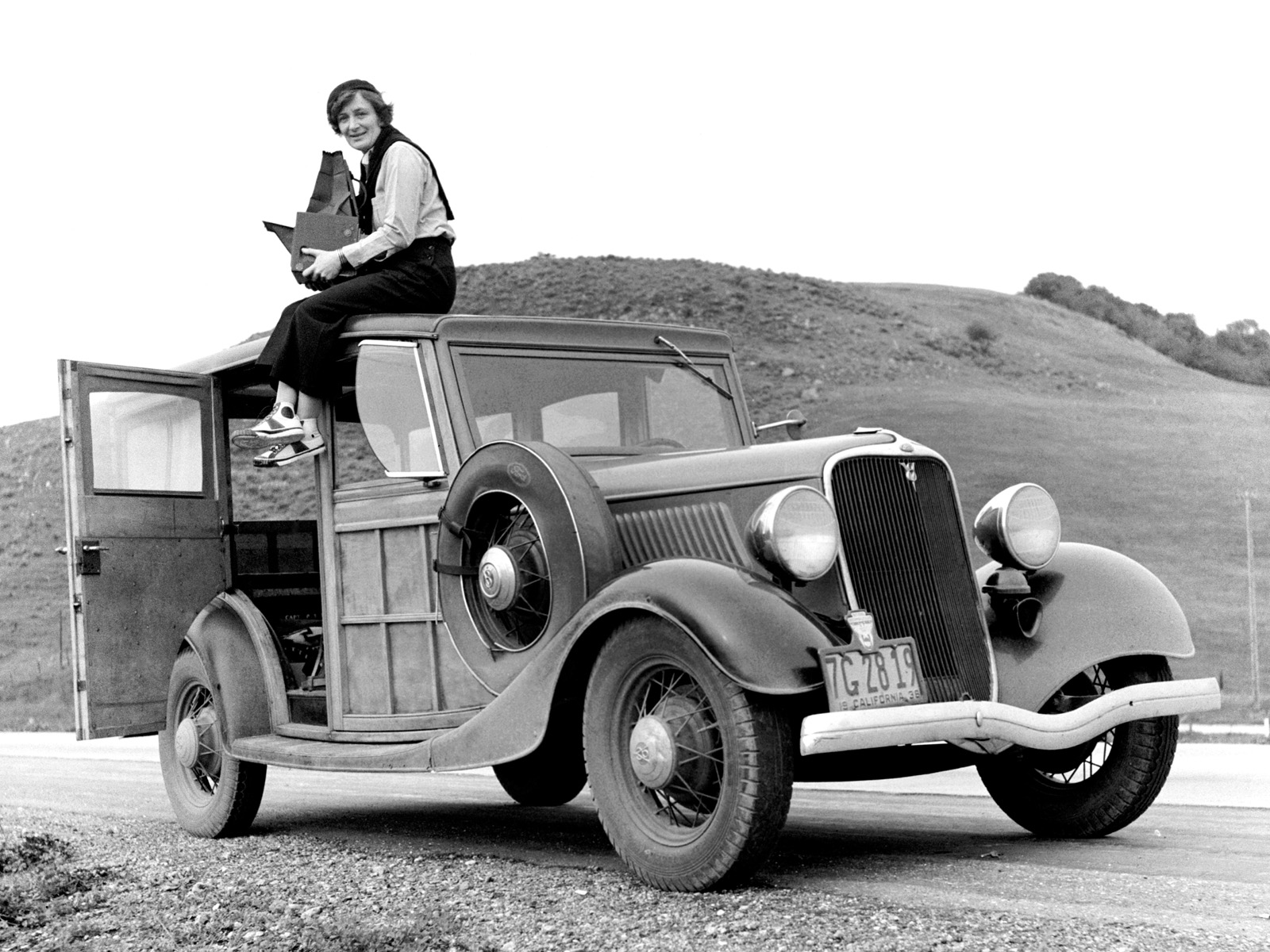
Dorothea Nutzhorn was born in Hoboken, New Jersey, in 1895. Two incidents in her childhood shaped the ambitious yet sensitive woman she would become: At age seven she came down with polio and at twelve her parent’s marriage dissolved. Left with an awkward limp and unresolved anger toward her family, she was determined to move forward. A sense of adventure took her from New York to San Francisco in 1919, where she renamed herself Dorothea Lange (her mother’s maiden name) and used her newly-acquired skills in photography to set up a studio. While the Depression was a time of lost opportunity for most Americans, it was a time of enormous growth for Lange, who divorced her first husband, married again, and became part of a team of government photographers now celebrated for creating a moving visual document of a difficult era.
dorothealange.jpg

"Dorothea Lange" Photo by Rondal Partridge. 1936, Library of Congress

In the 1930s, Lange worked for a government program that documented relief sent to farmers who had been hit hard by the collapse of the U.S. economy. Her images of desperately poor families told the stories of those who had been unfortunate. They also drew the sympathy and support of the American public. Her camera gave a voice to people who might have been forgotten. Lange used the lens as a tool to lead a “visual life”—to communicate the difficult beauty and power of what she witnessed.

As a young woman, Lange’s ability to work well with people led to her success as a portrait photographer. With time, her artistry and skill with the camera improved and her interest in social issues deepened. After the stock market crash of 1929, the country plunged into a deep economic slump known as the Great Depression. Severe drought in the 1930s ravaged millions of acres of farmland and brought on the Dust Bowl, prompting hundreds of thousands to flee the damaged prairie states for California, where they hoped for a better life.

Lange and her soon-to-be husband, economist Paul Taylor, began to document the plight of migrant farm workers who lived in squalor in California labor camps. Her work earned her a job with one of Franklin Delano Roosevelt’s New Deal programs—the Resettlement Administration (later renamed the Farm Security Administration)—in 1935. While touring the country on behalf of the agency, Lange came across a hungry and desperate mother and took several pictures of her, one of which would become known as Migrant Mother.

Dorothea Lange believed the camera was an instrument of democracy. She tried to be open-minded and approached her subjects with respect. She died in 1965 at the age of 70, but her personal philosophy continues to influence documentary photographers, and her extraordinary pictures allow Americans to see other Americans in a new light.
Migrant Mother

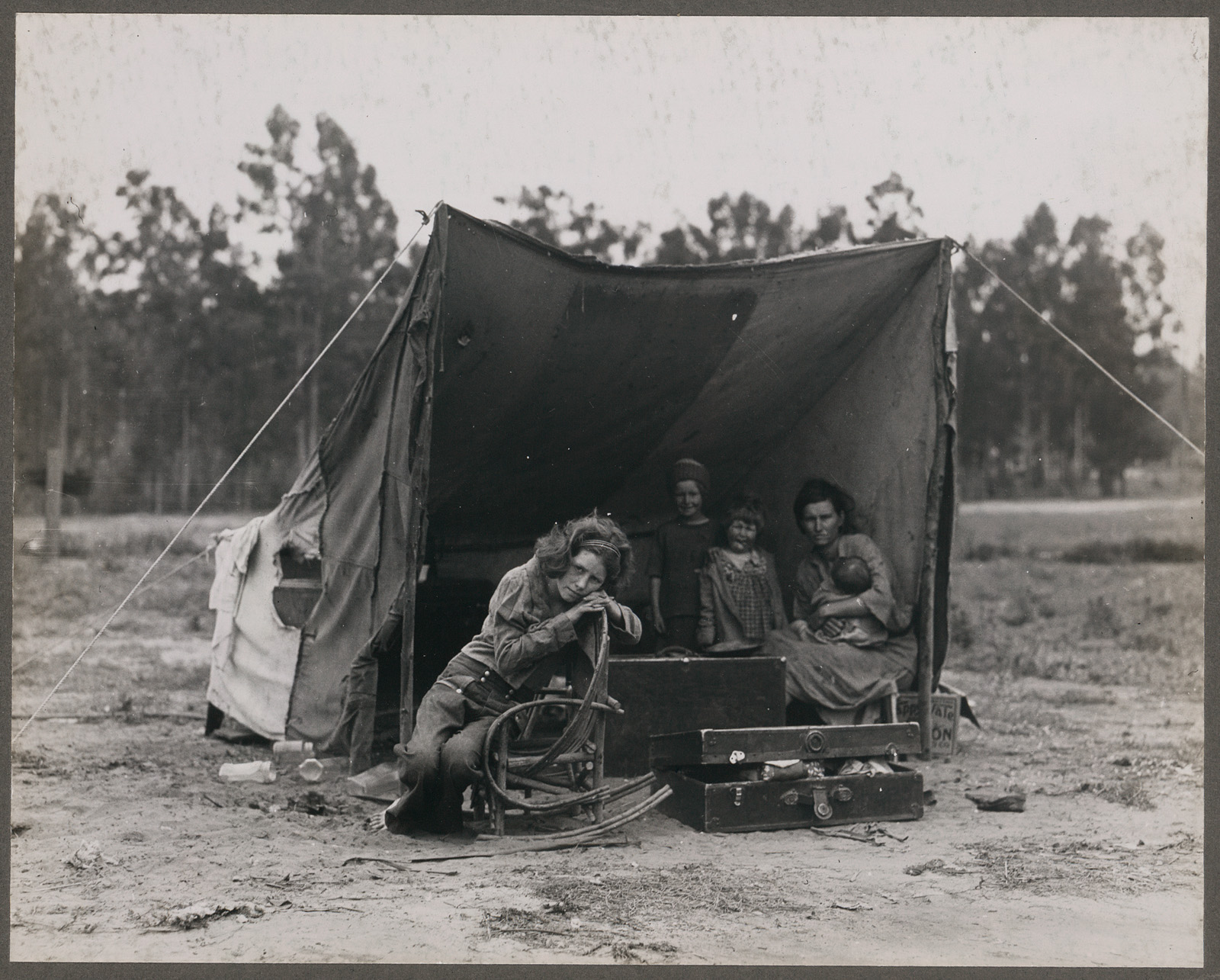
Dorothea Lange was returning home from an assignment for the Resettlement Association in March of 1936 when she came across a sign near Nipomo, California, that would change her life: PEA-PICKERS CAMP. Although she had all the pictures she needed, something compelled her to stop:

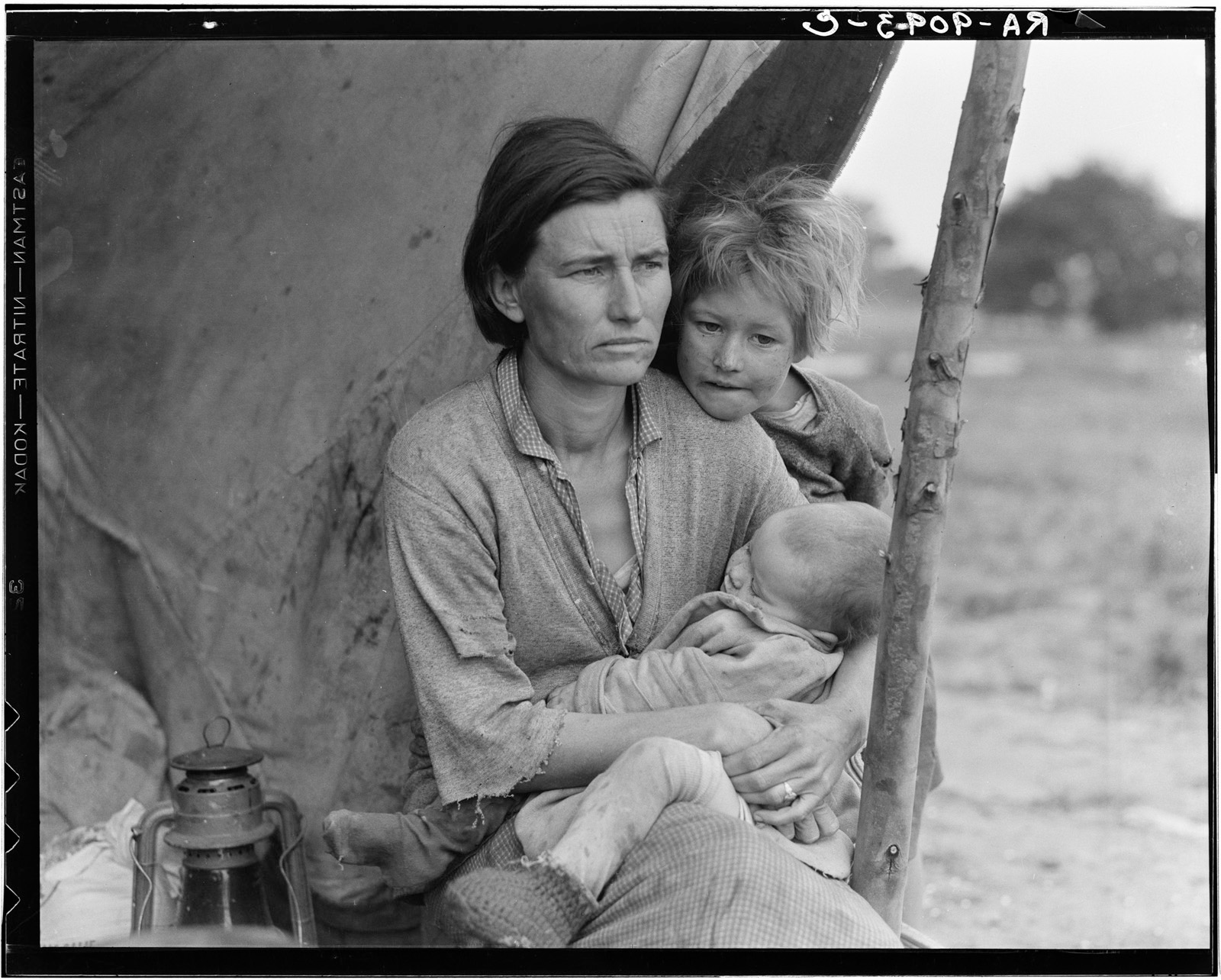
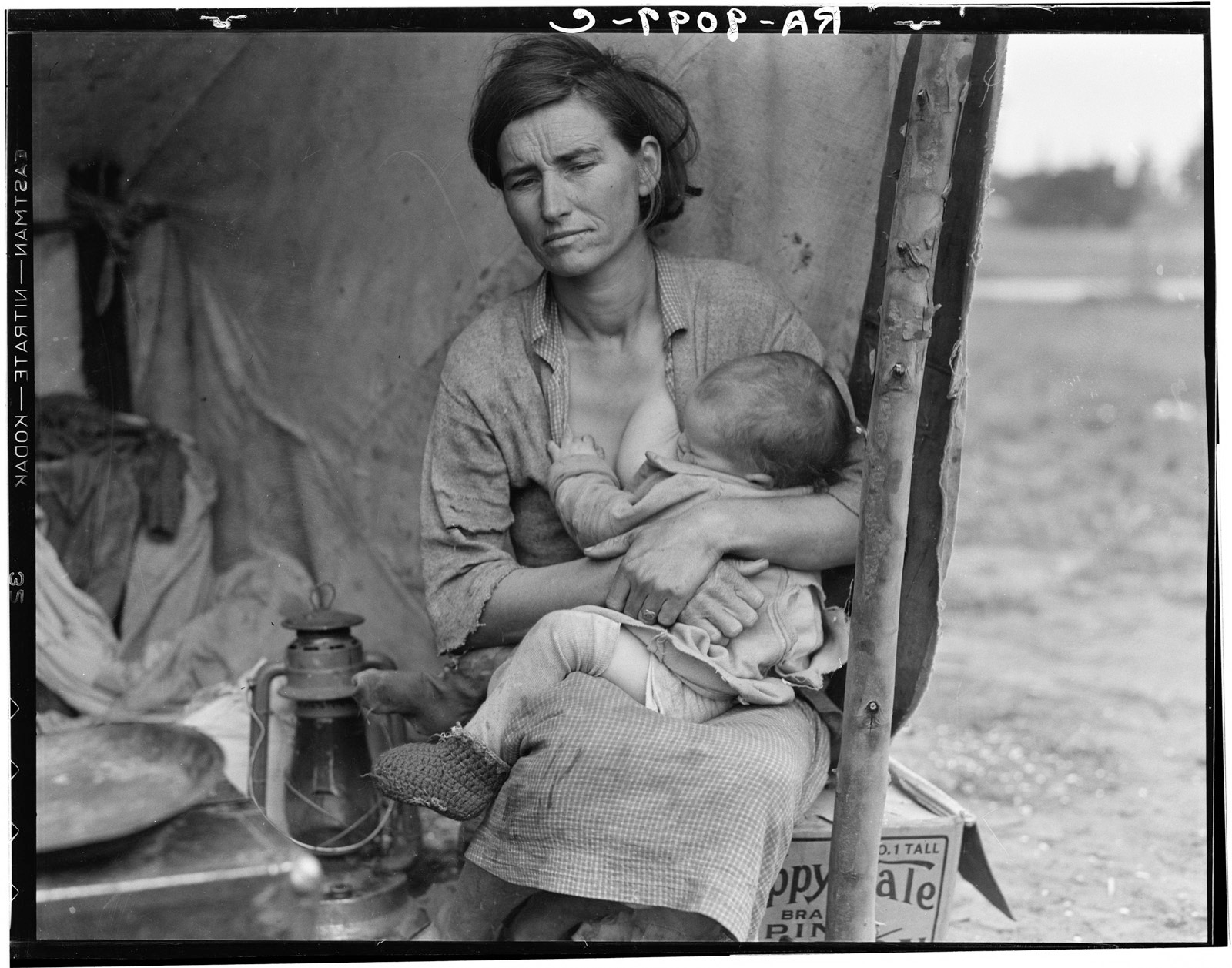
"I was following instinct, not reason; I drove into that wet and soggy camp and parked my car like a homing pigeon. I saw and approached the hungry and desperate mother, as if drawn by a magnet. I do not remember how I explained my presence or my camera to her but I do remember she asked me no questions. I made five exposures, working closer and closer from the same direction."

"I did not ask her name or her history. She told me her age, that she was 32. She said that they had been living on frozen vegetables from the surrounding fields, and birds that the children killed. She had just sold the tires from her car to buy food. There she sat in that lean-to tent [shed] with her children huddled around her, and seemed to know that my pictures might help her, and so she helped me. There was a sort of equality about it. The pea crop at Nipomo had frozen and there was no work for anybody. But I did not approach the tents and shelters of other stranded pea-pickers. It was not necessary; I knew I had recorded the essence of my assignment."


Soon after, Lange shared the story about the pea-pickers with the editor of a San Francisco newspaper. He published an article that included two of her images, prompting federal authorities to send 20,000 pounds of critically-needed food to the camp.

Forty years after Lange took her famous photograph, a reporter located the woman known as Migrant Mother. She was living in a trailer home in Modesto, California. Her name was Florence Thompson. Mrs. Thompson saw Lange’s photo as a bit of a curse. She was ashamed of revisiting the poverty she endured decades earlier, but her children came to a different conclusion. They were proud of the woman who sacrificed for her family and became a symbol of female strength in times of adversity.

Look Closer

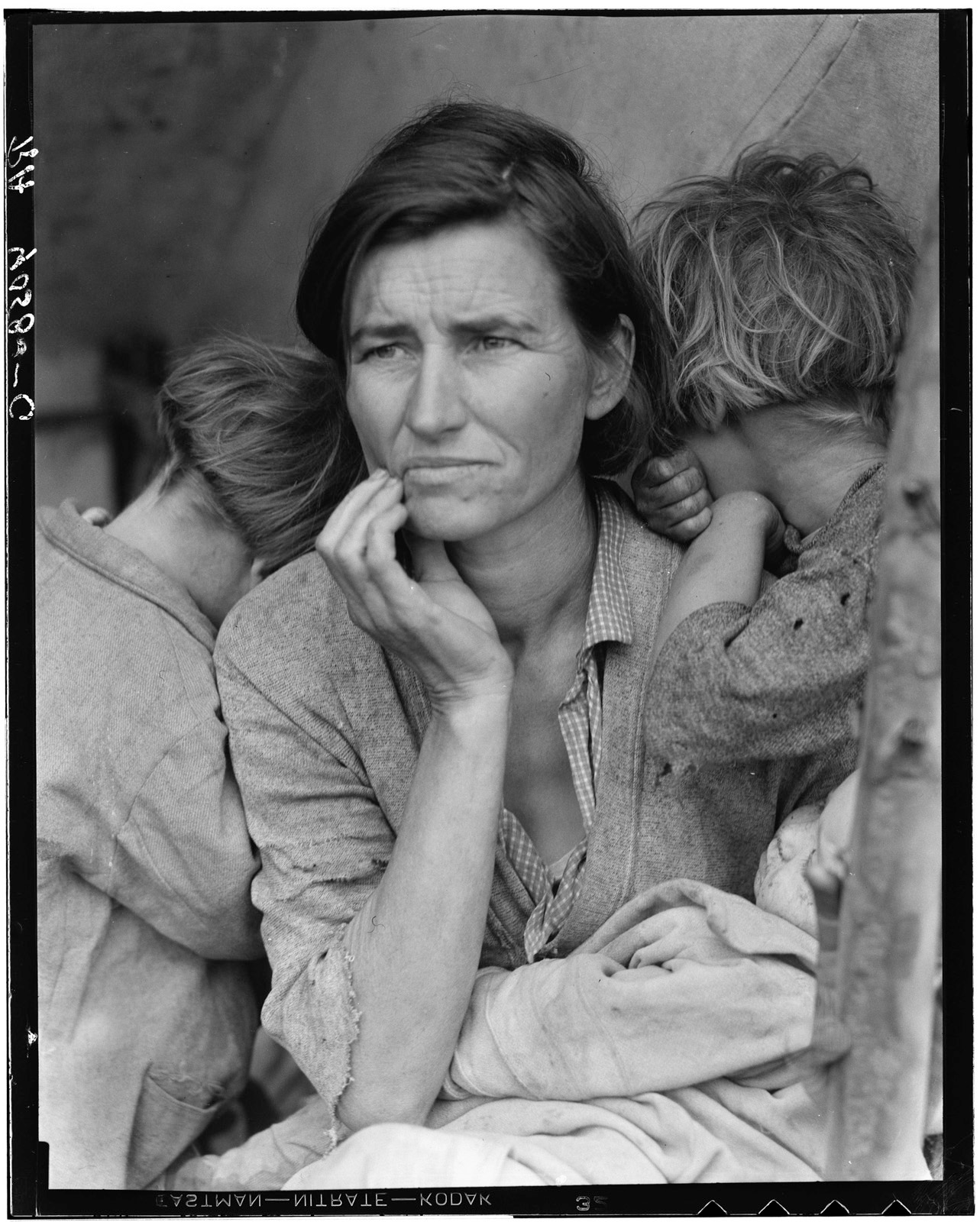
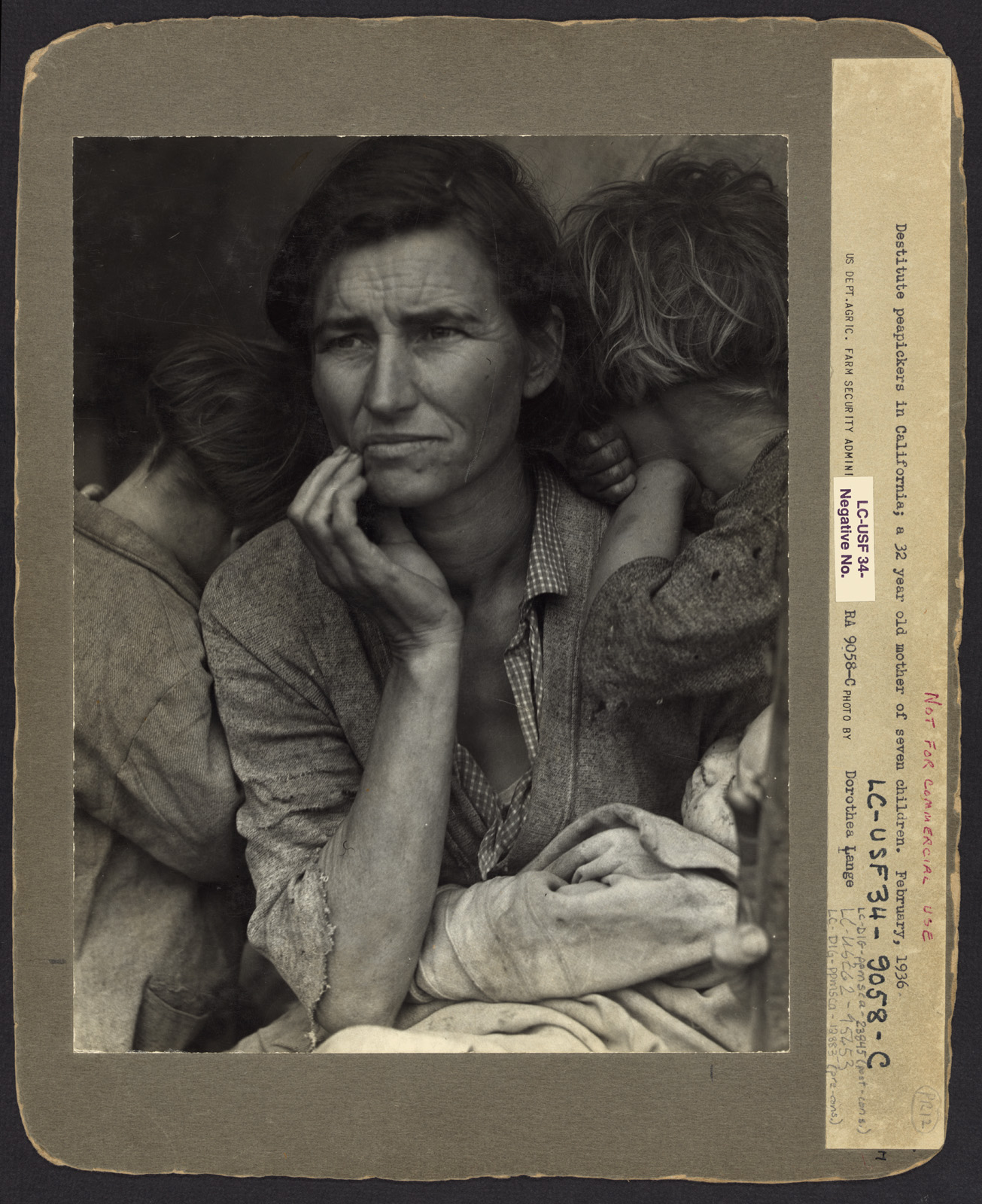
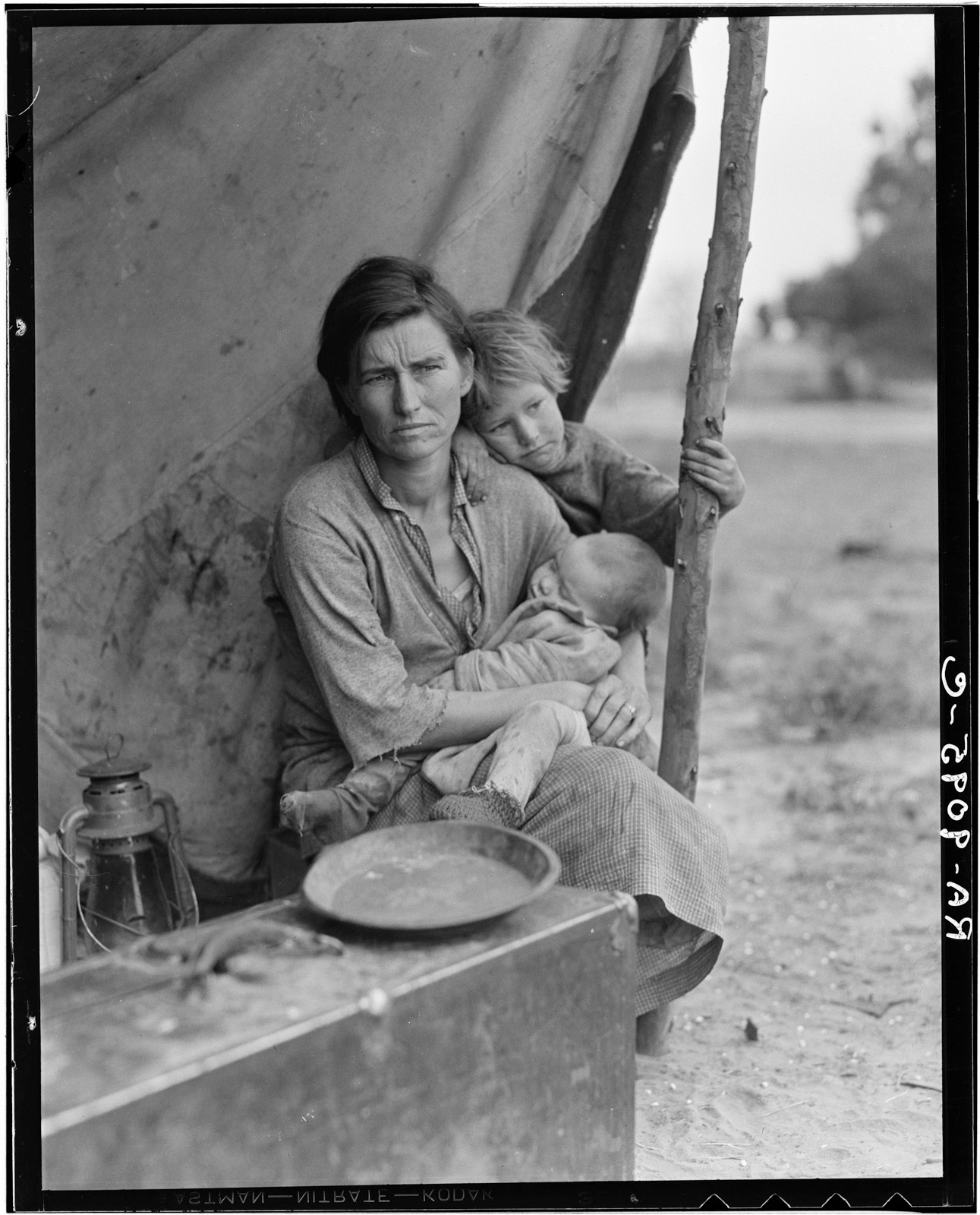
Look carefully at the photograph Lange took that day. How is Migrant Mother different from portraits of your family or friends? How does the photo make you feel?

lange-migrantmother06.jpg

"Migrant Mother" by Dorothea Lange, Public Domain

Things to consider:

  • Why is the image in black and white? Color film was rare in the 1930s. It was expensive, sensitive to changes in temperature, and difficult to process. In addition, many documentary photographers felt that color would distract the viewer and change the intention of the photograph, so most, like Lange, used only black and white film.
  • Why is no one smiling? Documentary photography is different from portrait photography. Rather than pose a family and capture them smiling, the documentary photographer tries to tell an important story by showing people as they are in the landscape—whether they are at home, work, or school.
  • Why do the two children on either side of their mother hide their faces from the camera? The children at the pea-pickers camp in California may never have seen a camera. Cameras were expensive and a relatively rare fixture in rural homes. When Lange, a stranger, approached them with what looked like a large imposing box, the children may have been frightened. However, it may be that Lange purposely posed the children with their backs turned, so the viewer would focus on their mother’s face. Their huddled backs imply shame at living in such squalor and make us sense Migrant Mother’s profound anguish.
  • What is the mother looking at? We really don’t know. Lange asked the mother for permission before she took the pictures, but the woman may not have realized when the photographer was actually clicking the shutter. Or, maybe the mother’s hunger and fatigue were so great, that she simply didn’t care about Lange’s presence. Experienced documentary photographers like Lange knew how to grow small behind the camera and become quiet observers of the scene before them.
  • What is the bundle in the mother’s lap? The bundle is a baby wrapped in rags, who almost seems lifeless.
  • Why is this photograph considered a master work? Lange composed the picture carefully, so that the viewer would focus on the mother’s beauty, faded by a life of poverty. The serious concern on the mother’s face, the way her body shields the children, the weight of her head resting on her hand, her fixed gaze, the closeness of the tent—all suggest a person of integrity who is imprisoned by the unfairness of life. Because so many Americans shared this mother’s fate during the Depression, the picture became a symbol of their situation. And because poverty and injustice remain critical social issues today, the picture has become an icon—or a master work.

Learn More

Find out more about Dorothea Lange, the Great Depression, America’s Dust Bowl, and documentary photography. Here’s a start:

  • View more Depression-era images by Dorothea Lange at the Library of Congress Prints and Photographs website at http://www.loc.gov/pictures. As you browse through them, think of how they compare to Migrant Mother. Then look at the five different shots Lange took of the mother in the pea-pickers camp (see Part 2 of this article). Why do you think the image we know as Migrant Mother became more famous than the others? On the Reflect tab of this article, notice the thumb holding a tent pole at lower right. Lange erased it in the final version. Why do you think she made that change to the photograph?
  • Explore the work of other photographers of the Depression, including Walker Evans, John Vachon, Arthur Rothstein, and Ben Shahn at http://memory.loc.gov/ammem/fsahtml/fadocamer.html.
  • Read John Steinbeck’s The Grapes of Wrath, a heartbreaking novel about Dust Bowl refugees
  • Watch the videos below for more information on Dorthea Lange and the Dust Bowl
  • Use your camera, computer, or cell phone to tell an important story through photographs. Try to apply Lange’s philosophy—be open-minded and respectful of your subjects. Let the camera speak for them. Engage your subjects, but don’t make yourself the subject. Show your images to friends or classmates and see how they react. Did you manage to communicate successfully through pictures? Did the message come through? Congratulations! Now you know what it means to lead a “visual life.”

Dorothea Lange's Documentary Photographs

Dorothea Lange's Documentary Photographs

Hear Dorothea Lange discuss her photographs and the difficulty of leading a visual life.

The Plow That Broke the Plains

The Plow That Broke the Plains

Watch a video about the Dust Bowl to hear stories of those who survived.

Woody Guthrie - Dust Bowl Blues

Woody Guthrie - Dust Bowl Blues

Listen to Woody’s Guthrie’s “Dust Bowl Blues” 

Kennedy Center Logo

  • Writer

    Amy Pastan

  • Editor

    Lisa Resnick

  • Producer

    Kenny Neal
    Ellie Pline

  • Updated

    March 2025

Related Resources

Collection America

Discover the multicultural heritage and history of the United States of America through explorations of immigrant life, the lives of legendary pioneers like Lewis and Clark, the modern political system, and significant works of American music, including our National Anthem.

  • Music Art
  • Dancing
  • Literary Arts
  • History
  • Social Studies & Civics
  • Musical Theater
  • Drawing & Painting
  • Photography
  • United States

Collection Media Arts

Audio, video, animation, photography, and technology. From Depression-era images that captured the attention of a nation, to student-produced videos on local artists, to how to make your own blood and guts special effects, explore the ever-changing world of media arts.

  • Media Arts

Media Brother Can You Spare a Dime?

Humbled by the Great Depression, this song gave voice to Americans' fears and feelings of loss

  • Music Art
  • History
  • United States

Media Dorothea Lange + White Angel Breadline

Dorothea Lange used photography as a way to document the hopelessness felt by Americans during the Great Depression. Learn more about her and her 1932 photograph White Angel Breadline.

  • Media Arts
  • History
  • United States
  • Women in the Arts

Media What Makes a Portrait “Great”?

What makes a great portrait in the digital—or any—age? By looking at the works of Richard Avedon and Andy Warhol we learn that it's not enough to create just another pretty face.

  • Visual Arts
  • Drawing & Painting
  • Photography

Media John Steinbeck + The Grapes of Wrath

John Steinbeck’s The Grapes of Wrath (1939) explores the adversity faced by many Americans during the Dust Bowl. Learn more about him, the novel, and America in the 1930s through this multi-chapter resource.

  • Literary Arts
  • History
  • United States

Lesson Photography: From Theory to Practice

In this 6-8 lesson, students will examine works of art and learn tools to analyze and discuss photography. Students will apply what they have learned by using cameras to document daily life in their community. They will prepare artist statements and present their work.

  • Grades 6-8
  • Visual Arts
  • English & Literature
  • Photography

Kennedy Center Education logo


Kennedy Center Education provides resources and experiences that inspire, excite, and empower students and young artists, plus the tools and connections to help educators incorporate the arts into classrooms and learning spaces of all types.

Connect with us!

spacer-24px.pngyoutube.png    facebook.png    twitter.png    instagram.png    email.png

Sign up to stay informed!

Generous support for educational programs at the Kennedy Center is provided by the U.S. Department of Education.

Gifts and grants to educational programs at the Kennedy Center are provided by The Paul M. Angell Family Foundation; Bank of America; Capital One; The Morris and Gwendolyn Cafritz Foundation; Carnegie Corporation of New York; The Ednah Root Foundation; Genesis Inspiration Foundation; Harman Family Foundation; William R. Kenan, Jr. Charitable Trust; the Kimsey Endowment; The Kiplinger Foundation; Laird Norton Family Foundation; Lois and Richard England Family Foundation; Dr. Gary Mather and Ms. Christina Co Mather; The Markow Totevy Foundation; Dr. Gerald and Paula McNichols Foundation; The Morningstar Foundation; Myra and Leura Younker Endowment Fund; The Irene Pollin Audience Development and Community Engagement Initiatives;

Prince Charitable Trusts; Dr. Deborah Rose and Dr. Jan A. J. Stolwijk; Rosemary Kennedy Education Fund; The Embassy of the United Arab Emirates; The Victory Foundation; The Volgenau Foundation; Jackie Washington; GRoW @ Annenberg and Gregory Annenberg Weingarten and Family; and generous contributors to the Abe Fortas Memorial Fund and by a major gift to the fund from the late Carolyn E. Agger, widow of Abe Fortas. Additional support is provided by the National Committee for the Performing Arts..

The content of these programs may have been developed under a grant from the U.S. Department of Education but does not necessarily represent the policy of the U.S. Department of Education. You should not assume endorsement by the federal government.