Play It Up
with teaching artist Teralyn Reiter

Teaching artist Teralyn Reiter breaks down the basic components involved in creating a play and demonstrates how to act out an original play using a few items found in the home. 

Recommended for Grades K-12

In this resource you will:

  • Learn about the essential components involved in creating a play
  • Create characters, a setting, a problem, and dialogue for a play 
  • Act out an original story using items found around your home 

Explore our other video-based activities!

Getting Started

Vocabulary You Will Learn:

  • Play - A story that’s acted out.
  • Playwright - A person who writes plays. 
  • Character - The people or creatures in a story.
  • Setting - Where a story takes place.
  • Dialogue - Two or more people having a conversation. 

Materials You Will Need:

  • Two objects such as toys or stuffed animals that can become characters in your play

Watch the Video

Try It Yourself

How to Create Your Play Using Items Found at Home 

  1. First, look around your home for two objects that can become the characters in your play. These can be toys, stuffed animals, or any other objects you want to bring to life. For example, one of Teralyn’s characters is a small pumpkin that she drew a face on. Be creative! 
  2. Next, you’re going to answer three questions about your character that will help you tell your story. They are:
    • What does your character sound like? Do they have a loud voice or a soft voice? A sing-songy voice or a robotic voice?
    • What does your character like to do? Do they have a hobby? Do they like inventing things? Or playing the guitar? Use your imagination! 
    • What is your character’s flaw or imperfection? Are they very nervous? Do they like to talk about themselves too much? 
  3. Now, it’s time to decide what problem your characters will face in your play. Teralyn offers three suggestions for problems that you can use:
    • Your characters are stuck on the moon. 
    • Your characters are being chased by a large animal.
    • Your characters have a huge mountain to climb.

You can use one of these problems, or you can come up with one of your own!

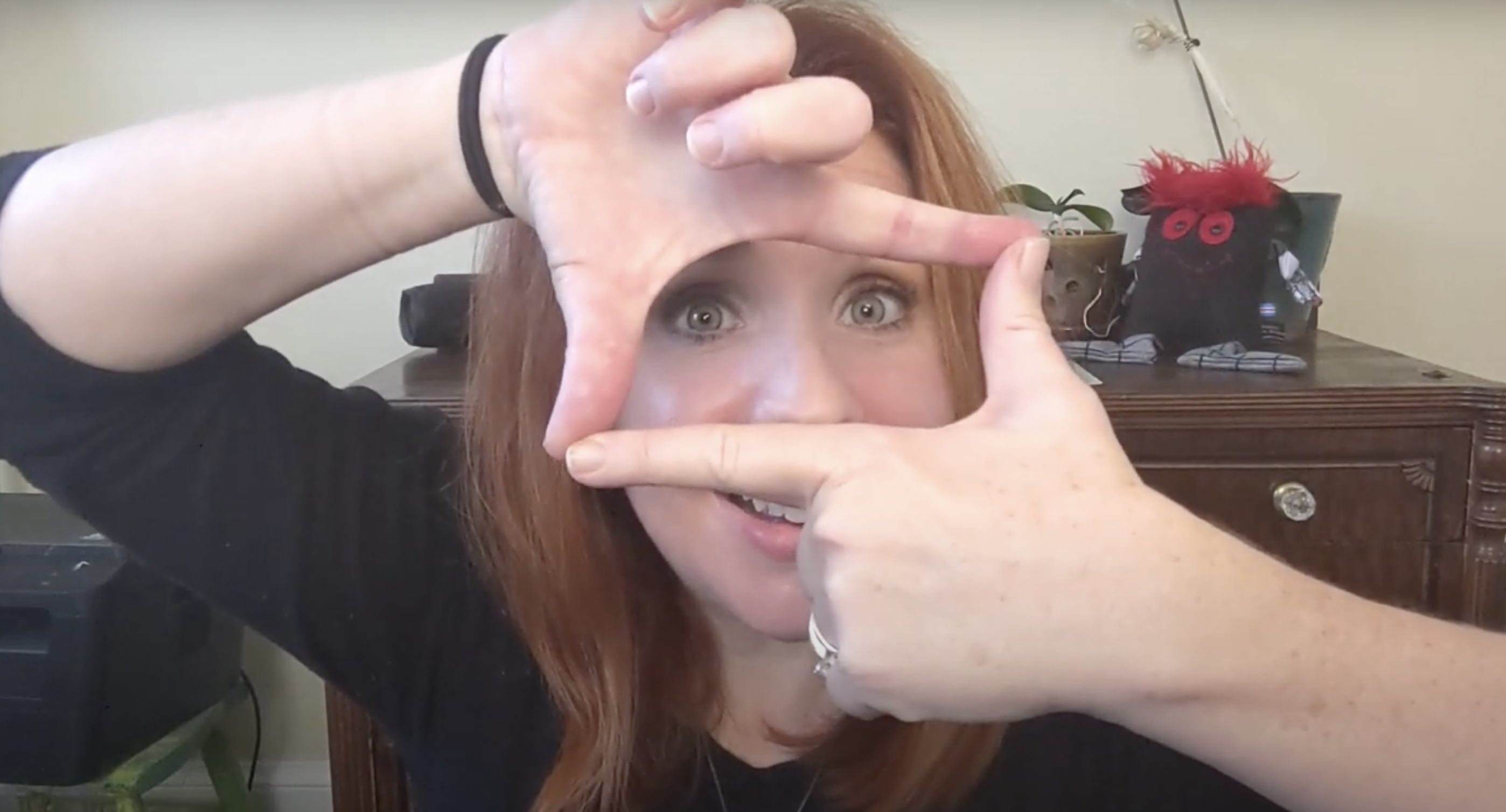
  1. Next, it’s time to come up with the setting where your story will take place. You can create a viewfinder by putting the thumb and forefingers of each hand together to create a rectangle and look through it, imagining how different spaces in your home could become your play’s setting. Could a plant become the jungle? Could a blanket on the couch become the moon?
  2. Finally, it’s time to create the dialogue for your play! What are your characters going to say to each other in this scene? If you’re stuck you can start by having them say “hello” to each other, having them blurt out the problem (“Oh no, we’re being chased by a lion!”) or having them blurt out the setting (“We’re stuck on the moon! What do we do now?”). Also remember the three facts you came up with about your character: what they sound like, what they like to do, and what their flaws are. Be sure to incorporate these facts into the play! 

Think About

In this video, Teralyn breaks down the basic components involved in creating a play and then demonstrates how to act out an original play using a few items found around the home. If you want to go even further, think about these questions: 

  • What happens if you add a third character into your play? Who is this third character, and how can they help - or further complicate - your characters solve their problem? 
  • Think about how your characters are going to solve their problem, and how your play will come to a resolution. How will it end? How will your characters escape the sticky situation they are in?
  • Try moving your characters into a different setting. What happens if instead of on the moon, they’re in the desert? Or in a supermarket? Or on a city street? What problems could they encounter in this new setting? 
  • Instead of acting out your play with objects, can you become an actor and perform it yourself? Can you find a friend or family member to act it out with you?

Accessibility

Don't forget that you can turn on "Closed Captioning" to view the YouTube video with English captions.


More about the Teaching Artist

Teralyn Reiter is a theater teaching artist in Maine who has taught children of all ages throughout the United States, Europe, and South Korea. She is the founder of Storytree Children's Theatre in Charleston, South Carolina, and recently launched TheatreTeacher.org, a resource for teachers and families looking to incorporate theater arts-integrated lessons, activities, and ideas into their classrooms and homes. Teralyn also developed Playwright's Pal, an online playwriting tool for storytellers of all ages.
Video Activity Credits

Resource Production: Kennedy Center Education

Additional Content: Laurie Ascoli

Copy Editing: Sandra Frey; Alyssa Kariofyllis

Revisions: Alice Doré

  • Teaching Artist

    Teralyn Reiter

  • Curriculum & Media Development

    Kennedy Center Education

  • Content Editor

    Laurie Ascoli

  • Revised

    December 30, 2024

Related Resources

Media Creative Monologue

Teaching artist Khaleshia Thorpe-Price breaks down the process of creating an original monologue based on a favorite character and how to bring this character to life through performance.

Lesson Exploring A Streetcar Named Desire

In this 9-12 lesson, students will analyze the setting, plot, and character development of Tennessee Williams’s play, A Streetcar Named Desire. They will discuss Williams’s craft as a playwright and his impact on American theater. Students will participate in a group reading and analysis of the play.

  • Theater Art
  • English & Literature
  • Grades 9-12

Lesson Creation Myth Play Scripts

In this 9-12 lesson, students will explore different cultures’ supernatural explanations for human existence. They will make comparisons between creation myths then write an original creation myth play script to perform for an audience.

  • Grades 9-12
  • Script & Playwriting
  • Myths, Legends, & Folktales

Kennedy Center Education logo


Kennedy Center Education provides resources and experiences that inspire, excite, and empower students and young artists, plus the tools and connections to help educators incorporate the arts into classrooms and learning spaces of all types.

Connect with us!

spacer-24px.pngyoutube.png    facebook.png    twitter.png    instagram.png    email.png

Sign up to stay informed!

Generous support for educational programs at the Kennedy Center is provided by the U.S. Department of Education.

Gifts and grants to educational programs at the Kennedy Center are provided by The Paul M. Angell Family Foundation; Bank of America; Capital One; The Morris and Gwendolyn Cafritz Foundation; Carnegie Corporation of New York; The Ednah Root Foundation; Genesis Inspiration Foundation; Harman Family Foundation; William R. Kenan, Jr. Charitable Trust; the Kimsey Endowment; The Kiplinger Foundation; Laird Norton Family Foundation; Lois and Richard England Family Foundation; Dr. Gary Mather and Ms. Christina Co Mather; The Markow Totevy Foundation; Dr. Gerald and Paula McNichols Foundation; The Morningstar Foundation; Myra and Leura Younker Endowment Fund; The Irene Pollin Audience Development and Community Engagement Initiatives;

Prince Charitable Trusts; Dr. Deborah Rose and Dr. Jan A. J. Stolwijk; Rosemary Kennedy Education Fund; The Embassy of the United Arab Emirates; The Victory Foundation; The Volgenau Foundation; Jackie Washington; GRoW @ Annenberg and Gregory Annenberg Weingarten and Family; and generous contributors to the Abe Fortas Memorial Fund and by a major gift to the fund from the late Carolyn E. Agger, widow of Abe Fortas. Additional support is provided by the National Committee for the Performing Arts..

The content of these programs may have been developed under a grant from the U.S. Department of Education but does not necessarily represent the policy of the U.S. Department of Education. You should not assume endorsement by the federal government.